
The Rise of ‘Coupon Justice’: How Travel Companies Are Replacing Cash Refunds with Expiring Vouchers
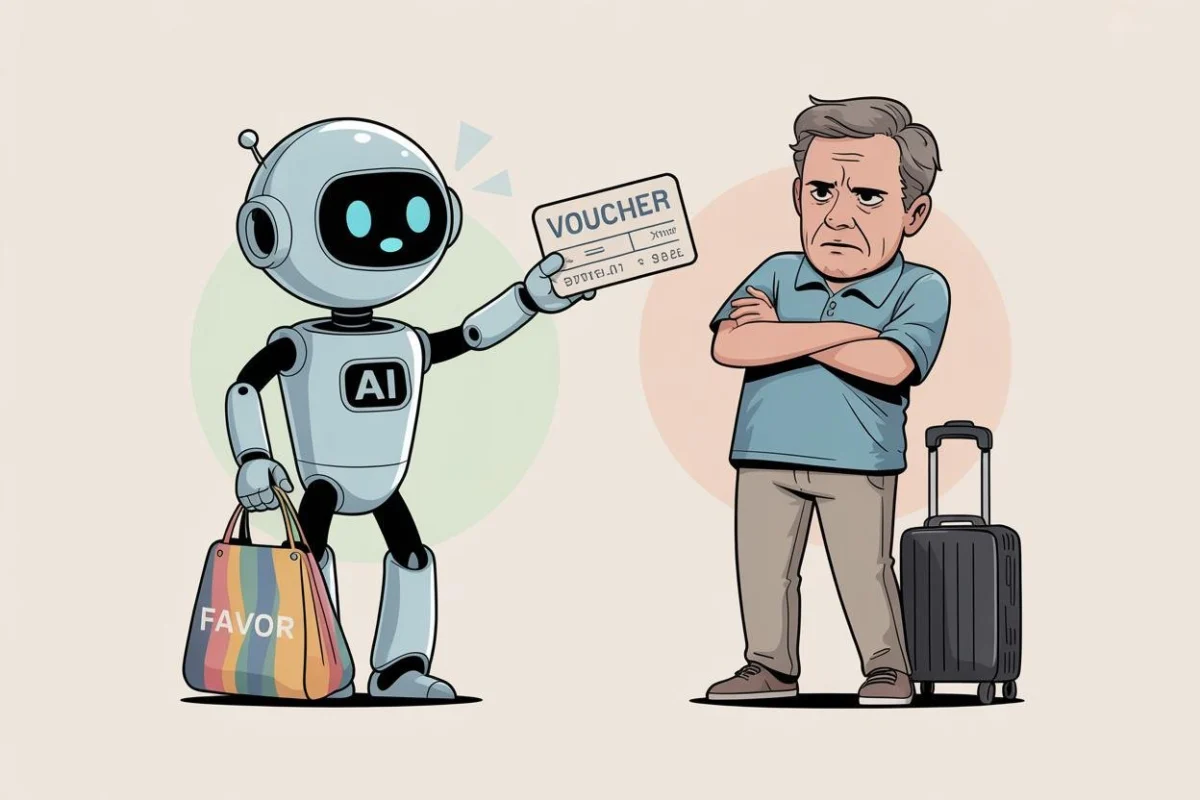
Your flight is canceled at the last minute, leaving you stranded in a crowded terminal. Your hotel loses your reservation for the night, or your car rental company runs out of vehicles entirely after you have already booked and paid.
Faced with these frustrating disruptions, what does the travel provider typically do? Instead of making things right with a direct cash refund, the company reaches into its corporate playbook and offers you a voucher or a “goodwill” credit that often expires in a year or less.
This practice is known as coupon justice, a troubling trend that has quietly swept across the modern travel industry. It functions as an increasingly automated system for handling legitimate customer complaints, replacing human empathy and financial accountability with digital codes and restrictive terms. And beneath the polite corporate language, it is not justice at all. Rather, it represents a calculated strategy of corporate self-preservation and penny-pinching, dressed up in consumer-friendly terminology to keep travelers from claiming what they are rightfully owed.
Coupon Justice Is Everywhere
The practice has exploded dramatically since the onset of the pandemic, a period when travel companies pivoted heavily toward vouchers to hoard cash and preserve their failing liquidity during unprecedented global shutdowns. Now, years later, corporate executives have discovered an additional, ongoing benefit: travelers do not always use the issued scrip. Consequently, the company gets to keep the cash while ultimately providing nothing in return.
Joe Cronin, president of International Citizens Insurance, notes the structural efficiency of the arrangement from a corporate perspective, describing it as elegant in a troubling way. He points out that the airline or travel provider secures interest-free financing from the consumer, effectively trapping the traveler inside their corporate ecosystem while leaving no one genuinely made whole.
However, these partial remedies are far from true compensation. They are corporate loopholes dressed in business casual attire, and travelers do not have to fall for them on their next journey.
Here’s Why Companies Love Vouchers (and You Should Hate Them)
Understanding the mechanics of coupon justice requires looking closely at how it operates in practice. Imagine a scenario where something goes terribly wrong with a $180 hotel room booking, such as incessant, disruptive construction noise right outside the window or a completely broken shower that makes the room unlivable. Instead of offering a straightforward refund for the ruined night, the hotel issues a $50 voucher toward a future stay.
This creates immediate problems for the consumer. First, there are frequently no $50 rooms available at the property, meaning the traveler is forced to spend more of their own money out of pocket just to redeem the promotional offer. Second, the hotel operates with the statistical certainty that a significant percentage of these vouchers will sit ignored on a desk, in a digital inbox, or inside an app until they quietly expire. The business should have paid out $180 in cash damages, but instead, the customer is left with nothing of real economic value.
Put simply, vouchers solve a company’s financial problem, not the consumer’s inconvenience.
When a traveler accepts a voucher instead of a cash refund, the company retains the consumer’s money directly on its financial books. The monetary value of the unspent voucher does not immediately hit the corporate balance sheet as an operational loss. Instead, it becomes a deferred liability—one that the company never has to pay out unless and until the consumer manages to navigate the restrictions and redeem it.
If the voucher is never spent, the company wins twice. It successfully kept the customer’s original cash while completely avoiding the cost of compensation.
Danny Karon, author of “Your Lovable Lawyers Guide To Legal Wellness: Fighting back against a world that’s out to cheat you,” explains that coupons fundamentally allow the wrongdoer to retain its ill-gotten gains. He notes that everyone understands how frequently standard gift cards and vouchers go unused, which is precisely the underlying goal for the issuing corporation. These credits successfully drive additional business back to the company that caused the original disruption, with victims often spending far more than the nominal value of the voucher just to use it.
Can Airlines Force You to Accept a Voucher Instead of a Refund?
When it comes to the aviation sector, federal consumer protections offer a clear baseline, though they are frequently obscured by corporate communication. Under Department of Transportation (DOT) regulations, airlines are legally required to provide prompt refunds to the original form of payment when they cancel flights or make significant schedule changes.
Despite these clear mandates, an airline can also offer a travel voucher. If an unsuspecting passenger says yes to the voucher, the transaction is treated as a done deal. Many passengers remain unaware of their legal rights, assuming that when an airline offers a flight credit, it represents their only available option.
It is not.
Eric Napoli, chief legal officer at AirHelp, emphasizes that airlines offering only vouchers without presenting a genuine, accessible cash option are in direct violation of their legal obligations.
At the same time, hotels, online booking platforms, and car rental agencies operate within a much murkier legal landscape. Few strict, overarching rules govern their specific refund practices, leaving them free to aggressively push promotional credits unless travelers actively push back against the practice.
How to Fight Back and Shift the Balance
Accepting vouchers is not an inevitable outcome of travel disruptions. Consumers can successfully secure real refunds if they understand their rights, document the issues clearly, and refuse to back down when faced with automated corporate deflection. Consumer advocates stress that persistence is often the key differentiator between accepting a worthless piece of digital paper and recovering hard-earned cash.
What Needs to Change in the Industry
Consumer advocacy veterans who have spent decades fighting on behalf of travelers agree that coupon justice will not come to an end without significant regulatory pressure and strict enforcement from government oversight bodies.
Meaningful reform requires several critical actions from regulators. First and foremost, existing consumer protection rules must be strictly enforced. The DOT’s refund requirements for airlines are explicit, as are similar passenger rights regulations in Europe. However, historical enforcement has often been weak, creating an environment where travel corporations calculate that ignoring the rules carries minimal risk.
Coupon justice is ultimately a sanitized corporate term for retaining customer funds while betting that the consumer will not fight back. While travel companies rely on fatigue and confusion to protect their bottom line, consumer advocates emphasize that travelers have the tools to push back—provided they recognize the practice for what it is.
| Source | : | Finance Poetry |
| Author | : | rifanmuazin |
| Editor | : | Finance Poetry Editorial Team |