
Switzerland’s Digital Health Industry Contracts as the Market Matures and Consolidates
Switzerland’s digital health landscape is undergoing a significant structural evolution. As the market continues to mature, it is experiencing a notable contraction in the total number of active startups, reflecting a broader trend toward consolidation, strategic acquisitions, and the increasing influence of established healthcare groups and international buyers.
According to fresh research published by Health-Trends, a prominent Swiss research organization and think tank dedicated to health innovation, the Swiss digital health market currently encompasses 159 active startups. This figure marks a notable 20% decline compared to October 2023, when the ecosystem counted 199 players. Furthermore, it represents a modest 4% contraction from the 166 startups recorded in 2025.
For the purposes of the report, digital health startups are defined as young, technology-driven companies that leverage advanced digital tools—including custom software, artificial intelligence, mobile applications, connected medical hardware and devices, and sophisticated data analytics—to fundamentally improve healthcare delivery, preventative medicine, clinical diagnosis, therapeutic treatments, and overall patient outcomes.
Industry analysts point out that this downward trend in the sheer volume of independent startups should not be interpreted as a sign of weakness. Instead, it highlights a maturing sector that is increasingly consolidating into fewer, highly integrated platforms. As the ecosystem scales, smaller players are frequently absorbed by larger corporate entities, established healthcare systems, and deep-pocketed international buyers looking to secure a foothold in Switzerland’s lucrative health-tech space.

Switzerland’s Digital Health Sector
Despite the rationalization in startup numbers, Switzerland has cultivated a remarkably dynamic and resilient digital health sector. This vibrant ecosystem is strongly supported by world-class medical and research institutions, a globally recognized pharmaceutical and life sciences industry, deep-seated technological expertise rooted in world-class academic institutions, and a steady stream of substantial private capital.
Institutional investors and venture capitalists have consistently favored the broader health sector, which has comfortably ranked among the largest and most reliable recipients of startup funding across Switzerland over recent years.
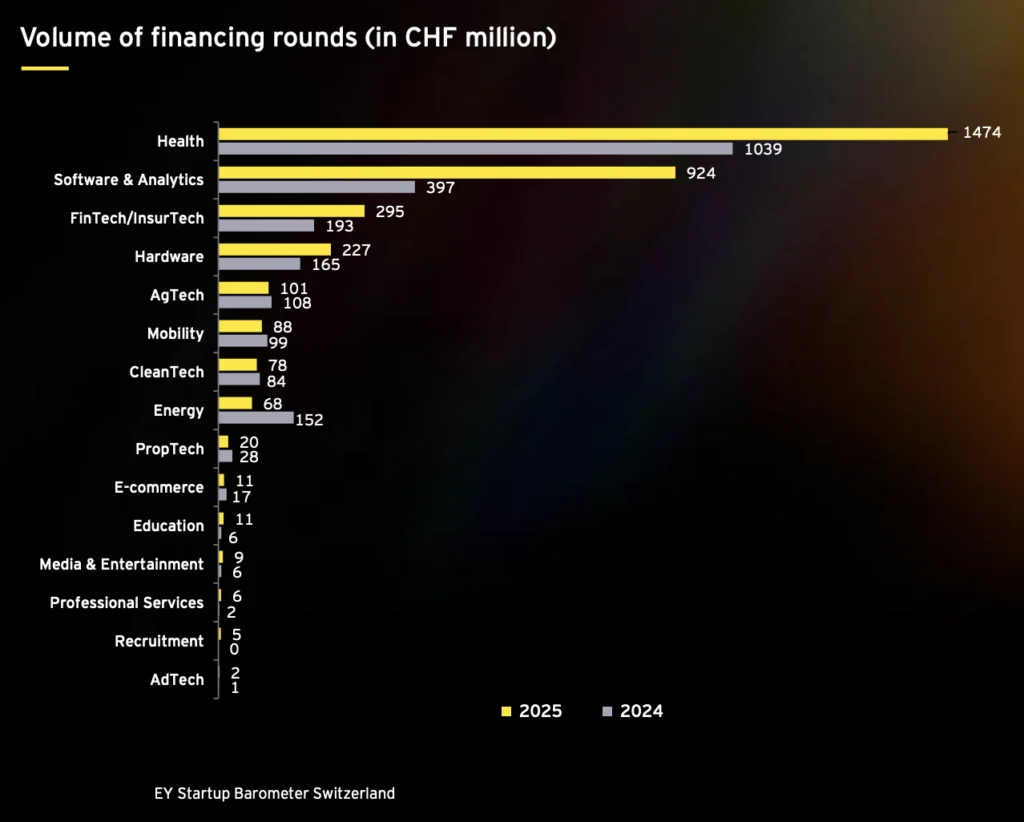
Data from the EY Startup Barometer Switzerland reveals that the health sector captured the lion’s share of venture capital investments within the country, pulling in approximately CHF 1.5 billion in 2025 alone. This massive influx of capital accounted for roughly 44% of all venture capital investment deployed in Switzerland that year. Furthermore, in terms of sheer deal activity, the health sector led the national rankings with 147 distinct financing rounds, narrowly outperforming the software and analytics sector, which registered 135 rounds during the same period.
A deeper dive into the health sector reveals clear internal distinctions regarding where capital is being allocated. Within the broader health category, biotechnology companies continued to command the largest share of funding. In 2025, biotech startups secured an impressive CHF 818 million across 62 individual deals, representing a staggering 56% of the sector’s total financial volume.

Meanwhile, medtech startups—firms focused on building advanced medical devices, precise diagnostic tools, and specialized clinical hardware and software—attracted CHF 369 million across 50 financing rounds. Notably, this represented an increase of CHF 94 million compared to the previous year, despite a minor dip of one fewer completed deal.
The care segment experienced the most dramatic percentage growth, drawing CHF 272 million across 23 deals in 2025. This marked a more than tenfold increase in funding volume relative to 2024, when the same category attracted a modest CHF 26 million.
To better understand these market dynamics, industry observers categorize these sub-sectors by their core focus. Biotech encompasses startups centered squarely around pharmaceuticals, biological therapies, and complex drug discovery pathways. Medtech focuses on physical medical devices, diagnostic instruments, and clinical infrastructure. Finally, the care sector involves startups dedicated to transforming everyday healthcare delivery and patient-centric services, spanning telemedicine platforms, digital therapeutics, and advanced chronic disease management solutions.
Switzerland’s reputation as an incubator for globally competitive health-tech companies is anchored by several standout firms. Among the most prominent names in the nation’s digital health arena are domo.health and Aktiia.

domo.health operates as an established Swiss digital health and health technology company that provides a unified, comprehensive platform connecting homecare providers, clinical practices, and medical research entities. Headquartered in the EPFL Innovation Park—a high-tech campus and deep tech innovation hub located directly on the École Polytechnique Fédérale de Lausanne (EPFL) campus in Lausanne—domo.health’s technology is actively utilized by more than 200 healthcare organizations.
Another prominent market leader is Aktiia, the pioneering company behind Hilo, a medical-grade, wearable blood pressure monitoring system. The Hilo device has achieved major regulatory milestones, having secured approval from the US Food and Drug Administration (FDA) alongside the CE mark designating it as a certified medical device within the European Union. Today, Aktiia’s technology is trusted by more than 200,000 individuals worldwide and is backed by a robust body of scientific research comprising 14 clinical studies, which includes four dedicated validation studies confirming its accuracy and reliability.
Swiss Digital Health Startup Map 2026
The release of the latest data via the Swiss Digital Health Startup Map 2026 underscores a transitional phase for Swiss health innovation. While the absolute count of independent startups has receded from its peak, the capital flowing into the remaining ventures is larger, more targeted, and increasingly concentrated in proven technologies capable of scaling internationally. As strategic mergers, acquisitions, and partnerships continue to reshape the marketplace, Switzerland remains firmly established as a premier global hub for health-tech innovation, deep science, and digital medical advancement.
| Source | : | Finance Poetry |
| Author | : | rifanmuazin |
| Editor | : | Finance Poetry Editorial Team |