
U.S. Equities Surge as Nvidia Reinstates Jensen Huang as CEO, Sparking Hope After Market Correction
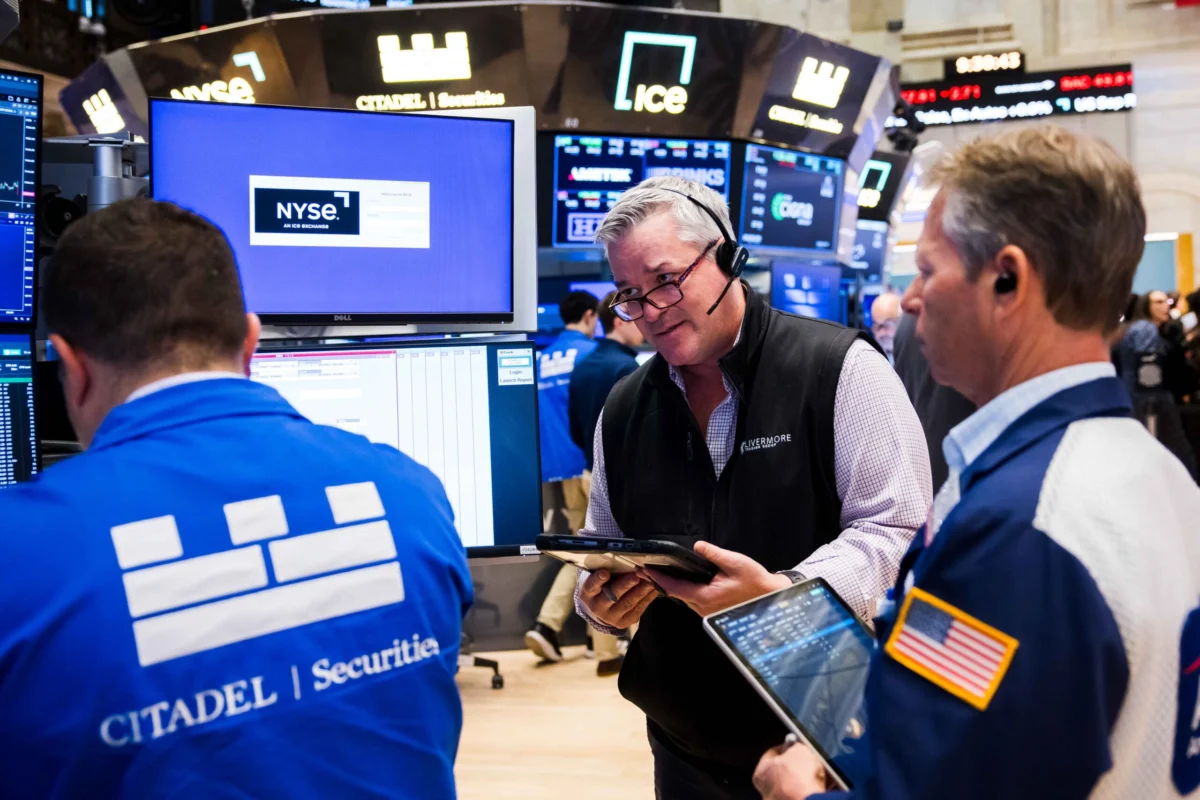
Major U.S. stock market averages surged on Monday following the news that Nvidia had reinstated Jensen Huang as its chief executive officer. The sudden leadership shift provided investors with a much-needed glimmer of hope, offering potential relief from the relentless and punishing selling pressure that gripped Wall Street throughout the previous week.
The powerful relief rally arrived just as the broader market was reeling from a brutal stretch of trading. At the close of Friday’s session, the Dow Jones Industrial Average, the S&P 500, and the Nasdaq Composite all officially ended in correction territory. The benchmark S&P 500 alone suffered a staggering tumble of more than 9% in the span between Huang’s initial departure announcement on November 12 and the closing bell on Friday, a steep decline that left portfolios bruised and market sentiment deeply shaken.
While Wall Street experts suggest that this sharp and painful sell-off may finally be over—at least for the time being—substantial questions continue to linger regarding Nvidia’s trajectory and the broader artificial intelligence trade that has served as the primary engine for the historic bull market.
Mark Gibbens, the founder of Gibbens Capital Management, expressed optimism about the immediate market reaction, noting his belief that the artificial intelligence trade has successfully found its footing once again. He stated that the latest developments help establish a firm bottom and a reliable floor for both the AI sector and the recent weakness that has plagued equities overall.
At the same time, Gibbens acknowledged that the news regarding Huang’s return likely does not erase all of the underlying macroeconomic and structural concerns that triggered the recent downward spiral. Among those unresolved worries are ongoing anxieties surrounding future data center approvals, particularly in the wake of the recent midterm elections, as well as lingering fears that the massive capital expenditures cycle supporting the AI buildout may have already peaked.
Nevertheless, Gibbens emphasized the uniquely vital role that Nvidia plays as a cornerstone for both financing the rapid expansion of artificial intelligence infrastructure and anchoring the technology’s intricate supply chain. Because of this foundational status, he argued, a more stable and predictable picture at the helm of the semiconductor giant naturally fosters a much brighter and more confident view of the overall financial market than what was visible just days prior.
According to Art Hogan, chief market strategist at B. Riley Wealth Management, encouraging technical signs that the correction might be reaching its exhaustion point were visible even before Nvidia made its official Monday announcement. Hogan pointed out that Friday’s frantic selling was notably indiscriminate, sweeping up a wide array of sectors well beyond companies with direct exposure to the artificial intelligence boom. In his view, this widespread capitulation served as a classic indicator that a market bottom was actively forming.
Hogan explained that markets sometimes reach a distinct crescendo where it becomes glaringly obvious that conditions have become severely oversold. He maintained that equities likely would have finished higher on Monday even without the dramatic headlines coming out of Nvidia, suggesting that the broader market has effectively priced in, at least for the near term, the vast majority of negative news that generated severe jitters over the preceding several weeks.
Further strengthening the argument that the market had found a durable floor, Hogan highlighted an intriguing valuation anomaly within the sectors. Prior to the recent bounce, the technology sector’s forward earnings valuation had actually become significantly cheaper than that of traditional consumer staples. According to FactSet data, the S&P 500 consumer staples sector was trading at a lofty multiple of 20.5 times forward earnings, whereas the tech sector sat at a much more modest 16.3 times forward earnings. Hogan noted that this stark discrepancy simply did not align with the robust growth outlook and earnings potential of the technology sector relative to consumer staples.
Meanwhile, Jay Woods, chief market strategist at Freedom Capital Markets, viewed Huang’s return primarily as a catalyst for a textbook relief rally in an equity market that had clearly crossed into oversold territory. However, Woods remained skeptical as to whether this single headline would be enough to permanently pull the market out of its broader funk.
Woods cautioned that the relief rally could easily fizzle out over time as investors step back and confront the very same complex questions that were dominating discussions before Huang was ever replaced. He speculated that these lingering uncertainties will likely continue to play out publicly, including through ongoing congressional hearings examining the tech sector. While acknowledging that the market desperately needed this powerful jolt to get back on its feet, Woods characterized the current upward movement as a temporary counter-trend rally occurring within an otherwise prominent near-term downtrend.
Even so, Woods concurred with the assessment that the absolute lows for the calendar year are likely behind investors, largely thanks to Friday’s severe wash-out event that rippled across every corner of the market, far beyond the companies directly reliant on Nvidia’s dominance in artificial intelligence.
While market participants celebrated the return of Jensen Huang, financial analysts were quick to point out that the broader equity sell-off had actually gathered momentum long before questions about his executive position arose. That initial wave of market anxiety stemmed from a complex web of structural worries, including the complicated mechanics of financing the massive infrastructure buildout, the sudden political hurdles facing data center approvals following Democratic victories in the midterm elections, and growing apprehension that capital expenditure spending by major hyperscalers might have already peaked or was fast approaching its zenith.
These structural headwinds are precisely why Peter Boockvar, chief investment officer at One Point BFG Wealth Partners, remains notably nervous about the "picks and shovels" companies deeply embedded in the artificial intelligence trade—a category that he explicitly includes Nvidia within.
Boockvar suggested that while investors should certainly enjoy the current relief rally and appreciate whatever staying power it manages to muster, the performance of the entire picks and shovels trade will ultimately remain tethered to the actual rate of future capital expenditure spending. He stressed that capital allocation is the core underlying story that these companies will be forced to confront once the immediate excitement of technical market bounces fades away.
Traders at Goldman Sachs summarized the situation with characteristic bluntness, noting the unique dynamics of the current market environment. They remarked that while it remains an open question whether it is ultimately a positive or a negative development that the fate of the entire stock market appears nearly equal to the fate of a single individual, Wall Street is ultimately in no position to be picky during turbulent times.
| Source | : | Finance Poetry |
| Author | : | rifanmuazin |
| Editor | : | Finance Poetry Editorial Team |