
Privacy-Focused AI Startup Maple Raises $5.3M to Build Zero-Trust Assistants
As artificial intelligence assistants rapidly evolve into deeply capable agents capable of navigating our personal files, parsing private emails, managing calendars, and controlling web browsers, the nature of our digital lives is shifting. This profound transformation inevitably forces consumers and enterprises alike to place an unprecedented amount of trust in tech companies. Yet, a growing faction of the tech industry is pushing back against this paradigm, arguing that convenience should not require sacrificing personal privacy.
Enter Maple, an innovative startup co-founded by a former Apple engineer who previously specialized in privacy-preserving technologies. Maple is taking a radically different philosophical and architectural approach to the AI app market by designing a platform where users’ data remains strictly private—shielded even from the company operating the infrastructure.
"We wanted to build something that was not only encrypted but also could be proven, and that people could go look at the open-source code, and then they could look at what we call trusted execution environments," explains Maple co-founder and CEO Mark Suman. "They can look at and verify the code that’s running on our servers, so they don’t really have to take our word for it."
Suman emphasizes that this level of transparency empowers users directly. "They can audit everything themselves and know how their data is being handled," he adds.

Redefining Trust in the Age of AI Agents
The core philosophy of Maple centers squarely on the concept of trust, proposing an alternative architecture where consumers no longer have to trade their digital privacy for technological convenience. This stands in stark contrast to many competing AI services on the market, which often require users to accept invasive privacy policies, broad data collection practices, and, in some cases, the utilization of personal conversations and documents to train future iterations of foundational models.
Instead of asking customers to simply take Maple’s word that it will handle their sensitive personal data responsibly, the startup is deliberately engineering a business model where it is technologically incapable of accessing that data in the first place.
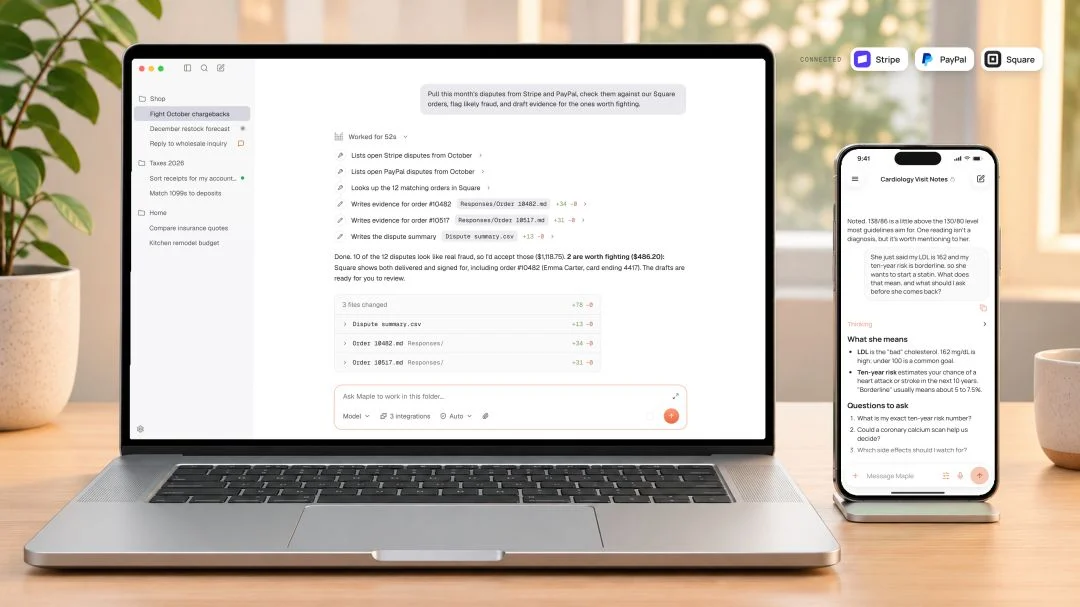
Like many conversational AI applications currently available, Maple allows users to engage in a traditional chat experience to ask questions and receive detailed answers. However, the startup’s recently launched desktop application, Maple Work, introduces a significantly more agentic experience. This software allows the AI to interact directly with the user’s computer environment, manipulating files, interfacing with local applications, and managing web browsers to execute complex, multi-step online tasks autonomously.
Fueling this expansion, the company recently closed an oversubscribed $5.3 million seed round. Led by EPIC Ventures with participation from Draper Associates, Planetary VC, and Epoch VC, the latest capital injection follows an earlier pre-seed angel round of under a million dollars. Building on this momentum, Maple is already looking ahead to its next major product release: a cloud-based agent designed to operate continuously, maintaining workflow execution even when the user’s personal computer is powered down. This upcoming capability is expected to position Maple more competitively against popular consumer AI services and viral agentic platforms like Meta’s Muse and Instinct. Spurred by strong investor interest, the startup is already planning a Series A funding round for the first half of 2027.

A Background Rooted in Privacy and Security
Suman’s journey toward founding Maple stems from a career where AI and privacy naturally intersected. During his six-year tenure at Apple, he worked extensively on artificial intelligence and machine learning, with a specialized focus on computer vision. Given Apple’s strict corporate stance on safeguarding consumer privacy, Suman frequently grappled with the complex challenge of developing products that could leverage advanced computer vision techniques while rigorously protecting individual identities.
His co-founder, Chief Technology Officer Anthony Ronning, brings a complementary background rooted in defense technology, cybersecurity, and advanced networking. Ronning originally launched the foundational technology behind what would become Maple back in 2023, initially conceptualizing it as a privacy-focused financial technology platform. When Suman teamed up with Ronning in August 2024, the vision pivoted to establish Maple AI. By January of the following year, the core product officially launched to the public as a mobile application.
While the app provides a familiar conversational interface for users accustomed to standard AI chatbots, its backend architecture stands apart by running a diverse array of open models. Users can choose from versions of DeepSeek, Kimi, GLM, Inkling from Thinking Machines, Google’s Gemma, and OpenAI’s GPT OSS. Customers can manually select their preferred models or use a simple toggle to switch between a fast, lightweight model and a more powerful, heavy-duty alternative.
Hardwiring Security Through Trusted Execution Environments
The underlying AI models operate entirely within Trusted Execution Environments (TEEs)—secure server architectures backed by hardware-level encryption hosted inside U.S.-based data centers. For European customers, Maple provides localized support through a dedicated partner operating regional servers.

"We actually don’t have access to [the data] while it’s inside the TEE," Suman explains. "The data gets encrypted first on your device using a unique password that’s only known by you, the user — we don’t have access to it. It then goes into this TEE, and it gets decrypted inside there. The AI does its thing, and then it re-encrypts it with your password and sends it back to you."
This end-to-end mechanism ensures a seamless user experience while preventing the company from ever viewing raw data, whether it is in transit or at rest. This cryptographic isolation guarantees that even in worst-case scenarios, such as a sophisticated external cyberattack on Maple’s infrastructure or a legal subpoena from government authorities, the company would be technically unable to surrender readable user data. The only thing available to hand over would be an impenetrable, encrypted file.
"We just simply don’t want access to it," Suman says regarding customer data. "That’s not part of our business model. And we also don’t want it to be part of our threat model."
Expanding Into Workplaces and Small Businesses
With the introduction of the Maple Work desktop application, the company is actively targeting small businesses and professionals seeking the productivity benefits of artificial intelligence without exposing proprietary operations to standard data privacy risks. The desktop application features an integrated marketplace allowing users to securely connect external tools, such as Gmail and calendar systems.

Furthermore, the desktop application can spin up a specialized subagent capable of operating inside other local AI applications that support the Agent Client Protocol, such as Claude or Codex. This interoperability allows professionals to leverage their preferred specialized AI apps for designated sub-tasks without surrendering their entire digital footprint—transmitting only the specific information required for the immediate task at hand.
Looking forward to the coming year, Maple plans to break into the enterprise market through structured pilot programs, offering a tailored version of zero data retention. While Maple typically avoids retaining customer data entirely, any necessary temporary caching is heavily encrypted. The startup is currently completing formal SOC 2 compliance certifications and rigorous security audits to prepare for this upcoming enterprise expansion.
Although the company declined to disclose exact customer registration numbers, it noted an impressive 60-fold growth trajectory over the past three months, driven by an escalating market demand for secure, privacy-centric AI tools.
Maple currently monetizes its platform through a subscription model with tiers comparable to those offered by other major AI model providers. The entry-level Pro plan is priced at $20 per month, alongside two higher-tier options—Max at $100 per month and Max Plus at $200 per month. Operating out of offices in Austin and San Francisco, the lean four-person startup continues to scale its operations and is actively hiring engineering and security talent.
| Source | : | Finance Poetry |
| Author | : | rifanmuazin |
| Editor | : | Finance Poetry Editorial Team |