
The Famed Ocean Liner SS United States Begins Its Final Journey to Become the World’s Largest Artificial Reef
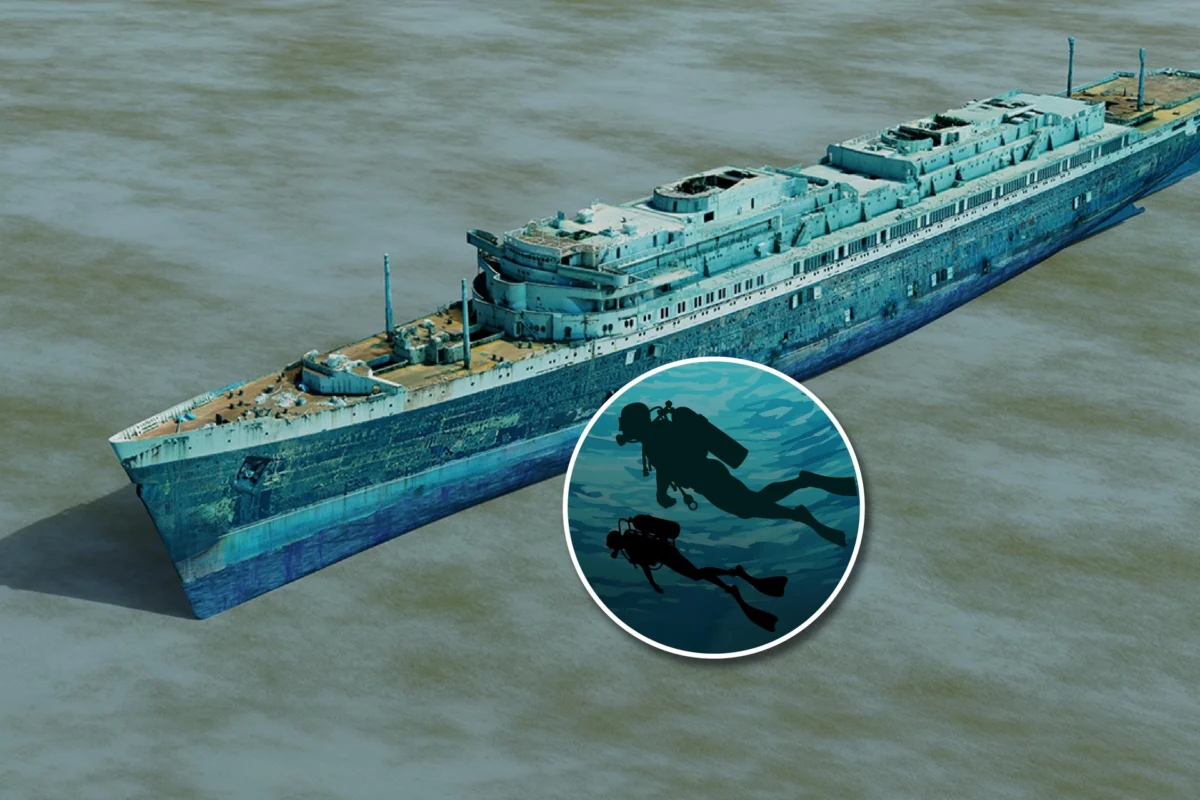
The famed ocean liner SS United States, which historically carried presidents, dignitaries, and celebrities across the Atlantic Ocean in high-class style during the golden age of ocean travel, is embarking on a dramatic new chapter. Today, the majestic vessel is being intentionally sunk beneath the surface of the Gulf of Mexico to transform into the world’s largest artificial reef, a destination that marine experts and tourism officials are comparing to a Mount Everest-type challenge for passionate scuba divers from around the globe.
Measuring a staggering 990 feet in length, the historic ship is currently undergoing a carefully controlled process of being flooded with seawater. This precise engineering operation will take the massive vessel down nearly 200 feet to its final resting place on the ocean floor, where it will settle upright and begin its new life as a thriving marine habitat.
Within a short time, scuba divers—ranging from the intensely curious and bucket-list adventurers to deeply passionate marine enthusiasts—are expected to descend upon the area in droves to explore the legendary liner.
"We anticipate the SS United States is going to be super popular," said Savanna Christy, owner and instructor at ScubaTech, a dive center located in Destin, Florida.
What’s the Attraction in Scuba Diving?
The allure of the underwater world has captivated millions of people for generations, driven by a combination of exploration, wildlife interaction, and a unique environment unlike anything found on land.
"What draws me to scuba diving is being able to be underwater and experience marine life," said Christy, reflecting on her 22 years of experience as an active diver. "It’s the sense of peace and tranquility that comes with that weightless feeling. For some, it’s the adventure, the thrill, but I would say experiencing the underwater world is not something you get every day."
According to data compiled by the Dive Equipment and Marketing Association (DEMA), a prominent dive marketing organization, there were approximately 2.5 million active scuba divers in the United States in 2024. Active participation in this context is defined as individuals who completed at least one recreational dive within the preceding 12-month period.
What Draws Divers to Sites Like the SS United States?
The decision to submerge the SS United States has generated immense excitement within the diving community because of the ship’s storied history. Divers are naturally eager to witness the ocean liner itself—a celebrated artifact of classic maritime lore whose days of mid-century elegance, record-breaking speed, celebrity passengers, and lavish parties are long gone, now reduced to a silent, majestic ghost resting beneath the Gulf waves.
"Those who are eager to dive immediately are there for the historical factor," Christy noted. "There’s something really cool about a wreck when it’s first gone down, before it attracts any marine growth."
Jennifer Adams, the director of tourism for Okaloosa County, emphasized the adventurous spirit that draws visitors to the region’s coastal waters. "Our waters are so clear and you can see not only that you’re around the reefs, but the wildlife that is around the reefs as well," Adams said.
The integration of the SS United States into the local maritime landscape also strengthens an already robust tourism initiative centered around historic shipwrecks.
"Here in this north part of the Florida Gulf, we have a shipwreck trail," Christy explained, noting similar cultural preservation efforts such as the nine ships designated within the Florida Keys National Marine Sanctuary. "People come, they get a passport that they can stamp off when they dive certain wrecks. This is going to be part of that."
Local authorities have spent years preparing the region’s infrastructure to support this influx of marine tourism. "We’ve been growing our artificial reef program for the past five years," Adams said. "Everybody comes here for the beaches, but we’re now seeing that people want to be in the water."
Furthermore, the scale of the new reef is designed to accommodate varying levels of experience within the diving community. The new attraction "will give multi-experienced divers some diversity," Adams added. "Not everybody’s going to go 180 feet down, we know that. Our dive operators are also focusing on that 40- to 50-feet-deep threshold and getting new people comfortable."
What Else Will Divers See?
When the sinking process is fully complete, the SS United States will claim the title of the largest artificial reef in the world. Notably, it will not be isolated; the current holder of that title, the aircraft carrier USS Oriskany, rests nearby in the Gulf.
"We’re going to be working with Pensacola in Escambia County, because we’ll have the two largest artificial reefs in the world," Adams said, pointing out that the two massive vessels will sit approximately 13 nautical miles apart from each other. "You could conceivably dive both of them on a daylong trip, unless you’re going to be doing the deep dive, which is going to take a lot longer."
In addition to marveling at the sheer scale of the submerged ocean liner, divers will have the opportunity to observe a diverse and rapidly expanding aquatic ecosystem. Artificial reefs are well-documented catalysts for marine growth, acting as hard substrates that attract a wide variety of marine species shortly after deployment.
"Marine life will quickly start to gravitate to the wreck and start living there," Christy said. "We’ll have fish that are important to our commercial fisheries—snappers, groupers, Amberjack, things like that. You’ll see sharks and turtles and small reef fish."
The ecological impact extends far beyond large pelagic species and popular game fish. "You’ll get crustaceans, crabs, and shrimp," Christy added. "You’ll see different things that will live and grow on the marine life that adheres to the wreck surface. It’s going to be an entire ecosystem."
Will Divers Need Special Training to Visit the Ship?
Because the ocean liner is settling in water depths ranging from 180 to 200 feet, visiting its deepest points requires significant preparation and specialized expertise. However, significant structural modifications were made prior to the sinking to ensure accessibility for a broader range of visitors. With its historic funnels, radar mast, and other upper deck structures removed, "the top of it will be in 55 to 60 feet of water," explained Alex Fogg, Okaloosa County’s chief of natural resources.
"A lot of those top decks are going to be easily accessible to the beginner diver and novice diver," Fogg said, adding that "technical divers who want to go down and see what the bottom looks like can go down there."
The interior of the massive vessel presents an entirely different environment that demands advanced training and certification. "There’s probably going to be plenty of cave divers and other penetration divers who are going to be exploring the inside of the ship, going down to the engine room, going to the pool, and other places like that," Fogg noted. "But that’s not something a recreational novice diver is going to be able to tackle."
Consequently, safety regulations dictate that visiting the upper portions of the ship requires—at a minimum—an Open Water Diver certification. Divers seeking to explore greater depths or venture into the ship’s interior must undergo rigorous advanced training and complete dives under strict supervision. Standard safety protocols in the diving community also strongly encourage individuals to dive in pairs or within organized groups led by professional instructors or local dive guides.
How Long Can Scuba Divers Stay Down?
The duration of any underwater excursion is governed by strict physiological and logistical constraints. The vast majority of recreational divers breathe compressed air, which typically features an oxygen concentration ranging between 20% and 22%, supplied from a portable scuba cylinder. Some specialized dives utilize enriched air mixtures, commonly known as nitrox, to extend bottom times within safe physiological limits.
A typical recreational scuba dive lasts anywhere from 45 to 60 minutes. However, the exact duration varies significantly depending on several critical factors, including the depth of the dive, physical exertion levels, individual breathing rates, and the total capacity of the air tank being utilized.
These variables directly influence how rapidly a diver consumes their breathing gas supply, according to guidance from the Divers Alert Network, a prominent nonprofit organization dedicated to scuba-diving safety, research, and marine medicine.
In addition to gas supply limitations, divers must constantly monitor the no-decompression limit, which is defined as the maximum amount of time a diver can safely spend at a specific depth before requiring mandatory decompression stops during their ascent back to the surface, according to divingstandard.com.
Permissible underwater durations decrease rapidly as depth increases. For instance, according to data published by the National Oceanic and Atmospheric Administration (NOAA) and commercial diving tables established by the Code of Federal Regulations, a diver operating at a depth of 130 feet is restricted to a maximum time of approximately 10 minutes at that depth before mandatory decompression stops become necessary for a safe return to the surface.
Don’t Even Think About Taking Dive Souvenirs
The ethical framework governing maritime exploration and artificial reefs is universally understood within the global diving community. The guiding principle can be summarized by a simple, widely respected ethos: "Take only photos, leave only bubbles."
"That’s pretty standard across the board," Christy emphasized. "No matter where we’re diving, it’s our code as stewards of the ocean."
Legal frameworks in the state of Florida reinforce these ethical standards with severe penalties for unauthorized interference with underwater sites. Under Florida law, individuals who remove or even attempt to remove an object from a marine site can be charged with a first-degree misdemeanor, carrying potential penalties of up to one year in jail and a $1,000 fine. Those found guilty of digging up or disturbing items face more severe consequences as a third-degree felony, punishable by up to five years in prison and a $5,000 fine.
While these legal protections are absolute, maritime authorities note that extensive preparation of the SS United States ensures there are no loose artifacts left behind for opportunistic visitors. "This is a project that’s undergone a lot of preparation," Christy said. "There’s nothing left behind that divers could pick up and put in their pockets, so to speak."
| Source | : | Finance Poetry |
| Author | : | rifanmuazin |
| Editor | : | Finance Poetry Editorial Team |