
The Startup Exit Illusion: Why 90% of Founders Walk Away Empty-Handed and How Switzerland Contrasts the US Model
Despite the romanticized narrative of overnight success stories, viral mobile applications, and multi-million-dollar initial public offerings, launching a profitable technology startup remains an exceptionally difficult endeavor. Behind the headlines of soaring valuations lies a sobering reality: for the vast majority of founders, achieving a viable, financially rewarding exit is statistically unlikely, particularly within the competitive landscape of the United States.
According to a groundbreaking academic study conducted by researchers from the Wharton School and the University of Zurich, roughly nine out of ten startup founders ultimately end up with a zero exit value. This stark statistic underscores the immense, systemic risks embedded within venture capital-backed entrepreneurship.
The research, which analyzed a massive dataset of nearly 250,000 individual founders, reveals that while the average individual founder exit value appears impressively high on paper at US$5.6 million, the distribution is profoundly uneven. Beneath that average lies the reality that 88% of founders actually receive nothing when their companies are sold, liquidated, or closed down.
According to the authors of the study, this disheartening outcome is driven primarily by two distinct mechanisms. First, founders are collectively wiped out in a staggering 81% of cases. This occurs either because the startup fails outright—running out of cash before achieving product-market fit or operational sustainability—or because of what the financial ecosystem refers to as “bad exits.” In these scenarios, venture capital investors claim all of the transaction proceeds, leaving the creators of the business with nothing.
This high baseline failure rate is corroborated by broader industry research. An analysis by Louis Bouwer, a deeptech positioning strategist, product marketer, and innovation specialist, suggests that between 90% and 95% of startups that manage to secure pre-seed funding ultimately fail to survive long enough to reach a Series A funding round.

The mechanics of a bad exit or a modest acquisition often catch early-stage entrepreneurs off guard. When a struggling or mediocre startup is sold, the purchase price may hover near or even fall below the cumulative amount of venture capital funding the company raised over its lifetime. Under these conditions, the majority—or even the entirety—of the sale proceeds are consumed by satisfying investor priority liquidation preferences. Contractual rights frequently grant venture capitalists preferred stock, giving them a strict legal right to be paid back their initial capital before anyone else sees a dime. Consequently, founders and operational employees holding common shares may receive little to nothing from the transaction, rendering years of grueling, round-the-clock labor financially worthless.
The Problem of Premature Founder Departures
The second major mechanism driving down founder payouts involves the reality that even among startups that successfully achieve lucrative exits through acquisitions or initial public offerings, there remains a persistent risk of displacement. Specifically, the Wharton and University of Zurich study highlights a 39% chance that an individual founder departs the company before an exit event takes place, thereby receiving zero financial payoff.
Individual founders frequently leave their ventures prematurely because venture capital boards choose to replace early-stage entrepreneurs with seasoned, professional corporate executives as the company scales. In other instances, internal co-founder friction, strategic disagreements, or boardroom clashes force an irreparable breakup. When founders depart before a liquidity event occurs, they typically forfeit any unvested shares they held. Furthermore, restrictive “bad leaver” clauses written into their shareholder agreements may force them to sell their remaining equity stake back to the company or investors at a heavily discounted price.
The phenomenon of replacing early-stage entrepreneurs with professional corporate executives is a widespread practice within the venture-backed ecosystem. A separate academic study conducted by researchers from Rice Business and the University of Beirut examined data on more than 1,000 venture capital-backed US initial public offerings between 1995 and 2013. The researchers discovered that 472 of those firms—representing 40.8% of the total sample—actively changed their chief executive officers between the initial round of venture financing and their eventual public market debut.
Extreme Financial Concentration
The academic study from the Wharton School and the University of Zurich also demonstrates that financial outcomes in the venture ecosystem are characterized by extreme concentration, with an even greater spread visible among positive values. When an exit successfully yields a positive financial return, the arithmetic average climbs to US$47.3 million. However, the median figure tells a vastly different story, standing at just US$4.8 million.
The upper echelons of the distribution reveal astronomical sums. The 90th percentile of successful founders reaches US$65.6 million, while the elite 99th percentile climbs to a staggering US$661.2 million. When viewed through a macro lens, the data shows that an overwhelming 89% of all individual founder exit value is derived entirely from the top 2% of founders—a calculation that factors in the zero-return outcomes. Furthermore, the top 1% alone account for a massive 79% of the total cumulative wealth generated.

Contrasting Ecosystems: The Swiss Advantage
When compared directly against the volatile exit patterns and punishing liquidation preferences observed in the United States, European markets—and particularly Swiss entrepreneurs—demonstrate markedly stronger and more resilient results. This relative stability is largely attributed to robust structural backing from the country’s extensive network of higher education institutions, world-class universities, and specialized research laboratories.
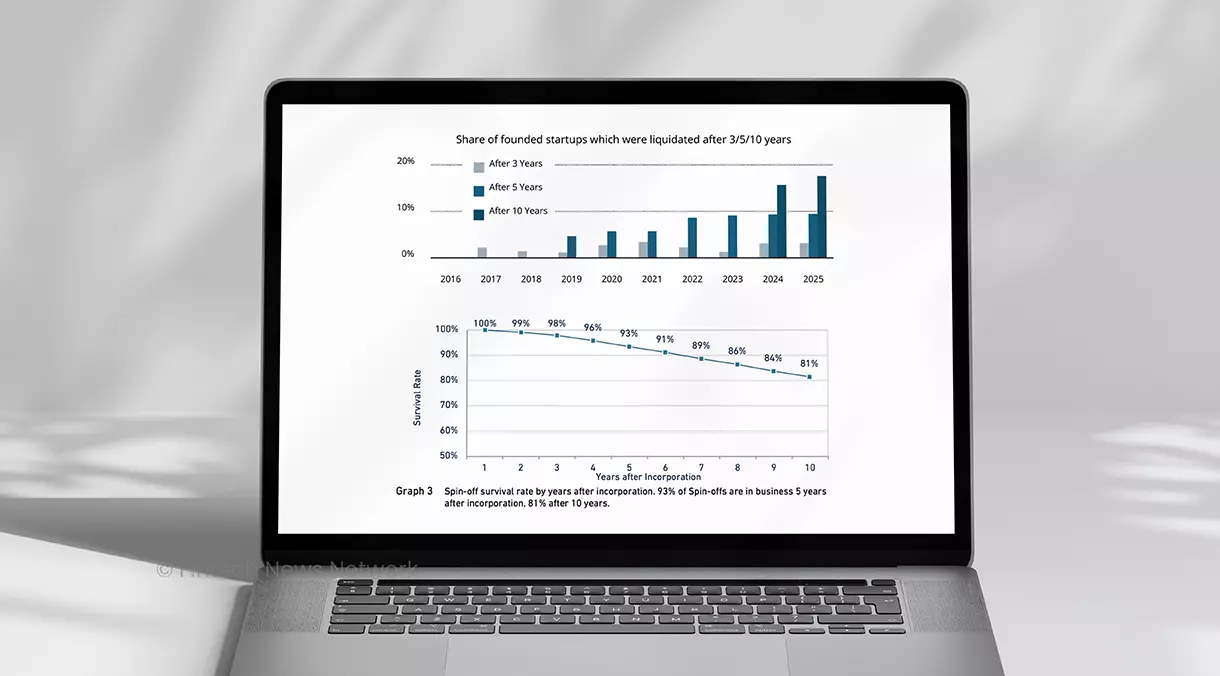
According to comprehensive research published by Startupticker.ch, a dedicated Swiss news portal focused on the national startup and innovation ecosystem, the current ten-year failure rate for startups in Switzerland stands at a modest 17.6%. This vital metric indicates that an impressive 82.4% of all startups founded in Switzerland in 2016 remain actively operational today. For younger companies, the safety data is even more encouraging: startups in their fifth year face a current failure rate of just 9.5%, while the three-year failure rate sits at a remarkably low 3.2%.
Survival rates rise even higher when examining institutional spin-offs originating directly from elite academic centers. For instance, empirical tracking shows that 93% of all spin-offs from ETH Zurich were still active five years after their initial launch, while the ten-year survival rate remained exceptionally high at 81%.
A deeper sectoral breakdown of the Swiss market, however, reveals shifting pressures across different industries, marked notably by an increase in liquidations within capital-intensive sectors over the course of recent years. According to the Startupticker.ch research, liquidations in the biotechnology sector rose significantly, with 14 biotech startups winding down operations—representing a 250% increase compared to the four startups liquidated in the previous year. Similarly, the hardware sector experienced a 100% increase, registering eight liquidations, while the cleantech sector saw a 66.6% rise, resulting in 15 liquidations.
Conversely, other prominent technology and healthcare sectors experienced a much milder trajectory, with some even recording declines in closures. The number of liquidations within the information and communications technology (ICT) sector grew by a very modest 3%. Meanwhile, across healthcare IT, fintech, and medtech, total liquidation numbers actually decreased, dropping by margins ranging between 12.5% and 35%, reflecting sustained demand and more resilient business models in those specific domains.
| Source | : | Finance Poetry |
| Author | : | rifanmuazin |
| Editor | : | Finance Poetry Editorial Team |