
Surge in European Phishing and Cloud-Based Attacks Signals Escalating Regional Threat
The cybersecurity landscape across Europe is undergoing a period of intense volatility, characterized by a rapid escalation in sophisticated phishing attempts and highly targeted cloud-based incursions. According to a comprehensive new report from cybersecurity firm Proofpoint, released on November 12, Europe has become a primary focal point for malicious actors, with the continent experiencing a surge in threat activity that significantly outpaces global trends.
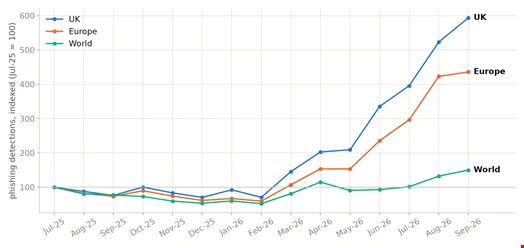
Data collected from the firm’s extensive telemetry network between July 2025 and September 2026 reveals that phishing threats across Europe have increased by a factor of 4.5. This sharp rise stands in stark contrast to the global average, which saw a more moderate increase of 1.5 times during the same period. Perhaps most concerning is the situation within the United Kingdom, which has been identified as a significant outlier; the region has witnessed a staggering six-fold jump in phishing detections, underscoring a concentrated effort by threat actors to compromise British digital infrastructure.
The implications of this shift extend beyond the raw volume of attacks. Proofpoint’s research highlights a troubling increase in the efficacy of these campaigns. European users are demonstrating a heightened susceptibility to malicious outreach, clicking on approximately 8.3 out of every 100 delivered threat messages. This engagement rate is more than four times higher than the global average of 2.0 per 100 messages, suggesting that phishing lures targeting European audiences are becoming increasingly nuanced, localized, and difficult to distinguish from legitimate communication.
Precision Cloud Attacks and the Challenge of Account Takeover
While the volume of phishing attempts has reached new heights, the methods employed by attackers have also evolved toward higher precision. The report sheds light on the rising success of "precision cloud attacks," which prioritize the compromise of specific accounts over broad, indiscriminate spam campaigns. Proofpoint found that 64% of European organizations targeted by these sophisticated operations showed clear evidence of successful compromise.
Speaking to the media at the Proofpoint Protect London event on November 12, Daniel Blackford, VP of threat research at Proofpoint, provided insight into the mechanics of these breaches. He explained that the research team arrived at these findings by analyzing comprehensive account-takeover telemetry. This includes monitoring abnormal login attempts, suspicious geographic shifts in user activity, and, critically, follow-on actions taken by attackers once they have gained initial access. These post-compromise actions often involve the creation of covert email forwarding rules, the illicit linking of third-party applications to a cloud environment, and the systematic exfiltration of sensitive data.
The effectiveness of these attacks lies in their surgical nature. Rather than relying on brute-force tactics that can be easily flagged by automated security systems, modern threat actors are leveraging techniques such as session hijacking and highly tailored phishing lures. By gaining access to specific, high-value user accounts, attackers can move laterally through an organization’s cloud environment, often bypassing traditional perimeter defenses. "These targeted attacks use techniques such as phishing and session hijacking to gain access to specific users and accounts, highlighting their effectiveness compared with broader brute-force attacks," the researchers noted in their report.
Sector-Specific Vulnerabilities and Emerging Espionage Trends
The threat landscape is not uniform across all industries, as specific sectors in Europe are being singled out for more intensive scrutiny. The hospitality and leisure sector, for instance, has seen a significant uptick in malware-based threats, which now account for 21% of detected attacks—nearly double the rate observed globally. Similarly, healthcare organizations are facing a barrage of sophisticated, high-impact threats. The report details a 257% year-over-year increase in "callback phishing," a dangerous technique where attackers trick victims into calling a fraudulent support number to facilitate credential theft or malware installation. Additionally, malware detections within the healthcare sector have surged by 84%, further straining organizations that are already managing complex digital transformation projects.
Beyond organized cybercrime, the geopolitical dimension of these threats is expanding. Proofpoint has observed that espionage operations are becoming increasingly prevalent across Europe. The report notes that South Asian threat actors are actively extending their reach into Western Europe, joining a crowded field of adversaries that includes Russian and Chinese state-aligned groups. These actors continue to iterate on their tactics, refining their malware payloads and obfuscation techniques to maintain persistent access to sensitive government and corporate networks.
The Role of AI in the Modern Threat Landscape
A significant driver of this shifting landscape is the rapid adoption of artificial intelligence and cloud-based services. While these technologies offer clear operational benefits, they also present a new and largely uncharted frontier for security teams. Proofpoint identified more than 188,000 AI-enabled applications connected to corporate environments through various authentication and OAuth frameworks. This rapid integration of third-party AI tools into the enterprise ecosystem creates a massive, and often overlooked, attack surface.
The risk is not merely theoretical. The proportion of European sensors affected by attacks targeting open-source AI technologies increased 4.6 times between consecutive 90-day periods. This suggests that attackers are actively scanning for vulnerabilities in the AI supply chain, targeting the frameworks and models that underpin modern business operations.
Reflecting on the pace of this evolution, Daniel Blackford emphasized that the era of speculative AI-driven threats has firmly transitioned into a period of widespread implementation. "Up to last year, I could have said AI for attackers was still a bit too hyped up, but within the last six to eight months, we’ve really started seeing widespread adoption of coding assistants and AI usage across the vast majority of the landscape," Blackford stated.
The integration of AI into the attacker’s toolkit has allowed for the rapid generation of highly convincing phishing content, the automation of malware variant creation, and the ability to conduct reconnaissance at a scale previously impossible for human-led teams. As these technologies become more accessible, the barrier to entry for sophisticated cyber-attacks continues to drop, leaving organizations across Europe to grapple with a threat environment that is becoming both more frequent and more difficult to defend against.
The findings from Proofpoint serve as a stark reminder that the digital security landscape is no longer a static environment. With phishing becoming more effective, cloud-based attacks becoming more precise, and the integration of AI-enabled weaponry by state-aligned and criminal actors, the mandate for European organizations is clear. Adapting to this new reality requires not only an investment in robust, multi-layered security architectures but also a proactive approach to threat intelligence and user awareness. As the data shows, the threats are no longer looming on the horizon; they are embedded in the daily traffic of the digital economy.
| Source | : | Finance Poetry |
| Author | : | rifanmuazin |
| Editor | : | Finance Poetry Editorial Team |