
Anthropic’s Project Glasswing: High Hopes Face a Reality Check as Vulnerability Fixes Stall
Seven months after its high-profile launch, Anthropic’s "Project Glasswing"—an ambitious initiative designed to leverage frontier AI models to identify and remediate software vulnerabilities—is facing intense scrutiny. What began as a promising bridge between advanced artificial intelligence and the critical world of open-source security is now being characterized by critics as a program struggling with "overwhelming" noise and "underwhelming" results.
The harsh assessment comes from Patrick Garrity, a vulnerability researcher at VulnCheck, who published a comprehensive analysis on November 9. Garrity’s report serves as the latest in a series of deep dives aimed at reconciling Anthropic’s lofty marketing claims with the verifiable data appearing on its public dashboard. The core of his inquiry is simple yet pointed: is Project Glasswing a revolutionary tool for the cybersecurity ecosystem, or is it an overhyped experiment that creates more problems than it solves for the developers it intends to protect?
A Growing Gap Between Claims and Reality
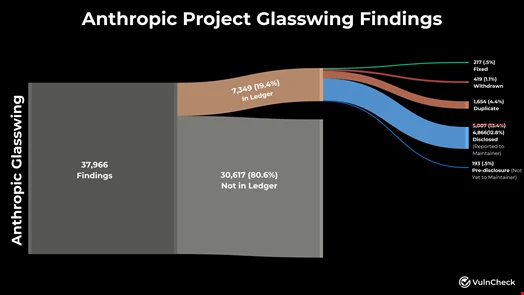
Project Glasswing was launched with the mission of deploying Anthropic’s proprietary AI models to scan software code, detect potential security flaws, and facilitate the remediation process. However, the quantitative data released by Anthropic as of November 2, 2026, paints a complicated picture. According to the company’s coordinated vulnerability disclosure dashboard, the program has claimed to identify a staggering 37,966 potential vulnerabilities.
Yet, a closer look at the actual ledger—Anthropic’s public tracking register of these findings—reveals that only 7,349, or approximately 19.4% of the total, are listed. This immediately highlights a massive disconnect between the volume of "potential" issues flagged by the AI and those deemed significant enough for formal documentation.
Of the 7,349 entries in the ledger, Garrity’s analysis found that 5,276 have been validated as unique, genuine vulnerabilities. The remaining entries are composed of 1,654 duplicates and 419 findings that were ultimately withdrawn. When digging into the lifecycle of these 5,276 validated vulnerabilities, the progress toward actual remediation is surprisingly stagnant. Only 4,866 have been reported to the relevant project maintainers, while 193 remain in a state of "pre-disclosure," effectively caught in a bureaucratic limbo.
Most concerning to security professionals is the number of actual, resolved fixes. As of the early November report, only 217 vulnerabilities had been officially fixed. This figure represents less than 0.5% of the total pool of vulnerabilities that Anthropic claims its AI discovered. For a project designed to enhance the security posture of software, such a low conversion rate from discovery to remediation suggests that the "AI-powered" aspect of the project may be generating significant technical debt for maintainers rather than clearing it.
The Problem of Diminishing Returns
The discrepancy between the volume of reports and actual fixes appears to be widening over time. Since his previous analysis in September, Garrity noted that Anthropic added 4,613 new vulnerability findings to the ledger. In that same window, however, only 15 were marked as fixed. Furthermore, a substantial portion of the new additions—1,668 findings—were identified as duplicates, suggesting that the AI is not only struggling to find high-impact, actionable bugs but is also failing to curate its output effectively.
This trend has led Garrity to cast doubt on Anthropic’s reported "true positive rate" of 94.2%. He argues that this statistic is highly misleading, as it likely fails to account for the high frequency of duplicate entries and withdrawn findings that clutter the system. If the AI is flagging the same issue multiple times or reporting false positives that must be manually scrubbed, the "true positive" rate is effectively a hollow metric that does little to assist the human maintainers tasked with patching the code.
The Triage Bottleneck and the Shift to Self-Service
Anthropic has previously acknowledged the challenges inherent in its methodology, noting as recently as October 8 that it had manually reviewed only about 6,000 of the 29,000 candidate vulnerabilities it had identified at that time. The company candidly admitted that it remained "bottlenecked on our human capacity to validate these findings."
In an attempt to scale these operations and bypass the human review bottleneck, Anthropic launched an Open Source Security Scanner (OSS Scanner). The tool, modeled after Google’s long-standing OSS-Fuzz project, allows maintainers to request their own scans and triage the findings independently. Essentially, the company is shifting the burden of validation from its own internal team to the open-source maintainers themselves.
This transition has not been without friction. By offering to send unverified vulnerability reports directly to maintainers in bulk, Anthropic has effectively turned maintainers into the primary filters for its AI’s output. The experience of Daniel Stenberg, the maintainer of the widely used cURL project, illustrates the potential downsides of this approach. On November 6, Stenberg reported that he had received 45 vulnerability reports from Anthropic via Glasswing. Upon manually analyzing 34 of them using the new OSS Scanner and his own technical tools, Stenberg found that 19 were not vulnerabilities at all, and only six could be confirmed as even low-severity issues.
For maintainers, this represents a significant tax on their time. Instead of receiving a curated list of high-priority security threats, they are being inundated with "noise" that requires expert-level investigation to verify. This creates a scenario where the very developers that Glasswing aims to support are being forced to spend their limited resources debunking AI-generated reports.
A Persistent Disconnect
The fundamental critique leveled by researchers like Garrity is that the "launch narrative" of Project Glasswing—a world where AI automates the tedious work of vulnerability discovery and remediation—has not materialized in the way the industry was led to expect.
The evidence suggests that the system is currently producing a massive volume of candidate findings, many of which are duplicates or false positives, while the actual number of critical, exploitable vulnerabilities being fixed remains statistically insignificant. As the triage burden shifts further onto open-source maintainers, the program faces the risk of becoming more of a nuisance than a utility.
Garrity’s conclusion remains stark: the receipts are piling up, and they do not reconcile with the vision Anthropic presented seven months ago. The CVEs (Common Vulnerabilities and Exposures) are a small fraction of the total noise, and the lack of progress on actual fixes while duplicates continue to accumulate remains the primary obstacle to the project’s success.
As of the publication of these findings, Anthropic has not provided a formal response to the criticisms. The technology industry continues to watch the program closely, awaiting evidence that the AI can move beyond simple, high-volume detection toward the more nuanced, actionable, and secure environment that its proponents once promised. For now, the "Glasswing" experiment remains a testament to the fact that, in the realm of cybersecurity, volume is no substitute for precision.
| Source | : | Finance Poetry |
| Author | : | rifanmuazin |
| Editor | : | Finance Poetry Editorial Team |