
Italy Tightens Security as Tens of Thousands of Students and Workers Join Nationwide Protests Over Living Costs and Middle East Wars
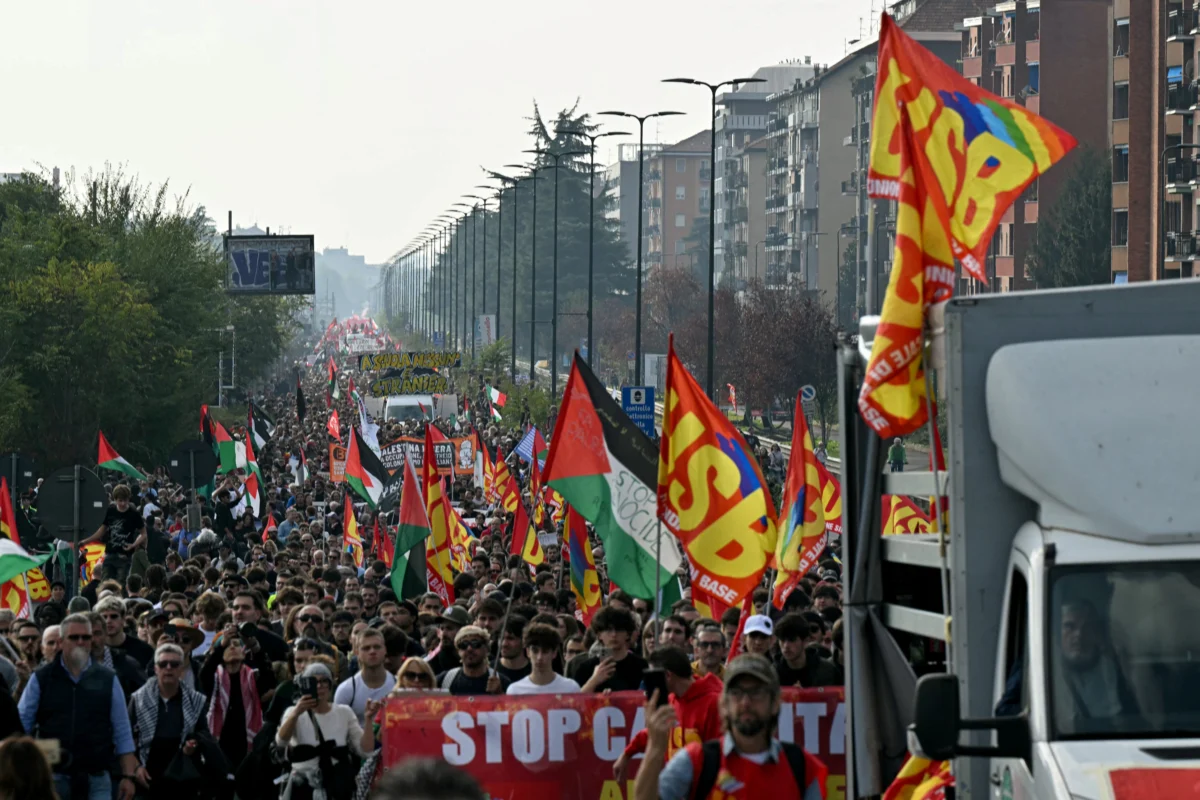
Italy has drastically tightened security measures nationwide as tens of thousands of
students, union members, and workers took to the streets on Friday. Marches and demonstrations were held in dozens of cities across the country, with major urban centers like Rome, Milan, and Naples bearing the brunt of the widespread disruptions. The coordinated protests targeted soaring living costs, demanded greater investment in the public education system, and called for an immediate halt to ongoing conflicts in the Middle East.
The demonstrations brought together a broad coalition of society, uniting students demanding educational reforms with trade unions representing laborers, agricultural workers, and transport personnel. A massive police presence was deployed across major cities, reflecting a hard-right government strategy to clamp down on potential unrest. In recent weeks, Italy, alongside several other European nations, has experienced heightened social tensions and demonstrations, prompting authorities to adopt a much stricter posture toward public gatherings and crowd control.
In the capital city of Rome, security was visibly stepped up around the Colosseum, Italy’s most visited tourist attraction and a global symbol of the nation’s cultural heritage. Similarly, Milan’s iconic cathedral received special protection from heavy police details stationed throughout the surrounding piazza. Despite the heavy security presence, tensions boiled over in several locations. A few sharp skirmishes erupted between protesters and riot police at the start of a demonstration in Turin, while other notable rallies took place in Bologna and Genoa, where demonstrators voiced fierce opposition to current economic and foreign policies.
The unrest follows a general strike called by the USB trade union, which successfully attracted large numbers of demonstrators, including truck drivers, taxi drivers, and farmers. These groups have grown increasingly vocal in recent weeks, organizing rallies to demand an end to punishingly high fuel prices and criticizing rising defense spending at a time when domestic households are struggling to make ends meet.
The grievances expressed by Italian workers also extended far beyond national borders. In a unified front, Italian unions issued a joint call alongside labor peers in France, Greece, Spain, Türkiye, and Morocco. This transnational coalition demanded an immediate end to the wars in the Middle East, specifically highlighting the devastating war in Gaza, and called for "an end to the militarisation of ports."
Emphasizing the moral and professional stance of transport workers, the joint union statement declared that ports must not be utilized for the transport of weapons, ammunition, military equipment, and troops. Dockworkers across the Mediterranean region have increasingly asserted that they will not facilitate military logistics, reinforcing the sentiment that dockworkers do not work for war.
The wave of domestic discontent comes as ordinary Italians grapple with severe inflationary pressures. According to economic data, the prices paid in Italy for essential goods and services—including food, energy, transport, and household utility bills—have risen by an astonishing 68 percent since the year 2000. Over the exact same multi-decade period, the average wage in the country has actually fallen by almost 5 percent, creating a profound squeeze on household budgets and deepening economic insecurity for working-class families.
In an effort to temper the growing anger, the Italian government last week agreed on a 175 million euro, equivalent to roughly $195 million, emergency aid package. This financial relief is specifically targeted at truck drivers, farmers, and fishermen who have been hit hardest by soaring fuel prices directly linked to the geopolitical fallout from the war in the Middle East.
Furthermore, political leaders are attempting to address long-term structural anxieties, particularly among the younger generation. Measures designed to support young people and struggling families have been formally inserted into the draft 2027 budget currently being debated and discussed among the various governing parties. Among these proposed provisions is an annual bonus of 2,500 euros targeted specifically at workers under the age of thirty.
Prime Minister Giorgia Meloni addressed the nation regarding these socioeconomic initiatives during a news conference, expressing hope that the budgetary measures would offer tangible relief. She stated that she hopes this can provide answers for young people in general who feel that the state does not care about them. At the same time, Meloni maintained a firm law-and-order stance, stressing during her remarks that the government’s support measures were not for those who smash windows.
The prime minister’s hardline rhetoric follows a weekend of intense civil unrest on October 17 and 18, during which clashes broke out between groups of mainly young people and police in Milan. Those weekend incidents involved groups looting shops and smashing windows, prompting severe political fallout. In response to the violence, Prime Minister Meloni’s administration rapidly moved to toughen laws governing public gatherings and simultaneously eased legal restrictions concerning the detention of minors involved in civil disturbances.
| Source | : | Finance Poetry |
| Author | : | rifanmuazin |
| Editor | : | Finance Poetry Editorial Team |