
**US Natural Gas Forward Prices Drift Lower Amid
Ample Supplies and Mild Weather**
United States natural gas forward prices are once again drifting lower across major market hubs following a brief and short-lived upward movement in recent weeks. The renewed downward pressure on the forward curve is primarily being driven by a combination of fundamentally weak market drivers, most notably ample domestic natural gas supplies and stubbornly mild weather conditions that continue to suppress seasonal heating and cooling demand throughout large portions of the country.
While meteorological conditions have remained largely benign, dampening residential and commercial gas consumption, there are a few notable regional exceptions. Pockets of weather-driven demand—particularly in the American South—along with robust activity surrounding liquefied natural gas (LNG) export facilities are offering some localized support, helping to lift specific segments of the forward curve even as the broader market struggles for upward momentum.
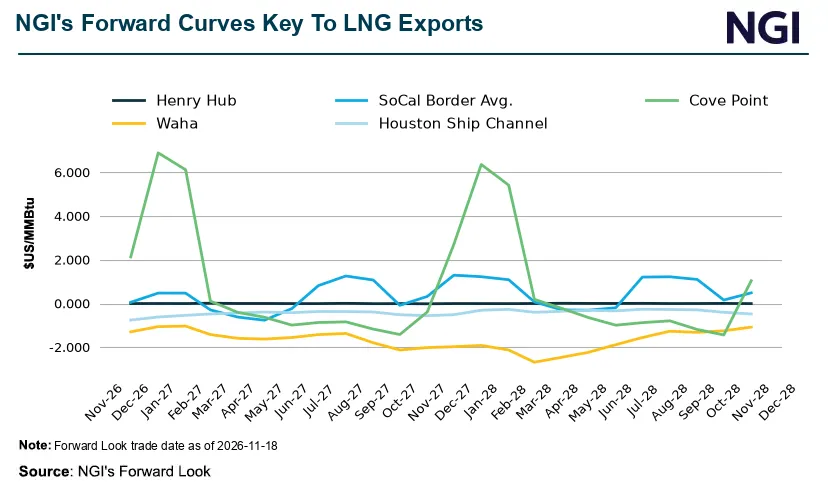
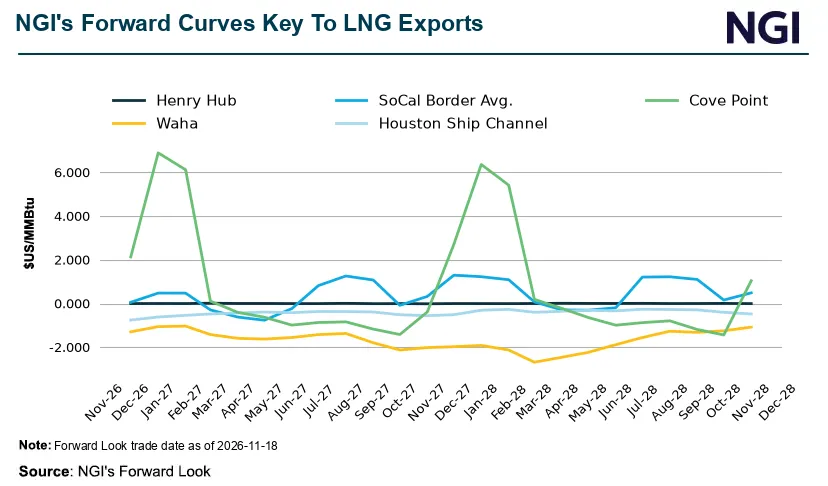
Market participants tracking the latest forward curves across key pricing points—including Henry Hub, Waha, SoCal Border, Houston Ship Channel, and Cove Point—are observing a market caught between regional bullish drivers and overwhelming national headwinds. The persistent overhang of inventory, combined with forecasts pointing to continued mild weather anomalies, has left traders questioning the sustainability of any near-term rallies.
At a Glance:
The broader macroeconomic and commodity market environment underscores the challenges facing natural gas producers and traders as the market navigates the shoulder seasons. With production remaining robust and storage inventories sitting comfortably relative to historical averages, the domestic supply-demand balance leans heavily toward oversupply. This fundamental imbalance has consistently capped rallies, turning brief bullish spikes into selling opportunities for market participants.
At the same time, the export sector continues to serve as a crucial pressure valve for the domestic market. Feedgas deliveries to US LNG export terminals remain strong, drawing heavily on supplies from nearby producing regions and providing vital support to Gulf Coast and South Texas pricing points. Facilities along the Houston Ship Channel and other regional hubs benefit immensely from this sustained international demand, creating a stark contrast between well-supported coastal markets and inland basins plagued by takeaway constraints and local oversupply, such as the Waha Hub in West Texas.
In the West, regional dynamics at locations like the SoCal Border continue to reflect localized weather patterns, pipeline maintenance schedules, and storage inventory management. However, even these traditionally volatile western markets have struggled to decouple entirely from the broader national narrative of adequate supply and lackluster weather-driven demand.
As the market looks ahead through the medium and long-term forward curves extending toward 2028, traders and analysts are weighing the long-term growth of US export capacity against domestic production efficiencies. While upcoming LNG export projects promise to structurally increase demand for domestic natural gas over the coming years, the immediate horizon remains dominated by near-term weather forecasts and inventory overhangs.
For now, the overarching sentiment in the natural gas forward market remains cautious. Unless a significant shift occurs in weather patterns—such as a sustained unseasonal cold snap or an early-arriving, intense summer heatwave—prices are expected to remain under pressure, reflecting a well-supplied market where regional LNG demand serves as one of the few reliable pillars holding up the curve.
| Source | : | Finance Poetry |
| Author | : | rifanmuazin |
| Editor | : | Finance Poetry Editorial Team |