
Bitcoin Enters Rare Period of Consolidation Near $81,500 as Broader Markets Stabilize Amid Macroeconomic Headwinds
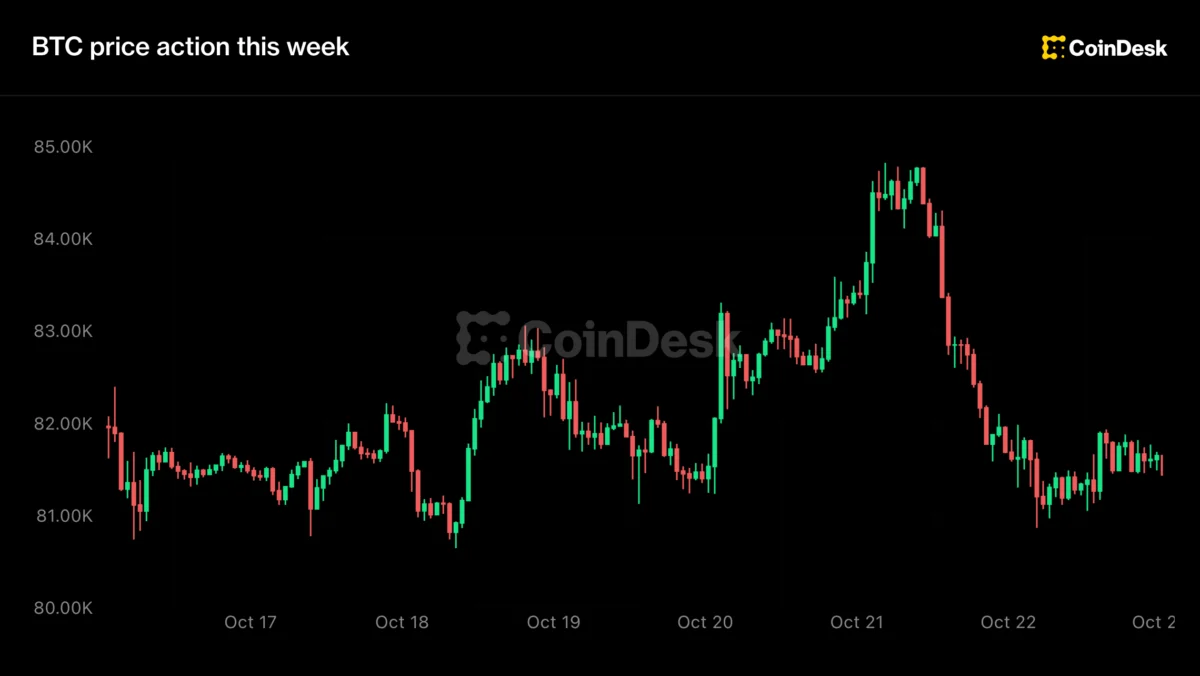
Bitcoin has entered a period of unusual calm following a volatile week of heavy trading, dipping to approximately $81,000 late Thursday before spending the subsequent session tightly boxed in a narrow range of less than $1,000. As of early Friday, the world’s leading cryptocurrency was trading steadily near the $81,500 threshold, representing a stark contrast to the aggressive $3,000 price swings that characterized the asset throughout much of the week.
This relative stability marks the quietest stretch Bitcoin has experienced in days, providing market participants with a brief respite from rapid directional shifts. Despite the newfound calm, the broader technical picture reflects lingering overhead pressure. Bitcoin is down roughly 0.4% over a 24-hour window, continuing to languish below the critical $82,500 level that served as a firm support line until it was decisively lost during Thursday’s trading session. Analysts and market observers are closely monitoring whether this tight consolidation phase will act as a base for a recovery or a precursor to further downside movement as the weekend approaches.
The broader digital asset landscape presented a mixed picture on Friday, with major altcoins moving in divergent directions rather than following a unified market trend. Binance Coin (BNB) emerged as one of the session’s primary outperformers, registering a notable gain of nearly 2% to trade at approximately $745. Meanwhile, Dogecoin (DOGE) managed a modest upward move, adding about 1% to its valuation.
However, the momentum was not shared across the entire alternative coin ecosystem. Privacy-focused cryptocurrency Monero (XMR) gave back a significant portion of the sharp gains it recorded on Thursday, tumbling 7% to hover near $607. Zcash (ZEC) similarly faced downward pressure, losing nearly 4% of its value to trade at approximately $1,200. Other prominent digital assets, including HYPE, XRP, Ethereum (ETH), and Solana (SOL), experienced minor retracements, slipping by about 1% or less. According to CoinDesk data, Ethereum traded just underneath the $2,400 mark as the second-largest cryptocurrency struggled to reclaim higher ground alongside Bitcoin.
Traditional financial markets displayed similar signs of stabilization as equities sought to find their footing following a turbulent previous session. Nasdaq 100 futures showed little change in early trading, holding relatively steady in the aftermath of what marked the index’s worst single-day performance since June. Exchange-traded funds tracking semiconductor and chipmaking companies also edged modestly higher in pre-market activity, offering a modest buffer of confidence to technology investors.
Individual corporate equities experienced mixed fortunes. Meta Platforms continued to face downward momentum, extending its recent losses. In contrast, private aerospace manufacturer SpaceX climbed higher following reports detailing the company’s strategic ambitions to expand into the telecommunications sector by becoming a wireless carrier.
Despite the tentative stabilization in equities and the quiet consolidation in crypto, macroeconomic anxieties persist, driven primarily by developments in the energy sector. Oil prices emerged as a significant source of worry for global financial markets, with Brent crude touching its highest price level since early May. The upward trajectory in crude oil prices introduces fresh complications into the macroeconomic inflation outlook, a factor carrying heightened relevance as central bankers prepare for the upcoming Federal Reserve policy meeting scheduled for October 27 through October 28.
The renewed focus on inflation and energy costs reverberated through the fixed-income market as well. United States Treasuries gave back a portion of the substantial safe-haven gains they accumulated on Thursday. That previous rally had driven the benchmark 10-year Treasury yield down by the largest margin seen in more than a year, reflecting a sharp, temporary flight to safety among institutional investors. Meanwhile, traditional safe-haven assets such as gold and the U.S. dollar remained relatively flat, showing little directional conviction as traders weigh competing signals from commodity markets, monetary policy expectations, and shifting risk sentiment across global exchanges.
| Source | : | Finance Poetry |
| Author | : | rifanmuazin |
| Editor | : | Finance Poetry Editorial Team |