
Elon Musk Proposes Moving AI Data Centers to Space to Circumvent Earthly Power and Environmental Constraints
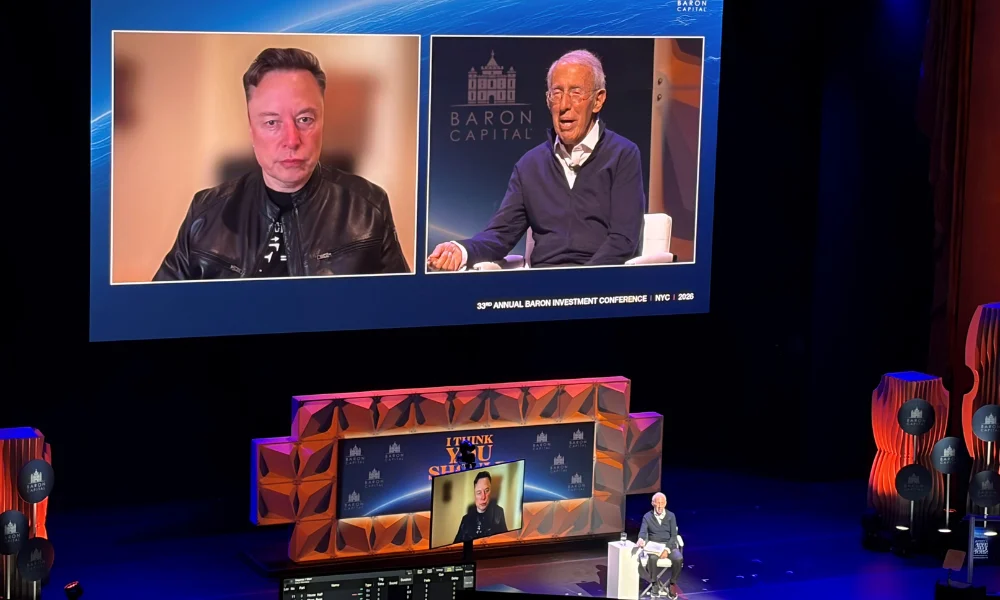
During a wide-ranging discussion at the annual Baron Investment Conference in New York City this past Friday, SpaceX CEO Elon Musk offered a provocative vision for the future of artificial intelligence infrastructure. Speaking via videolink from the Metropolitan Opera House, Musk addressed the mounting friction surrounding the terrestrial expansion of AI data centers, suggesting that the ultimate solution to the industry’s energy and public relations woes may lie not on Earth, but in orbit.
The backdrop for Musk’s comments is a period of intense scrutiny for the tech industry. As the AI revolution continues to accelerate, the demand for massive, power-hungry data centers has surged. However, these facilities have increasingly become lightning rods for criticism. Local communities and environmental advocates have frequently clashed with tech giants over the massive electricity consumption and the physical footprint required to support the next generation of large language models and neural networks.
"The pitchfork level for data centers is pretty high," Musk quipped during his hour-long "fireside chat" with Baron Capital CEO Ron Baron. The remark underscored a growing reality: as the demand for compute power grows, the social and logistical resistance on the ground is reaching a breaking point. With power grids already strained and environmental impact reports becoming a significant hurdle for new developments, the search for alternatives has intensified.
When prompted by Ron Baron about the viability of placing data centers in space, Musk expressed significant optimism, pointing to successful preliminary tests already underway. He noted that SpaceX has already successfully deployed hardware to orbit to prove the concept. "There’s a satellite with an NVIDIA GPU up there that we launched, and there’s a satellite we recently launched with a Google TPU," Musk explained. "And these are operating to the best of my knowledge—they’re working fine in space."
These early experiments are part of a broader industry interest in orbital computing. Google’s Project Suncatcher, for instance, is a dedicated research initiative focused on the feasibility of scalable machine learning infrastructure beyond the atmosphere. Musk’s own company is taking this concept a step further with its "Starmind" project. The ambitious initiative aims to capture solar energy in space and distribute compute power back to Earth through a specialized satellite constellation.
Musk provided a rough timeline for the rollout of this technology, signaling that while the effort will begin modestly, it is designed for rapid scaling. "We expect to start launching the first Starmind computers, which we’ve co-designed with NVIDIA, probably—I’m just guessing here—but in the 3rd quarter of next year," he said. "And we’ll start off slow, but then it will ramp to significant volume probably in ’28, and then very, very large volume in ’29."
The economic and physical rationale behind the move is rooted in the inherent limitations of Earth-based energy production. According to Musk, the sheer scale of energy required to sustain the future of AI—which he estimates could reach the terawatt or at least the 200-gigawatt per year scale—is physically impossible to manage on the ground without triggering systemic energy shortages.
"In order to get to the terawatt per year scale or even, let’s say, maybe the 200 gigawatt per year scale, you really need to go into space because there just isn’t enough power on the ground to realistically get to those levels per year," Musk argued.
The advantages of space-based solar harvesting, Musk noted, are fundamentally superior to terrestrial solar arrays. In space, solar panels can maintain an optimal, direct orientation toward the sun at all times, unhindered by the rotation of the Earth or weather patterns. Furthermore, the lack of an atmosphere provides a significant boost in efficiency. "You don’t have atmospheric attenuation of solar power, so you get 30% more solar power in space," he noted. This constant, uninterrupted energy flow also simplifies the engineering requirements for storage. "You can get away with a very tiny battery pack because you don’t need to last through the night."
Central to this grand design is the Starship mega-rocket, which SpaceX views as the essential vehicle for enabling a new orbital economy. The economics of space infrastructure are entirely dependent on the cost of launch, a metric that Musk believes will be revolutionized by Starship’s full reusability. By drastically reducing the cost of heavy-lift transport to orbit, SpaceX aims to make the deployment of complex data center hardware economically competitive with ground-based construction.
"The cost of intelligence in space is dramatically less than the ground once you have a low cost per ascent to orbit," Musk explained. "So Starship, because it will be the first fully reusable rocket, will lower the cost of access to space, by a factor of 100, or maybe more."
The reliance on Starship brings the company to a critical juncture. SpaceX is currently preparing for its next major milestone, the Starship 15 mission, which is reportedly targeted for November 13. This mission is highly anticipated in the aerospace community as it marks the first attempt to catch the massive rocket booster using the launch tower’s mechanical "chopstick" arms, a technique intended to facilitate rapid turnaround and reuse.
The appearance at the Baron Investment Conference served as a platform for Musk to outline a future where orbital infrastructure solves terrestrial bottlenecks. However, it was also a week of significant corporate maneuvering for his other interests. Reports emerged earlier in the week that Tesla plans to phase out production of the Cybertruck at its Gigafactory in Texas by mid-2027. This decision is reportedly aimed at reallocating manufacturing capacity to support an increase in the production of the company’s dedicated "Cybercab," a shift that highlights Musk’s broader focus on autonomous transport and AI-driven technology.
Despite the news surrounding his automotive business and the shifting political landscape, the discussion with Ron Baron remained largely focused on the long-term technological trajectory of SpaceX and the AI sector. By pivoting the conversation toward the final frontier, Musk signaled that for the most ambitious players in the technology industry, the solution to Earth’s growing pains may ultimately be to leave the planet behind. Whether the technical challenges of cooling, data latency, and hardware maintenance in the harsh vacuum of space can be solved as efficiently as Musk suggests remains a question for the coming years, but the vision for a space-based compute network is clearly moving from the theoretical to the experimental phase.
| Source | : | Finance Poetry |
| Author | : | rifanmuazin |
| Editor | : | Finance Poetry Editorial Team |