
Morgan Stanley Sets Sights on Tokenisation and Private Markets with Acquisition of Vinyl Equity
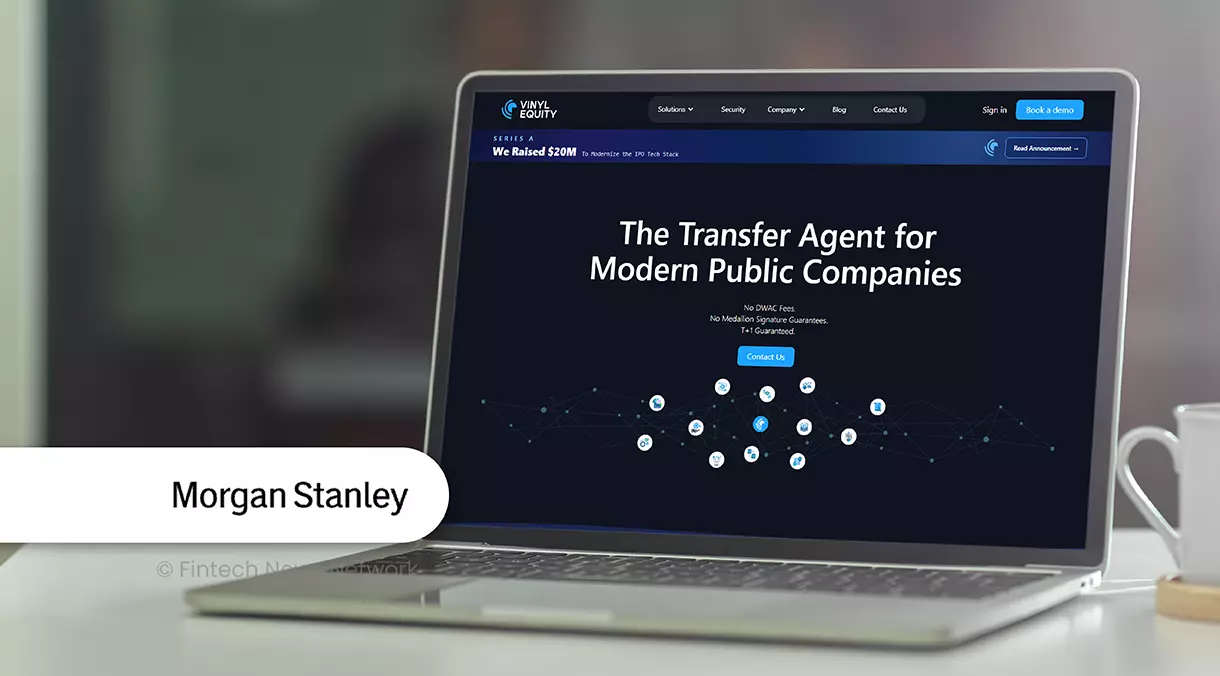
Wall Street banking giant Morgan Stanley has reached an agreement to acquire Vinyl Equity, a digital transfer agent registered with the US Securities and Exchange Commission (SEC). While the financial terms of the transaction were not officially disclosed by either party, the strategic acquisition represents a major step forward for the bank’s long-term technology and infrastructure roadmap, particularly within the realm of digital assets, blockchain integration, and private market wealth management.
A traditional transfer agent plays a foundational role in corporate finance by maintaining the official, legally binding registry of a company’s shareholders and managing the complex transfers of shares between them. Once the deal officially closes, Vinyl Equity will be integrated directly into Morgan Stanley at Work, the banking institution’s robust equity compensation and workplace financial services unit.
Through this integration, corporate clients will gain the unique capability to seamlessly manage their capitalization tables, corporate share plans, share transfers, and comprehensive wealth services within a single, unified ecosystem. This streamlined approach is designed to alleviate administrative burdens for issuers while bridging the gap between corporate equity management and institutional wealth management.

Founded in 2022, Vinyl Equity was built to disrupt and modernize an industry that has historically relied heavily on manual processes, legacy systems, and cumbersome paperwork. By leveraging advanced digital workflows and real-time reporting capabilities, the firm has sought to transform how corporate ownership records are maintained and managed. The startup works closely with a diverse ecosystem of corporate issuers, legal professionals, and financial institutions, specializing in navigating high-stakes, highly complex corporate milestones, most notably initial public offerings (IPOs).
For Morgan Stanley, the acquisition is much more than a routine addition to its existing workplace services division. The bank has explicitly stated that the buyout will lay the essential technological groundwork for its broader, forward-looking tokenisation plans. Tokenisation refers to the process of recording the ownership of traditional assets, such as corporate shares, as digital tokens on a distributed ledger or blockchain network.
According to leadership at Morgan Stanley, emerging technologies such as blockchain, tokenisation, and atomic settlement are fundamentally reshaping the financial services industry. Atomic settlement, in particular, represents a paradigm shift from traditional settlement cycles by ensuring that both legs of a trade—the delivery of the asset and the receipt of payment—occur simultaneously at the exact same moment, thereby virtually eliminating counterparty and settlement risks.
The strategic rationale behind the acquisition is heavily influenced by broader structural shifts within the global economy, where companies are choosing to remain privately held for significantly longer periods than in previous decades. This trend has fundamentally altered where wealth is generated and captured.

“Private markets are playing an increasingly important role in wealth management as companies stay private for longer and value is created outside the public markets,” noted Jed Finn, Head of Wealth Management at Morgan Stanley, highlighting the growing necessity for sophisticated digital infrastructure to support private enterprises and their stakeholders.
Rob Schoder, Co-Founder and Chief Executive Officer at Vinyl Equity, echoed this sentiment, emphasizing the original mission that inspired the creation of the startup just a few years ago.
“We started Vinyl with the belief that the infrastructure supporting corporate ownership needed to change,” Schoder said, reflecting on the company’s journey from an agile fintech upstart to a key component of one of the world’s leading financial institutions.
Following the completion of the transaction, Vinyl Equity will not operate in isolation within the banking giant’s sprawling organizational structure. Instead, it will sit alongside Morgan Stanley’s existing Private Markets Transaction Desk and its proprietary private share marketplace, EquityZen. These specialized units already play a vital role in supporting late-stage private companies as they prepare to transition into the public markets or navigate liquidity events for founders, early investors, and employees. By combining Vinyl’s digital transfer agent capabilities with EquityZen and the Private Markets Transaction Desk, Morgan Stanley aims to create an end-to-end digital lifecycle solution for private enterprises from their early funding rounds all the way through to public listing and beyond.

The acquisition agreement is subject to customary closing conditions and regulatory approvals. Stakeholders and market observers anticipate that the transaction will officially close in the first quarter of 2027, setting the stage for Morgan Stanley to accelerate its digital asset strategy and further cement its competitive advantage in the rapidly evolving private equity and wealth management landscapes.
| Source | : | Finance Poetry |
| Author | : | rifanmuazin |
| Editor | : | Finance Poetry Editorial Team |