
Fintech Marketing Leaders Pivot to AI-Powered Search as Consumer Behavior Shifts
As consumers increasingly rely on artificial intelligence chatbots to discover, evaluate, and choose financial brands, fintech marketing leaders are recognizing an urgent operational shift. According to a comprehensive new report by the Fletcher Group—a US-based public relations, branding, and content marketing agency—fintech brands must now engineer digital content that can be effortlessly found, understood, summarized, and cited by AI-powered search tools and large language models (LLMs).
The report, which draws on a survey of marketing and public relations leaders across the fintech, payments, and banking sectors, highlights an escalating competitive race for AI discoverability and brand visibility. Among the fintech chief marketing officers (CMOs) surveyed by the Fletcher Group, an overwhelming 69% reported that they are actively investing in answer engine optimization (AEO) and generative engine optimization (GEO).
These specialized digital strategies mark a fundamental departure from legacy visibility frameworks. AEO involves structuring digital content so that search engines and conversational AI assistants can quickly extract precise details and display them as direct, short answers to specific consumer queries. Meanwhile, GEO focuses on optimizing a brand’s core messaging, statistical data, institutional definitions, and authority markers so that LLMs and generative search systems routinely reference, synthesize, and cite the brand within longer, multi-paragraph conversational responses.
Together, AEO and GEO represent the vanguard of modern digital marketing and search paradigms, effectively adapting traditional search engine optimization (SEO) techniques for the era of AI-driven answer engines.

AI Search Tools on the Rise
The momentum behind these advanced optimization techniques is underpinned by a widespread industry consensus. Every single respondent polled by the Fletcher Group indicated explicit plans to increase their investments in GEO moving toward 2027, reflecting a broader market forecast that the reliance on AI-driven search tools will continue to accelerate exponentially.
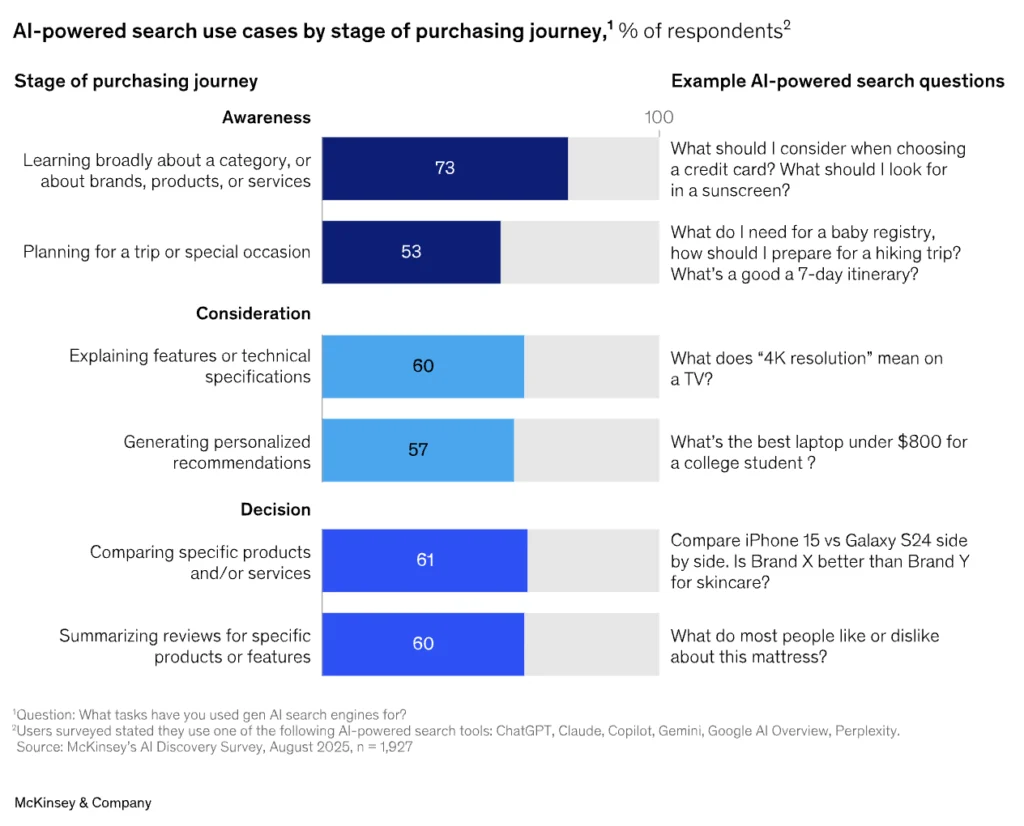
This projection is heavily reinforced by data from McKinsey’s AI Discovery Survey. Conducted in August 2025 with nearly 2,000 respondents, the McKinsey study revealed that 50% of consumers now regularly use AI-powered search. Furthermore, a majority of those users identified conversational AI as their primary digital resource for making critical purchasing decisions.
Looking ahead, McKinsey anticipates that by 2028, approximately US$750 billion in US revenue will flow through transactions influenced or driven by AI-powered search. The firm further estimates that between 20% and 50% of traditional web traffic could be at risk as AI platforms capture consumer intent and decision-making much earlier in the engagement journey. This structural evolution illustrates how everyday consumer queries are rapidly migrating away from traditional search engines toward conversational AI platforms, compelling brands and marketers to fundamentally rethink their visibility and acquisition strategies.
The McKinsey research demonstrated that while 73% of AI-powered search users leverage the technology at the top of the funnel to learn about a broad category, brand, product, or service, the utility of conversational AI extends deeply across the entire consumer decision journey. Specifically, the data showed that 61% of users utilize the technology to compare specific products or services against one another, 60% rely on AI to summarize user reviews for specific products or features, and another 60% use it to explain complex technical features or product specifications.

AI Becomes Ubiquitous in Marketing Operations
Within modern marketing departments, the influence of artificial intelligence has expanded far beyond external digital content and search strategies, weaving itself directly into everyday operational workflows. Among the CMOs surveyed by the Fletcher Group, AI has achieved widespread mainstream adoption.
Every single interviewed CMO reported utilizing AI tools for core research and data analysis tasks. Additionally, 94% apply artificial intelligence to content creation and search optimization initiatives, while 88% have successfully transitioned from ad-hoc, experimental use to highly structured workflows embedded into their daily operational routines.
The survey findings also highlight a dramatic maturation in AI adoption maturity levels since 2024. Two years prior, the vast majority of CMOs were merely testing artificial intelligence for basic content brainstorming sessions without any formal processes or governance. By contrast, the 2026 data shows that only 13% of organizations remained in this early, experimental stage of adoption without formal methods. Meanwhile, 13% of respondents had reached an advanced stage of maturity, with the technology deeply embedded across the vast majority of operations, and 19% had entered the scaling stage by formally integrating AI into their most critical organizational workflows.
The Shift Toward AI-First Marketing Capabilities
Complementing these findings, a separate 2026 report published by McKinsey outlines five distinct AI capabilities that will ultimately separate leading firms practicing AI-first marketing from their competitors.

Continuous insights represent the foundational pillar of this transformation. This capability empowers organizations to convert live signals harvested from customers, broader markets, and various digital channels directly into actionable business decisions. By doing so, marketing teams can build a deeper understanding of market dynamics, anticipate emerging consumer needs, test innovative ideas, and actively steer the customer experience in real-time.
Scaled creativity is identified as another essential capability. It enables marketing teams to produce large volumes of highly tailored content for distinct consumer segments while rigorously maintaining a consistent brand voice. In particular, autonomous AI agents can be deployed to continuously monitor LLMs, search engine environments, and social ecosystems. These agents identify emerging trends and shifts in consumer intent, subsequently generating, testing, and optimizing relevant content tailored for both human audiences and AI algorithms.
According to McKinsey, organizations effectively leveraging these capabilities are already witnessing two- to fivefold increases in creative productivity, alongside cost reductions ranging from 10% to 30% in creative operations, illustrating the powerful dual impact of AI on efficiency and effectiveness.
AI-driven hyperpersonalization forms another critical dimension of future-proof marketing strategies. Rooted in continuous learning and adaptation, this capability delivers deeply tailored experiences to individual consumers in real-time across multiple touchpoints. McKinsey notes that successful hyperpersonalization can elevate customer satisfaction by 15% to 20%, drive revenue gains of 5% to 8%, and lower the cost of customer service by up to 30%.

Directly addressing the changing search landscape, marketing to AI agents has emerged as a major operational focus. This refers to a brand’s capacity to deliberately influence how complex AI systems interpret, evaluate, and recommend a specific product or service. Because agentic customer experiences are conversational, adaptive, and continuously learning, they signal a broader systemic transition away from a traditional attention economy and toward a trust economy.
Finally, always-on orchestration replaces rigid, campaign-driven cycles with continuously managed and optimized marketing operations executed by collaborative human-agent teams. When configured correctly, always-on orchestration can improve a marketing department’s return on investment by roughly 30%. Furthermore, it can dramatically reduce the proportion of time marketers spend on manual execution tasks—slashing it from between 60% and 70% down to just 10% to 15%—thereby freeing professionals to focus their energy on higher-value strategic initiatives.
| Source | : | Finance Poetry |
| Author | : | rifanmuazin |
| Editor | : | Finance Poetry Editorial Team |