
U.S. Household Incomes Edge Higher, But Surging Mortgage Rates Keep Homeownership Out of Reach
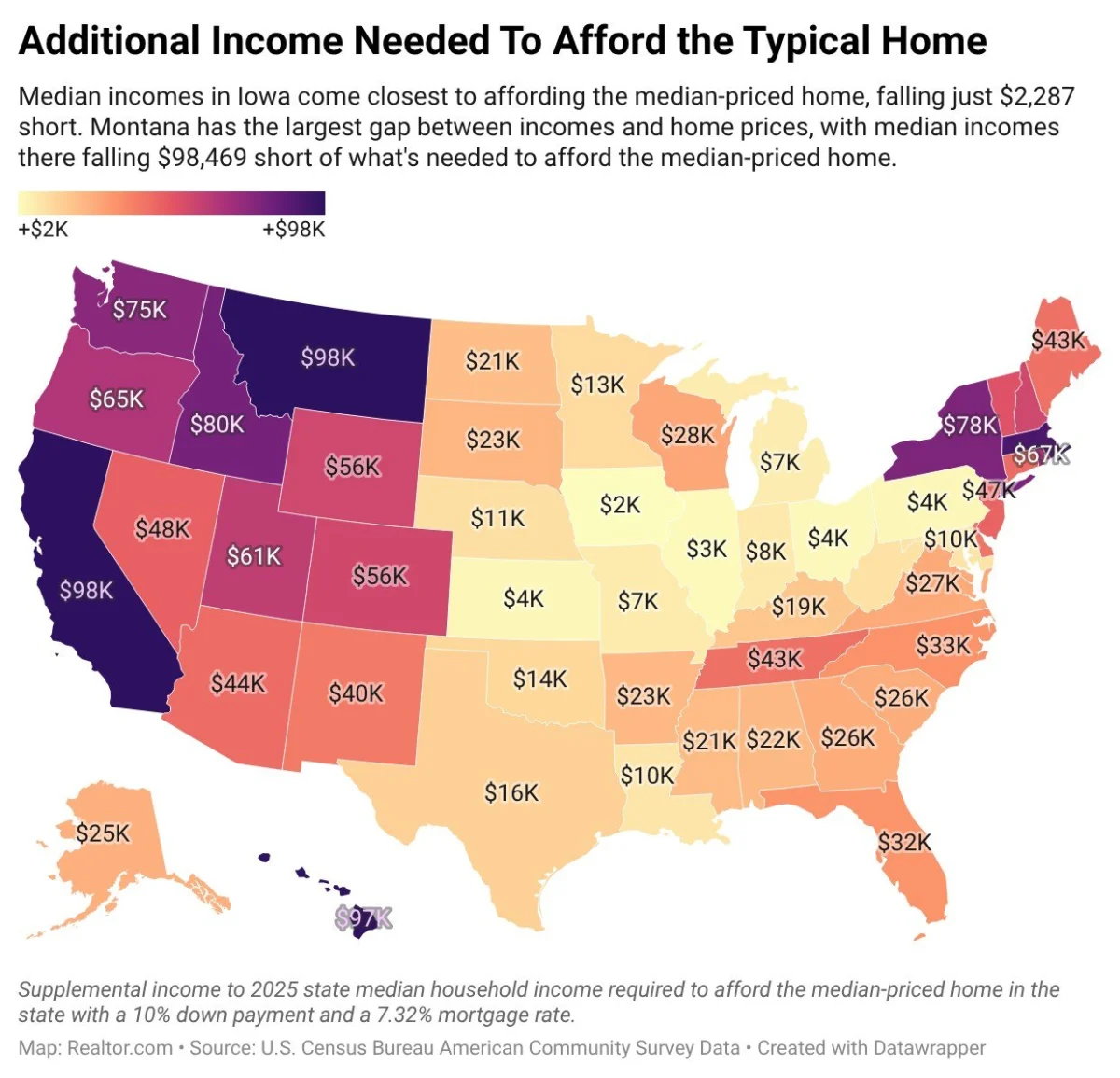
American household incomes inched higher over the past year, but the modest financial gains proved entirely insufficient to close a widening affordability gap driven by stubbornly high mortgage rates and elevated home prices. Newly released data from the U.S. Census Bureau highlights a persistent national dilemma: even as wages increase on paper, the dream of homeownership remains financially out of reach for median-income earners in every single state across the country.
According to the latest American Community Survey data released by the bureau, the national median household income reached $84,780, representing an increase of roughly 3.8% compared to the previous year. On a nominal basis, household earnings rose across every state in the nation with the sole exception of Alaska, which experienced a slight dip of 0.47%. Leading the nation in nominal income growth were Rhode Island, where earnings surged by 9%, Virginia with a 7.9% increase, and Wyoming at 7.1%. However, once adjusted for inflation, the picture becomes considerably less optimistic, with only 37 states managing to secure real, positive income growth.
Yet, even in the top-performing regions, inflation-adjusted income growth fell short of bridging the chasm created by a punishing combination of high mortgage rates and elevated home prices. The latest data indicates that the typical U.S. household earned approximately 27%, or $31,136, less than the minimum income recommended to comfortably purchase a home at the national median listing price of $419,250, based on housing and income data analyses. By comparison, the median U.S. household income the previous year was about 24% below the level required to buy a home, underscoring a steady and concerning deterioration in overall housing affordability.
A Deepening Deficit
The financial models utilized to evaluate these market conditions assume a prevailing mortgage rate of 7.32%, a standard 10% down payment, and 1.7% in combined annual property taxes and insurance. Furthermore, these findings rely heavily on the foundational "30% rule," a widely accepted financial benchmark dictating that prospective homebuyers should spend no more than 30% of their gross monthly income on total housing costs.
When applying this same methodology to localized state-level housing and income data, the results reveal a stark reality: there is currently no place in the United States where a median-income earner can purchase the median-priced home without becoming severely cost-burdened.
"States have moved further from affordability on average, driven by higher mortgage rates," explains Realtor.com senior economist Hannah Jones. She notes that the average interest rate on 30-year fixed home loans increased by more than a full percentage point compared to the prior year. This jump directly cuts into prospective buyer budgets, successfully offsetting any affordability gains that might have otherwise resulted from softening home prices and rising household incomes.
"In September, home prices fell year over year in 40 of the 50 states and nationally," Jones adds. "Incomes also rose slightly on average between 2024 and 2025, so higher mortgage rates account for the deterioration in affordability in almost every case."
Across the 50 states and the District of Columbia, the minimum required income to comfortably afford a median-priced home exceeds actual state-level earnings by anywhere from a manageable 2.9% to a staggering 56.1%. This means that while the broader issue of housing unaffordability is truly nationwide, the sheer severity of the financial shortfall varies dramatically depending on the local market.
Midwest Remains Attainable
Despite the pervasive nationwide challenges, the overarching regional affordability map remains largely unchanged, with the Midwest firmly maintaining its long-held status as the most budget-friendly region for prospective property buyers.
For the second consecutive year, Iowa secured its position as the nation’s most affordable state for buyers. During the evaluated period, the typical Iowa household earned $78,483, falling just $2,287—or a mere 2.9%—shy of the minimum income required to purchase the state’s median-priced home of $284,900.
"We have a strong job market, which I think is the biggest factor," says Chuck Simmons, a broker and mortgage originator at Motto Mortgage in Des Moines, Iowa. "Iowa has always been strong in the insurance and healthcare sectors, but the rise of data centers has brought a lot of additional good-paying job opportunities."
Simmons also attributes Iowa’s relative economic and housing stability to the steady nature of its property appreciation. "This past year saw around 3% in appreciation, which is on the lower end compared to many other states. But it has led to a steady growth without any noticeable bubbles or risk of widespread depreciation," he notes. "These factors, combined with a strong state housing program for first-time homebuyers, has created an environment where owning outweighs renting in most situations."
Iowa’s stellar performance is further highlighted by its recognition in the broader regional evaluations, where it earned an elite A grade and finished second nationwide, trailing only Indiana, on the strength of its overall housing affordability.
Even so, Simmons cautions that high closing costs, escalating insurance premiums, and rising property taxes continue to erode the purchasing power of everyday buyers. Echoing the warnings issued by economic analysts, he stresses the critical need for lower borrowing costs to truly shift the market dynamics.
"A 1% drop in rates on a $300,000 loan would lower a payment by around $200 a month on a 30-year loan," Simmons points out. "Or, for the same payment, a 1% drop in rates would increase a buyer’s purchasing power by around 10%. That kind of savings would definitely make a huge difference in affordability."
Beyond Iowa, several other Midwestern and Rust Belt states posted similarly narrow income deficits. Jurisdictions such as Illinois, Pennsylvania, Ohio, and Kansas reported shortfalls ranging tightly between 3.5% and 4.9%.
"Home prices in these states are well-aligned with local incomes," Jones observes. "Growing demand has pushed prices up and eroded some of that advantage, but they still perform best in today’s challenging market."
The West and Coastal States Feel the Pain
On the opposite end of the national spectrum, high-priced coastal and Western states face the most severe homebuying conditions in the country, with Montana ranking dead last in overall affordability.
In the Big Sky State, the typical household brings in an annual income of $77,099. However, this earning power falls nearly 56%—or roughly $99,000—below the income threshold necessary to successfully finance a median-priced home valued at $635,000.
Chase Heiland, a real estate broker with Keller Williams Montana Realty, argues that this massive gap between local wages and home prices is driven by a persistent combination of sustained buyer demand and tightly restricted housing inventory. "Prices only run that far ahead of local wages when more people want in than there are homes available," Heiland explains.
On the supply side, Heiland notes that existing Montana homeowners are currently sitting on significant amounts of accumulated equity and are therefore rarely forced to sell their properties out of desperation or foreclosure. Homeowners who genuinely wish to sell but find themselves unable to secure their desired price frequently choose to pull their properties from the sales market and rent them out instead.
Another primary factor keeping inventory severely constrained in Montana is the exceptionally high cost associated with new construction. "Most of the materials have to be shipped in from out of state, Montana is short on construction workers in every region, and winter leaves builders only part of the year to work outside," Heiland says. "So new homes cost a lot more to put up here than most people expect, especially when you combine that with impact fees most cities and counties impose."
Reflecting these profound market imbalances, Montana earned a failing D grade in official evaluations, held back by prices and building costs that vastly outpace what average local buyers can reasonably afford. This affordability crunch has forced countless median-wage earners in the state to remain in the rental market indefinitely or move outward to more distant commuter towns.
"I see the same thing in the Bozeman area, where people are heading out to Belgrade, Manhattan, and Three Forks for more house," Heiland observes.
At the same time, the veteran real estate agent notes that he is observing several encouraging psychological shifts within the local market that provide grounds for optimism. "I’ve worked with more local first-time buyers and move-up buyers than I have in years," he notes. "Wages have come up, there’s more room to negotiate than there was a few years ago, and the people I’m working with are more ready to make decisions than I’ve seen before."
He attributes this behavioral change primarily to buyers gradually accepting the reality of the higher mortgage rate environment. "A lot of buyers were holding out for interest rates to come down dramatically, and since that hasn’t happened, more people are planning around today’s interest rates," Heiland explains. "Life keeps moving forward for everyone, and they still want to make decisions about where they live and put down roots here."
Over the long term, Heiland contends that for Montana’s housing market to become meaningfully more attainable, a series of structural and policy reforms will be necessary, though they inevitably carry their own local complications. "Impact fees, permitting, and the regulations a builder has to work through all end up in the price of new-construction homes, so easing those where it’s reasonable would help supply," he notes. "That’s a bit of a catch-22, though, because more development changes how these towns feel, and a big part of why people choose Montana is that they don’t want suburban density."
Additionally, municipal and county governments must invest in long-term solutions, such as permanent affordability trusts and income-restricted rental developments, to ensure that housing remains perpetually attainable for low- and middle-income families. "When cities set affordability targets, they usually use 60% or 80% of area median income, and for a lot of working households, that still isn’t a realistic or attainable number," Heiland points out.
Montana is far from alone in experiencing these extreme structural pressures. Prospective buyers in California must contend with a punishing 49% gap between earned household income and the minimum income required to purchase a home. They are followed closely by Idaho at 48.6%, Hawaii at 48.2%, and New York at 46.7%.
"High demand and limited new construction keep inventory scarce and affordability strained in these states," Jones concludes. Reflecting these intense regional pressures, New York, Hawaii, and California earned failing grades in the broader state report card evaluations.
| Source | : | Finance Poetry |
| Author | : | rifanmuazin |
| Editor | : | Finance Poetry Editorial Team |