
Gulf Tensions Spike as US and Iran Trade Air Strikes and Maritime Attacks Intensify
Tensions across the Persian Gulf reached a dangerous new threshold this week as the United States and Iran traded retaliatory military blows, prompting neighboring nations to activate air defense systems and casting a shadow over vital global shipping lanes.
The escalating hostilities, occurring as a lasting peace deal remains frustratingly elusive, drew in multiple regional actors on Tuesday. Kuwait’s armed forces officially announced that the Gulf country was under attack by drones, reporting via social media that residents could hear explosions echoing across the sky as air defense systems successfully intercepted incoming hostile targets. The military statement urged the public to remain calm and strictly follow safety instructions, though authorities did not immediately specify the exact origin of the drones, nor did they report any definitive casualties or structural damage on the ground.
The latest wave of direct violence follows a rapid succession of escalations initiated by an Iranian drone strike targeting a critical US radar system in Bahrain. According to the United States Central Command, Iranian drones were launched directly at a radar installation positioned at an air base in Bahrain. US military officials confirmed that the incoming projectiles were intercepted before they could impact, resulting in zero damage to US equipment and no injuries among American personnel.
Bahrain Attack and Regional Fallout
Iran’s Islamic Revolutionary Guard Corps quickly claimed responsibility for the operation, describing it as a "precision operation" utilizing advanced drones. Tehran asserted that the strike was carried out in direct retaliation for what it termed "repeated violations of Iranian airspace by US military drones."
The incident marks the third Iranian drone attack on Bahrain within a span of just five days, breaking what had been a relative lull of several weeks. Prior to this recent cluster of strikes, analysts noted that Friday’s attack had represented the first direct Iranian assault on a Gulf country since early September. According to media reports, the timing of these renewed attacks also closely coincided with a controversial domestic ruling in Bahrain, where a local court sentenced 64 individuals—the vast majority of whom are Shia clerics—to life in prison on allegations of colluding with Iran.
Bahrain itself plays a profoundly strategic military role in the region, hosting the United States Navy’s Fifth Fleet. Local authorities confirmed that the island nation’s sophisticated air defenses successfully intercepted the incoming threat, with multiple loud blasts reverberating over the capital city of Manama.
Hours after the Bahrain incident, the United States military responded with retaliatory airstrikes targeting locations on Iran’s southern island of Qeshm, strategically situated within the vital Strait of Hormuz. A US official speaking to media outlets explained that the American strikes specifically targeted a missile launch site on Qeshm in direct retribution for the earlier assault on the US base in Bahrain.
Local Iranian officials sought to downplay the immediate physical impact of the American retaliation. Ahmad Nafisi, the deputy governor of Iran’s southern Hormozgan province, told the official IRNA news agency that the US attacks against locations on Qeshm island resulted in no damage to residential, commercial, or infrastructural areas. Nafisi added that the local situation was firmly under control and that regional relief agencies had been placed on full alert. Meanwhile, IRNA reported that residents heard five to six powerful explosions echo across the island on Tuesday evening.

Tankers Hit in Hormuz
Beyond the direct exchange of airstrikes and drone intercepts, the ongoing conflict continues to exert a devastating toll on commercial maritime traffic, particularly within the Strait of Hormuz—a crucial maritime bottleneck that normally carries approximately one-fifth of the entire world’s petroleum supply.
Iran’s armed forces reported on Tuesday that three separate oil tankers struck naval mines while attempting to navigate the narrow strait. While
the US military maintains that it has continuously cleared the primary shipping channels of such hazards, commercial operators face mounting dangers.
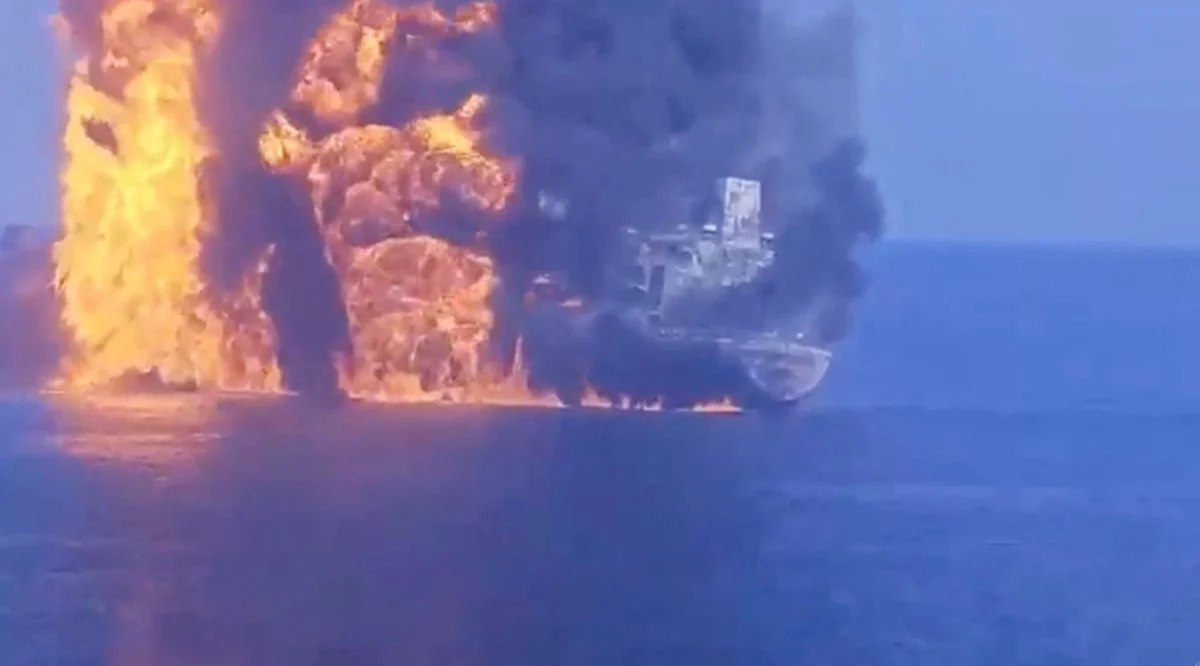
The security firm Vanguard reported that another commercial vessel, the Panamanian-flagged tanker Tara Gas, was struck on Monday roughly seven nautical miles north of Khasab in Oman. The impact triggered a severe fire in the ship’s engine room. Initial reports from Vanguard and India’s ports minister indicated that all 25 crew members—24 of whom were Indian nationals—were safe. However, the situation deteriorated rapidly when the United Kingdom Maritime Trade Operations agency reported that the vessel had been struck a second time, leaving the crew "currently unaccounted for." India’s ports minister subsequently confirmed that the traumatized crew was forced to abandon the burning ship following the secondary attack, leaving one Indian sailor officially missing. In a separate incident on Monday, yet another Panamanian-flagged tanker, the On Phoenix, was struck by an unidentified projectile off the coast of Oman.
Since the broader conflict erupted on February 28, Iran has aggressively attempted to restrict commercial traffic moving through the Strait of Hormuz, repeatedly insisting that all international vessels use only routes explicitly authorized by Tehran. In response, the United States has enforced a stringent naval blockade of Iranian ports while actively deploying warships to escort vulnerable commercial tankers through the perilous waters.
Ongoing Diplomacy
Amid the compounding military escalations and maritime dangers, diplomatic channels remain active, though heavily strained. Iran’s Foreign Minister, Abbas Araghchi, met with his Omani counterpart, Badr Albusaidi, in Muscat. According to regional news agencies, the two senior diplomats discussed critical measures to safeguard international shipping and explored potential diplomatic pathways to de-escalate the broader regional crisis.
The diplomatic push comes as military postures grow even heavier. A third US aircraft carrier, the USS Theodore Roosevelt, officially arrived in the Middle East on Monday, further bolstering American military assets in the theater. The evolving crisis is also slated to occupy center stage at the highest levels of international politics, as US President Donald Trump prepares to participate in a high-stakes three-way summit in China alongside Chinese President Xi Jinping and Russian President Vladimir Putin, where the ongoing war involving Iran sits prominently on the diplomatic agenda.
| Source | : | Finance Poetry |
| Author | : | rifanmuazin |
| Editor | : | Finance Poetry Editorial Team |