
US Defense Secretary Announces Landmark Military Partnership with Venezuela’s Interim Government
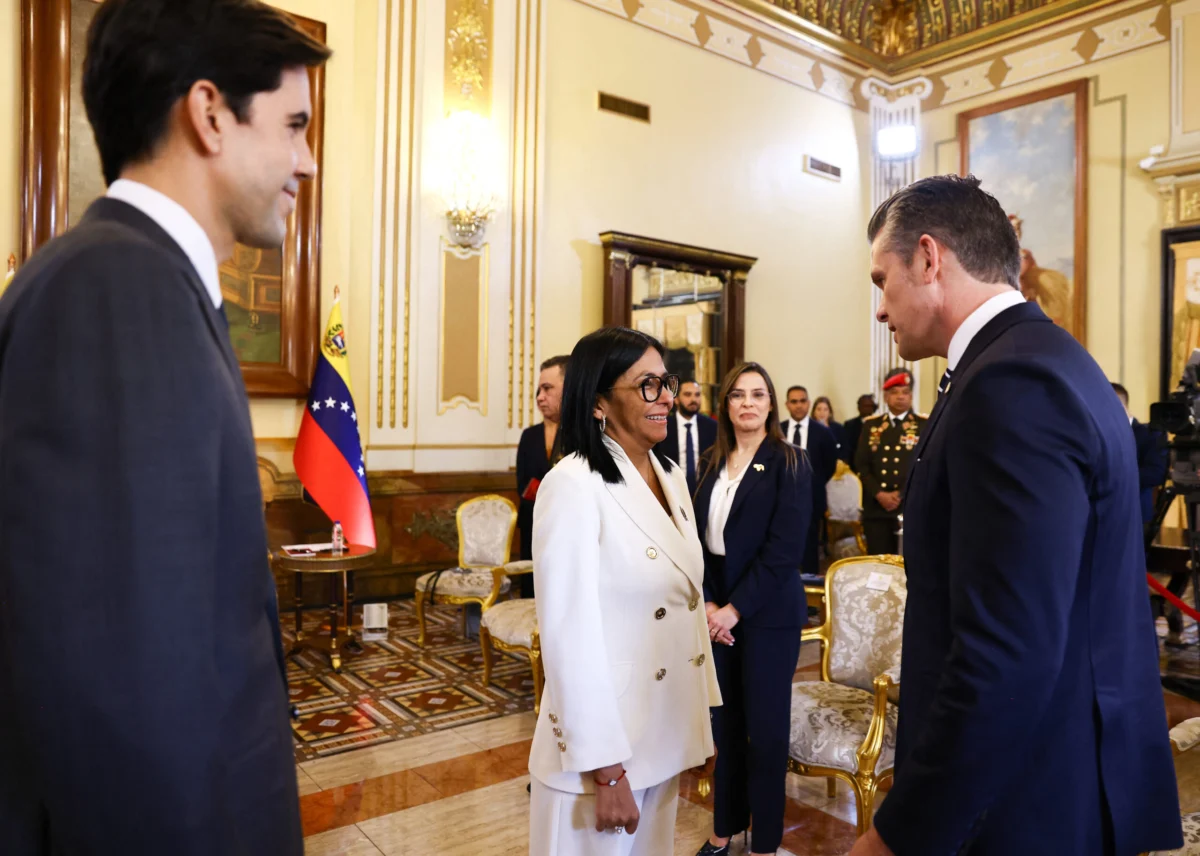
WASHINGTON — United States Defense Secretary Pete Hegseth has announced a significant new cooperation agreement with Venezuela’s interim government, establishing a framework for expanded military collaboration between Washington and Caracas.
The Pentagon chief’s announcement came during an unannounced visit to the Venezuelan capital on Wednesday, marking another major milestone in a shifting bilateral relationship that has undergone profound upheaval over the past year. According to US officials, the newly minted agreement is designed to combat transnational drug trafficking and enhance regional security. Meanwhile, officials in Caracas have framed the pact as a mechanism to strengthen the nation’s military capabilities without compromising its hard-won sovereignty.
The surprise diplomatic and military outreach raises critical questions regarding timing, geopolitical strategy, and the domestic political pressures facing both governments in Washington and Caracas.
What is the New US-Venezuela Military Agreement?
Under the newly forged accord, the United States and Venezuela have agreed to deepen military cooperation across several pivotal areas, including joint tactical training, intelligence sharing, the provision of modern military equipment, and heightened border security measures.
During his visit to Caracas, Hegseth held high-level meetings with Venezuela’s interim President Delcy Rodriguez and Defence Minister Gustavo Gonzalez Lopez. Speaking to local officials, Hegseth outlined that the agreement would empower the armed forces of both nations to work in tandem to eradicate drug trafficking syndicates and dismantle armed non-state actors operating within Venezuelan territory.
President Rodriguez described Hegseth’s visit as an extraordinary step forward in diplomatic and military relations between the two countries. She emphasized that renewed bilateral cooperation would directly benefit the Bolivarian National Armed Forces (FANB) by improving troop training standards, modernizing aging military hardware, and granting security forces access to advanced technological resources.
Despite the broad outlines provided by both administrations, the full terms and classified annexes of the agreement have not been made public. Crucially, neither side has released specific details regarding how joint military operations would be coordinated or executed on the ground.
Why is the US Strengthening Military Ties with Venezuela?
The Trump administration maintains that closer security cooperation with Venezuela is an essential component of its broader counter-narcotics strategy and regional defense framework. Hegseth stressed that the partnership is intended to help the interim government regain operational control over remote or lawless regions where illicit drug trafficking networks and armed militant groups have historically operated with impunity.
However, political analysts point out that the timing of the defense secretary’s unannounced visit is deeply intertwined with domestic political developments in the United States, particularly the outcome of the November midterm elections. Last month, the Democratic Party secured a majority in the US Senate and is poised to take control of the House of Representatives in January.
Political analyst Carlos Pina noted that many of the current geopolitical maneuvers involving Washington and Caracas are directly connected to the shifting balance of power in Washington. Pina observed that congressional Democrats have already signaled their intent to launch rigorous oversight hearings regarding US foreign policy toward Venezuela, focusing heavily on the sweeping sequence of events that began in January when US military forces abducted then-President Nicolas Maduro and transported him to New York to face federal charges. Since that dramatic intervention, the United States has effectively assumed control over Venezuela’s lucrative oil industry, which boasts the largest proven crude reserves in the world.
Pina suggested that Hegseth’s visit to Caracas must also be viewed through the lens of his own political survival. On November 10, the House of Representatives narrowly voted 211-204 against a motion to advance impeachment proceedings against Hegseth. However, with a new congressional majority set to take power in the new year, Democrats are widely expected to revisit the effort.
The November impeachment resolution, introduced by Republican Representative Thomas Massie, outlined eight articles of impeachment targeting Hegseth over the US-Israel conflict with Iran, military strikes against suspected drug-smuggling vessels, and the high-stakes January operation that ousted Maduro. Massie argued at the time that Hegseth had executed unlawful orders that constituted acts of war against a sovereign nation without congressional authorization, going far beyond a routine law enforcement operation to secure control over Venezuela’s petroleum assets.
Against this turbulent political backdrop, Pina believes Hegseth’s trip to Caracas is designed to solidify and defend the administration’s Latin American policy before the new Congress convenes. By showcasing what the White House considers a rare and successful foreign policy intervention, administration officials hope to demonstrate tangible benefits to the American public.
Why is Delcy Rodriguez Cooperating with the US?
For interim President Delcy Rodriguez and her administration, the decision to welcome the US military delegation and endorse the cooperation agreement is viewed by analysts primarily through the lens of political survival. Venezuelan officials have publicly welcomed the pact as a boon for military modernization, while repeatedly asserting that all cooperative measures must strictly respect the national constitution and state sovereignty.

Independent observers, however, argue that Rodriguez has very little room for maneuver. Phil Gunson, a senior analyst at the International Crisis Group, noted that the interim leadership faces unrelenting pressure from Washington.
Gunson explained that Venezuelan authorities have been left in no doubt about the consequences of non-compliance. If they decline to cooperate with Washington’s strategic objectives, they have been given to understand that they risk facing the same fate as Maduro, or worse. Furthermore, Washington wields immense financial leverage over Caracas through its control of foreign earnings. Since Maduro’s removal in January, revenues generated from Venezuelan oil sales have been channeled into US-controlled accounts, with the White House and Department of State supervising the disbursement of funds.
According to a Department of State report released on November 12, more than $12 billion in revenue from oil and natural resource exports passed through these restricted accounts between January and September. While the US government reported that nearly 99 percent of these funds were ultimately disbursed to commercial banks, individuals, and businesses inside Venezuela, the structural arrangement leaves Caracas entirely dependent on Washington’s ongoing financial approval. This mechanism provides the Trump administration with an extraordinarily potent tool to exert continuous political pressure on Rodriguez’s government.
Pina characterized the stance of the interim Venezuelan government as a calculated survival strategy. He noted that Venezuelan leadership is prepared to concede ground to Washington on specific security and economic fronts, provided their core hold on government authority remains unthreatened. Additionally, by aligning temporarily with the White House, Rodriguez is effectively buying valuable time ahead of the congressional power shift in Washington, hoping that upcoming legislative debates might create fresh diplomatic space for negotiation.
What Could the Agreement Mean for Venezuela’s Military?
A central question for regional analysts is whether closer integration with the Pentagon will precipitate deep institutional reforms within the Venezuelan armed forces, many of whose senior commanders rose through the ranks during the Maduro era.
Gunson noted that the trajectory of these reforms will depend entirely on Washington’s long-term intentions. Key questions remain as to whether the United States will actively seek to purge or restructure security leadership elements that have previously faced international accusations of drug trafficking, human rights abuses, and tacit collaboration with foreign guerrilla movements, such as Colombian insurgent groups.
At present, analysts observe that the Venezuelan military as an institutional body is in no position to resist systemic US influence, given its weakened state following years of internal political and economic turmoil. Nevertheless, Gunson cautioned that certain hardline senior officers might attempt to obstruct or sabotage the implementation process out of fear of future criminal prosecution or the loss of their command privileges.
Meanwhile, newly appointed Venezuelan Defence Minister Gustavo Gonzalez Lopez issued his first formal public statement since assuming office, acknowledging the profound impact of the January 3 military intervention that removed Maduro. Gonzalez Lopez reiterated that any cooperative security framework undertaken with Washington would strictly adhere to the Venezuelan constitution, preserve national sovereignty, and maintain the territorial integrity of the state. He emphasized that the FANB would retain absolute internal command and operational control over its own troops and leadership structure.
Could the Agreement Lead to a Greater US Military Presence in Venezuela?
While the precise operational details of the agreement remain undisclosed, regional experts believe the immediate focus will center on targeted counter-narcotics missions and joint operations against armed non-state actors along the porous border shared by Venezuela and Colombia.
Pina noted that while limited joint exercises and intelligence-led air operations against border militias are plausible, the Venezuelan military would fiercely resist any proposal that grants American forces a broad, permanent footprint inside the country. Maintaining domestic legitimacy requires the governing party to keep foreign military involvement carefully bounded. At the same time, Washington may find that maintaining long-term influence over Venezuela’s political transition requires a more visible and sustained security posture, given that the domestic armed forces remain structurally tied to the ruling political apparatus.
What Does the Agreement Mean for Latin America?
The implications of the US-Venezuela security pact extend far beyond Caracas, sending ripples across the wider Latin American region, particularly in neighboring Colombia. The shared border has long served as a stronghold for various Colombian armed factions, including the National Liberation Army (ELN), which has waged a decades-long insurgency against Bogotá. Joint military operations involving US and Venezuelan assets could significantly impair the operational mobility of these cross-border guerrilla networks.
However, the regional diplomatic landscape remains delicate. Recent media reports concerning proposed cross-border security operations have sparked regional debate. While Colombian President Abelardo de la Espriella’s administration has expressed a willingness to enhance military ties with Washington, any foreign troop presence on Colombian soil would require formal legislative approval. Hegseth forcefully dismissed preliminary media reports suggesting tensions over proposed joint maneuvers, labeling them entirely false.
Analysts suggest that Washington’s assertive posture in Venezuela has established a dramatic precedent for regional hemispheric security policy. Gunson observed that while the White House views the Venezuela intervention as an unmitigated success and a blueprint for broader regional engagement, the incoming shift in the US Congress could prompt allied governments across Latin America to reassess their strategic alignment with Washington’s security directives.
Whether the bilateral military agreement represents a permanent structural transformation in US foreign policy toward Latin America or functions primarily as a tactical political maneuver to counter domestic criticism in Washington remains a central question as both nations navigate an uncertain political future.
| Source | : | Finance Poetry |
| Author | : | rifanmuazin |
| Editor | : | Finance Poetry Editorial Team |