
Autonomous AI Agents and LLMs Threaten Traditional Bank Deposits, McKinsey Report Reveals
Artificial intelligence is no longer just a back-office tool for the banking sector; it is actively moving money, interacting with customers, and reshaping the economic foundations of retail finance. According to a comprehensive new report released by McKinsey and Company, autonomous AI agents are beginning to manage financial transactions independently on behalf of users, posing a direct threat to traditional bank deposit profits. At the same time, large language models (LLMs) are rapidly emerging as powerful new distribution channels and financial intermediaries, changing how consumers discover and interact with banking products.
Published on November 10, 2026, the global banking annual review analyzes the worldwide banking industry’s economic health, performance, profitability, and strategic shifts. The findings draw heavily on a major consumer survey conducted in June 2026, which captured insights from 46,000 retail banking customers across several major international markets. While the rapid adoption of generative AI presents profound disruptions to legacy business models, the report emphasizes that traditional financial institutions still retain a vital trust advantage that they must actively capitalize on to protect their market share.
Agents Move Money
The financial landscape is entering a new era where capital flows based on the guidance and execution of software agents. Major payment networks are already moving to accommodate this structural shift. Visa’s Intelligent Commerce and Mastercard’s Agent Pay initiatives are designed to allow merchants to accept purchases securely from verified software agents. Concurrently, PayPal has agreed to integrate its digital wallet directly into ChatGPT’s checkout system, backed by a co-developed protocol created through a partnership between Stripe and OpenAI.
Industry analysts widely expect that these autonomous agents will soon begin systematically sweeping idle cash from low-yielding checking accounts into higher-yielding investment alternatives. This optimization behavior poses a severe threat to the core profitability of traditional banks, which rely heavily on low-cost deposits. According to McKinsey’s economic modeling, if software agents directly move or indirectly guide—through real-time portfolio advice—even 5 to 10 percent of retail checking balances toward higher-yielding products, overall industry deposit profits could plummet by as much as 20 percent.
However, the report suggests that the broader financial gains unlocked by AI disruption could easily offset any potential drop in deposit earnings. Financial institutions that proactively prepare for this environment can capture new revenue streams by offering clients more appealing investment products, sophisticated automated financial guidance, and advanced cash management tools that restore overall institutional profitability.
A New Distribution Channel
Large language models are scaling as an entirely new distribution channel at a historic pace. While the transition of banking services to mobile devices took nearly a decade to reach half of all bank users, McKinsey’s research reveals that more than 50 percent of affluent consumers with US$100,000 or more in wealth are already utilizing LLMs to answer complex financial questions. This rapid uptake underscores the profound and immediate disruption driven by generative AI across demographic segments.

Rather than functioning solely as an informational channel, LLMs are increasingly acting as direct intermediaries situated squarely between banks and their retail clients. This intermediation is forcing financial institutions to adopt one of two primary strategies: either positioning themselves as underlying data sources that feed the LLMs, or embedding themselves directly into popular LLM platforms as storefronts.
In the United States, OpenAI launched a comprehensive suite of personal finance tools tailored for ChatGPT Pro subscribers, enabling users to securely link external bank accounts and execute complex queries such as detailed spending analysis and future financial planning. This capability was made possible through a strategic partnership with Plaid, which facilitates secure connectivity to more than 12,000 financial institutions, including major names like Schwab, Fidelity, Chase, Robinhood, and American Express. Through this architecture, these traditional institutions effectively serve as foundational data sources for AI platforms.
Conversely, innovative institutions such as Banco Bilbao Vizcaya Argentaria (BBVA) have chosen the storefront route by building native applications directly inside ChatGPT. This integration allows clients to explore, evaluate, and engage with banking products without ever leaving the conversational interface. BBVA officially launched this application in Germany and Italy, setting an early precedent for embedded banking within generative platforms.
This fundamental transformation in how consumers discover financial services has also sparked a massive evolution in digital marketing strategies. Marketing teams across the financial sector are increasingly focusing on generative engine optimization (GEO). GEO aims to refine brand identity, statistical transparency, definitions, and institutional authority so that LLMs and generative search engines reliably cite the brand in their extended conversational responses. Alongside answer engine optimization (AEO), these modern strategies represent the natural evolution of traditional search engine optimization for the era of AI-powered answer engines.
Consumers Embrace GenAI for Financial Tasks
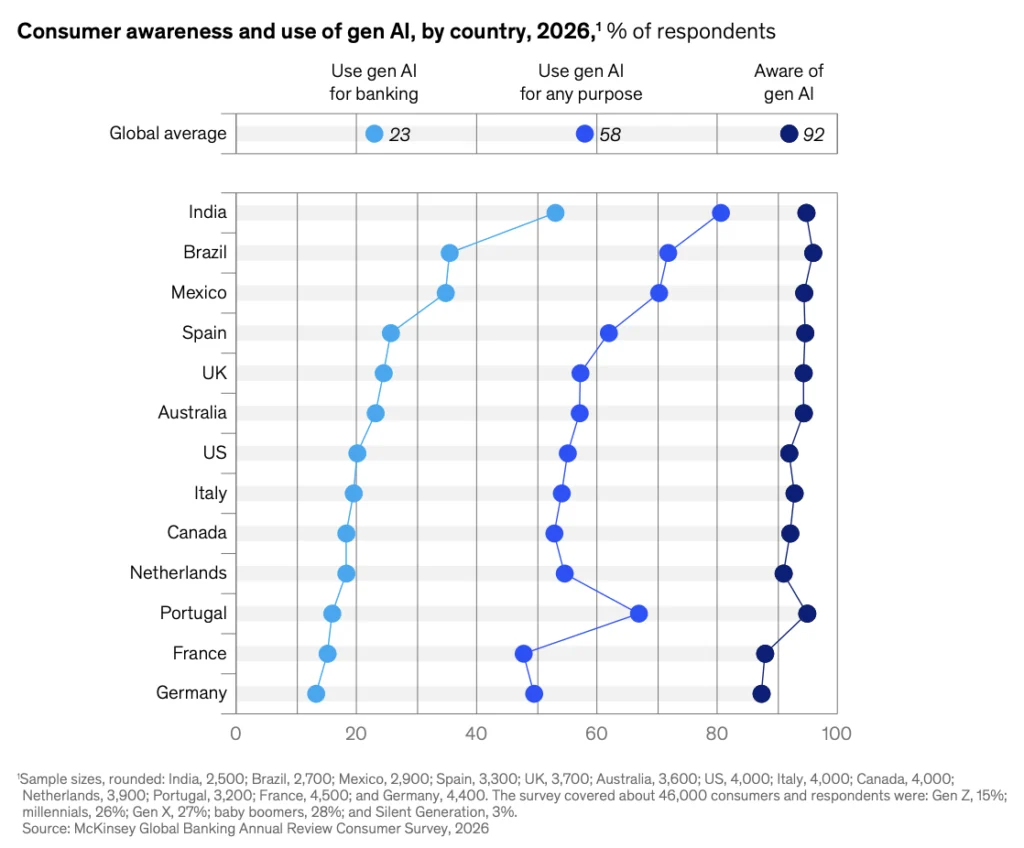
Consumer adoption of generative AI for everyday financial tasks has accelerated dramatically. McKinsey’s consumer survey indicates that public awareness of these technologies is now nearly universal, with 23 percent of surveyed retail banking customers already actively using generative AI tools to manage their personal finances.
Despite financial institutions investing heavily in their own proprietary AI chatbots, popular standalone AI platforms continue to dominate consumer preference. Among consumers who use AI for banking-related tasks, 74 percent rely on established platforms like ChatGPT, Claude, or Gemini. This usage rate is roughly double the share of consumers who utilize the official chatbots provided by their own banks. This dynamic highlights a critical industry trend: while the underlying financial transactions ultimately flow back to regulated banks, the conversational dialogue and decision-making process that shape those transactions are increasingly taking place on external technology platforms.

Overall customer satisfaction with AI tools remains high, particularly for straightforward informational inquiries. The survey shows that 59 percent of consumers prefer AI assistance when handling basic financial questions. However, the appetite for artificial intelligence drops significantly when higher stakes are involved; when seeking complex investment and wealth management advice, 34 percent of respondents explicitly favor human assistance over automated solutions.
The study also uncovers a growing willingness among retail banking customers to delegate routine execution. Among active AI users, 72 percent stated they would allow a banking agent to perform at least one automated financial task on their behalf. However, most consumers expect the agent to request explicit confirmation before executing a transaction, and many indicated they would cap autonomous approvals at a conservative threshold of US$500, reflecting a pragmatic need for robust financial controls and consumer safeguards.
Trust remains the single most important factor governing this transition, with traditional banks maintaining a clear advantage. Fully 62 percent of AI users stated they would prefer to receive AI-powered financial services and advisory products from their primary bank rather than any other provider. When evaluating these technologies, consumers identified privacy as their single greatest concern.
This institutional trust advantage, however, is deeply conditional. Approximately half of all AI users surveyed indicated they would willingly switch to a third-party financial application if their primary bank failed to provide capable, competitive AI tools, signaling that retail customers will not wait indefinitely for legacy institutions to modernize.
The Advent of Institutional Intelligence
To date, the vast majority of financial institutions have deployed artificial intelligence primarily as a tool for individual employee efficiency, helping staff work faster and process tasks with greater speed. McKinsey’s report points toward a necessary next phase known as institutional intelligence, which aims to make the entire organization inherently more capable.
Institutional intelligence functions by integrating data pools, internal policies, historical decisions, and specialized expert judgment that currently remain siloed across different departments. By aggregating this information into a unified framework, every autonomous agent and human employee can operate from a centralized, continuously expanding corporate knowledge base.

The individual productivity benefits of these technologies are already clearly documented. McKinsey’s 2026 State of AI survey revealed that 80 percent of more than 1,700 professionals polled reported tangible productivity improvements from using the technology. Furthermore, benchmark testing conducted by QuantumBlack, AI by McKinsey, across seven distinct agentic systems operating in production environments within financial and professional services firms demonstrated that these agents successfully reduced task completion times by approximately 60 percent.
Building the Foundation for Institutional Intelligence
Despite these impressive individual productivity gains, firms have largely struggled to translate them into broad, enterprise-wide financial impact. Only 37 percent of respondents in the 2026 State of AI survey reported that artificial intelligence had measurably improved their operating profit—a figure that remains virtually unchanged from the previous year, even as a growing number of firms scale their AI deployments.
Industry-leading banks have recognized that capturing real financial value from AI requires fundamentally redesigning workflows, restructuring internal job roles, and building robust underlying technological infrastructure. Many institutions are now actively constructing the foundational layers required for true institutional intelligence. This includes developing reliable data products, such as a unified "customer 360" and "credit 360" profile, which autonomous agents can leverage securely at scale.
In McKinsey’s survey, 48 percent of banking executives identified data readiness as their primary barrier to successful AI implementation, while core technology infrastructure ranked as their least significant concern.
The second critical element of this architecture is context, which maps out how a customer’s various accounts, financial obligations, and regulatory statuses interconnect. Strict permissioning protocols are applied before any information is passed to a model, ensuring that every agent draws from a single, verified version of the customer profile rather than fragmented internal views. Finally, the judgment element captures the nuanced expertise of senior credit officers and risk managers—insights that traditionally remained locked outside formal policy manuals—and formats them so they can be reused effectively by autonomous agents across the enterprise.
| Source | : | Finance Poetry |
| Author | : | rifanmuazin |
| Editor | : | Finance Poetry Editorial Team |