
AI Agents Evolve from Browsing to Buying as Security Risks Escalate
The rapid integration of Artificial Intelligence agents into the digital ecosystem has fundamentally altered the landscape of cybersecurity, shifting the focus from simple automated traffic to complex, high-stakes interactions. According to a new report from security firm Cequence, malicious actors are increasingly exploiting the reputation of these AI agents, using their names as a digital camouflage to infiltrate corporate networks and probe for sensitive data. Simultaneously, legitimate AI agents have moved beyond their traditional role as passive information gatherers, now actively engaging in transactional processes such as logging into accounts, making purchases, and managing sensitive user data.
The findings, detailed in Cequence’s Agentic AI Security Index, are based on extensive telemetry data collected from the businesses it protects between May 16 and November 15. The research underscores a critical correlation: as organizations place greater trust in AI agents to perform complex, authenticated tasks, the value of those agents’ identities to malicious bots has surged. By masquerading as established AI services, these bots gain a sophisticated "cover" that allows them to bypass traditional security filters that might otherwise flag unknown, unauthorized, or suspicious traffic.
The Rise of Spoofing and Targeted Probing
The most alarming trend identified in the report is the aggressive use of AI agent names by malicious bots to scout for vulnerabilities. These bots are not merely looking for public information; they are specifically targeting configuration files, API keys, and administrative consoles—the "crown jewels" of a business’s digital infrastructure.
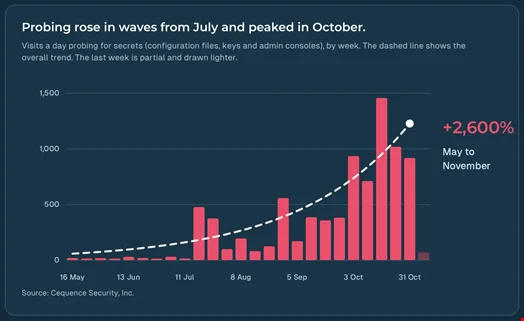
Cequence’s data illustrates a dramatic and sustained increase in this malicious activity. In May, the firm recorded fewer than 30 daily visits from bots masquerading as AI agents. By mid-October, that figure had ballooned to a peak of approximately 1,450 daily visits. Even as the trend cooled slightly toward the end of October, it remained at an elevated baseline of roughly 1,000 visits per day. Throughout the study period, Cequence successfully blocked 37,917 of these fraudulent visits, highlighting the scale of the threat faced by modern enterprises.

The report notes that certain brand names carry more weight than others in this digital masquerade. For instance, of the visits claiming to originate from Perplexity agents, 63% were actively probing for sensitive secrets. It is vital to emphasize, as Cequence did, that these agent names are self-reported by the bots themselves. Consequently, these statistics do not suggest that the legitimate Perplexity service is behind the probing; rather, they demonstrate that malicious actors are weaponizing the reputation of trusted AI entities to facilitate their reconnaissance efforts.
Industry experts warn that the emergence of "Agentic AI" necessitates a complete rethink of current security postures. Dana Simberkoff, chief risk, privacy, and information security officer at AvePoint, emphasizes that organizations can no longer rely on perimeter-based security alone. She advocates for a robust implementation of the principle of least-privilege access, granular identity controls, continuous monitoring, and comprehensive audit trails. Furthermore, Simberkoff suggests that for high-risk actions—such as large financial transactions or the mass export of data—human-in-the-loop approval processes are becoming an essential layer of defense.
Aviv Nahum, co-founder and CEO of Above Security, echoed these sentiments, stressing that the industry needs to adjust its mental model regarding what constitutes an insider. He argued that organizations must begin to treat AI agents as "first-class identities" and a new, distinct category of insiders. By categorizing agents as internal entities with defined roles and risks, companies can better manage the permissions and access levels granted to these autonomous systems.
From Information Gathering to Transactional Autonomy
The functional evolution of AI agents has been as significant as the security risks they have inadvertently fostered. Throughout the study, Cequence tracked established AI agents and observed a profound shift in their behavior. In May, the vast majority of agent-led interactions were read-only, limited to browsing and retrieving public information. By November, the nature of these visits had changed drastically.

The data shows that 13% of visits from established AI agents involved taking substantive actions in November, a massive jump from just 1.4% in May. Cequence defines "taking action" as any operation involving authentication or transactional integrity, such as signing into a secure account, booking reservations, purchasing goods, or managing financial account details. When analyzed together, these action-taking visits grew by 240% during the study period, while read-only browsing visits plummeted by 73%.
This shift toward active, transactional engagement is being driven by the rapid introduction of new, more capable agent types. Between late September and early October, six new agent varieties appeared on the digital landscape, including Meta Muse, Google’s shopping crawler, and a dedicated Amazon agent. These tools are designed for efficiency and conversion, often performing the very tasks that humans once reserved for manual labor. For example, Meta Muse was found to have taken action on 51% of its visits within its first 30 days of operation, accounting for 40% of all action-taking agent visits during that window.
The impact of this trend was particularly evident during the early holiday shopping season. Between November 5 and 15, the data revealed that 3% of all agent visits resulted in a completed purchase, a significant increase from the 0.2% observed during normal business periods. While the data collection window concluded before the peak intensity of Black Friday and Cyber Monday, the trend suggests that AI agents are becoming a primary driver of commercial traffic.
Governing by Behavior, Not by Identity
The dual challenges of spoofing and the increasing transactional power of AI agents leave organizations in a precarious position. When a bot can successfully masquerade as a legitimate AI agent to gain access to sensitive systems, and when legitimate agents are simultaneously being granted the power to execute financial transactions, the margin for error is razor-thin.

Cequence advises that businesses can no longer afford to "trust" traffic based on the labels it presents. Because an agent’s name is easily forged, relying on identity claims is an ineffective strategy. Instead, the firm recommends that organizations shift their governance models to focus on behavior. By analyzing the actions an agent takes—and comparing those actions against established baselines of what is expected and safe—security teams can identify anomalies that suggest either a malicious actor or a malfunctioning agent.
As AI agents continue to weave themselves into the fabric of commerce and internal business operations, the line between "useful automation" and "security risk" will continue to blur. The transition from reading to buying is not merely a technical update; it is a fundamental shift in how digital services interact with the assets they serve. For organizations, the task ahead is to develop a defensive framework that is as dynamic and autonomous as the agents they are attempting to secure. This requires moving beyond traditional static defenses toward a model of behavioral analysis and identity management that recognizes these AI entities for exactly what they are: powerful, influential, and potentially dangerous components of the modern digital enterprise.
| Source | : | Finance Poetry |
| Author | : | rifanmuazin |
| Editor | : | Finance Poetry Editorial Team |