
ThreatBook Pulls Open-Source CyberStrikeAI Following Surge in Malicious Exploitation
In a significant move aimed at curbing the proliferation of automated cyber threats, agentic security firm ThreatBook has officially discontinued the open-source version of its penetration testing platform, CyberStrikeAI. The decision, announced on November 26, marks a major pivot in how the security industry manages powerful, AI-driven offensive tools that have increasingly fallen into the hands of malicious actors. While the open-source iteration—which had gained significant traction on GitHub with over 7,000 stars—has been permanently scrubbed from public repositories, ThreatBook continues to offer a restricted, closed-source enterprise edition to verified organizations.
The removal of the project is a direct response to the weaponization of what are known as Agentic Offensive Frameworks (AOFs). These tools represent a new frontier in cybersecurity, capable of orchestrating complex attack chains at speeds and scales that were, until recently, beyond the reach of human-operated scripts. By automating the reconnaissance, vulnerability scanning, and exploitation phases of a cyberattack, these frameworks have become high-value assets for threat groups seeking to compromise targets with minimal manual intervention.
The Strategic Shift Toward Restricted Access
ThreatBook’s journey with CyberStrikeAI began in September, when the Singapore and Hong Kong-based company acquired the platform. At the time, the acquisition was viewed as a move to bolster the company’s portfolio of AI-native security testing tools. Following the acquisition, the firm attempted a dual-track strategy: maintaining the open-source community version while simultaneously developing a robust, closed-source "Pro" version as part of its "RedAgents" suite.
However, the rapid escalation in the misuse of these tools forced a reconsideration of this strategy. As reports of illicit activity linked to AOFs climbed, the risks associated with public availability outweighed the benefits of open-source collaboration. The company has now confirmed that all official repositories for CyberStrikeAI have been taken offline.
This decision is not merely a technical removal but a precautionary measure intended to protect the broader ecosystem. ThreatBook has issued a stark warning to security practitioners who may still be looking to deploy the tool, advising them to remain "vigilant of forks that appear elsewhere." Because the original code was open-source, malicious actors or opportunistic developers may have created derivative versions. ThreatBook warns that any unofficial or forked iterations of the software should be treated with extreme caution, as they could be modified to include backdoors or vulnerabilities that would ultimately compromise the security of the very networks they are intended to test.
The Escalating Threat of Agentic Offensive Frameworks
The catalyst for this takedown lies in the tangible, real-world impact of AI-powered exploitation. Over the past year, security researchers and government agencies have observed a sharp increase in the deployment of AOFs by sophisticated threat actors. These tools allow for a level of precision and persistence that traditional malware often lacks, enabling attackers to navigate internal networks and identify high-value targets with alarming efficiency.
The urgency of this situation was underscored just one month prior to ThreatBook’s announcement, when the Indian Computer Emergency Response Team (CERT-In) issued a formal warning to the financial and cryptocurrency sectors. The agency highlighted the activities of a threat group identified as "Crafty Falcon." According to the report, Crafty Falcon had been executing a series of coordinated strikes against financial institutions, utilizing a variety of AI-powered tools to bypass traditional defenses. CyberStrikeAI was specifically cited as one of the instruments in their arsenal, proving that the tool had moved well beyond the realm of authorized security research and into the hands of active criminal syndicates.

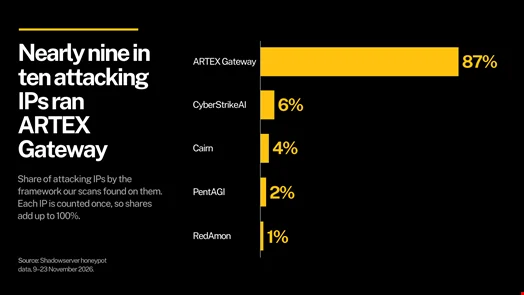
Data provided by the Shadowserver Foundation, a UK government-funded nonprofit organization dedicated to monitoring global cyber threats, provides a harrowing look at the scale of this problem. In a report published on November 25, the foundation analyzed the prevalence of AOFs across the internet. As of November 23, they identified more than 4,200 servers actively running various agentic offensive frameworks—a noticeable jump from the 3,700 servers identified just 24 hours earlier.
Of these identified servers, 6% were directly linked to CyberStrikeAI. The remainder were dominated by other frameworks, most notably ARTEX, which accounted for 87% of the observed activity. ARTEX has previously been linked to high-profile malicious campaigns involving state-aligned groups from China and North Korea, illustrating that the trend of AI-driven exploitation is a global phenomenon involving some of the world’s most advanced persistent threat actors.
It is important to note, however, that the mere detection of these frameworks on a server does not inherently prove malicious intent. Shadowserver and other security analysts have been careful to clarify that these tools remain legitimate components of the cybersecurity professional’s toolkit. When used by ethical hackers, penetration testers, and red-teamers, these frameworks are essential for identifying structural weaknesses in an organization’s defense. The challenge facing the industry is the "dual-use" nature of the technology: the same automated logic that helps a defender find a critical vulnerability in a company’s web server is identical to the logic used by an attacker to gain unauthorized access to that same server.
Balancing Innovation with Defensive Responsibility
In the wake of the takedown, ThreatBook has taken a firm stance on the ethical responsibilities of security vendors. The company maintains that the technology itself is neutral, but the power it grants requires a controlled environment. By limiting access to its RedAgents offering—which includes the advanced, closed-source versions of CyberStrikeAI Pro and ARTEX Pro—ThreatBook is attempting to enforce a "gatekeeper" model of security.
Under this model, only verified enterprises that hold clear, legal authorization to test their own network assets are granted access to the software. This is designed to ensure that the tools are used strictly for defensive self-assessment, allowing organizations to find and patch their security gaps before malicious actors have the chance to exploit them using similar AI-driven methods. Furthermore, the company has implemented a policy of accountability, stating that it "reserves the right to immediately revoke access" if it detects any misuse of the software by its clients.
The discontinuation of the open-source version of CyberStrikeAI marks a significant turning point in the industry’s approach to the democratization of offensive AI tools. It acknowledges a reality where the potential for harm has become too high to justify public, unrestricted access to sophisticated exploitation engines. As AI continues to evolve, the tension between the open-source philosophy of security research and the need for controlled, responsible development of offensive technologies is likely to intensify.
For now, the removal of CyberStrikeAI from platforms like GitHub serves as a cautionary tale for both the security community and software developers. It highlights the growing necessity for security vendors to vet their users and carefully consider the potential for "dual-use" before releasing powerful capabilities into the wild. As threat actors continue to adopt AI to scale their operations, the cybersecurity industry is moving toward a more guarded, verified approach to the tools that define the future of both attack and defense. Organizations that previously relied on the open-source iteration of CyberStrikeAI for their internal testing will now need to adapt to this new landscape, focusing on authorized, enterprise-grade solutions that provide the same capabilities while ensuring the necessary guardrails are in place to prevent the technology from falling into the wrong hands.
| Source | : | Finance Poetry |
| Author | : | rifanmuazin |
| Editor | : | Finance Poetry Editorial Team |