
US, Russia and China Hold Historic Trilateral Meeting in Shenzhen as Xi Jinping Shapes Global Diplomacy at APEC
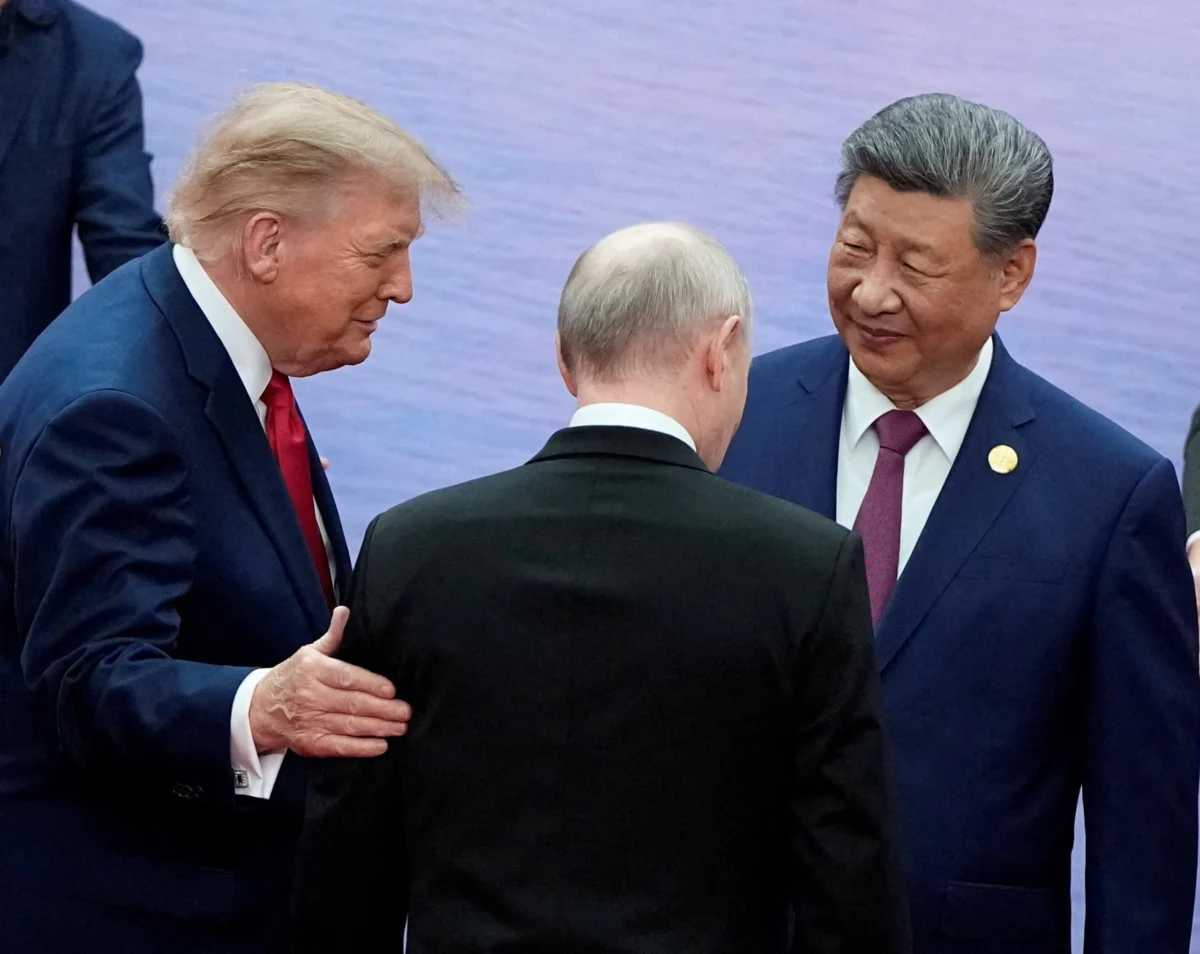
SHENZHEN, China — For the second consecutive year, Chinese President Xi Jinping has successfully convened a high-profile diplomatic gathering on mainland Chinese shores, bringing together the leaders of major global superpowers in a display of international reach and statecraft.
In a historic geopolitical development, U.S. President Donald Trump participated in a high-stakes trilateral meeting with Chinese President Xi Jinping and Russian President Vladimir Putin on Thursday. The face-to-face discussions followed an initial gathering the previous evening during the official welcome banquet for the Asia-Pacific Economic Leaders’ Meeting, held in the southern Chinese tech hub of Shenzhen, Guangdong province. The interactions marked the first time the three leaders have ever met together in person, drawing intense global scrutiny and highlighting the shifting dynamics of international diplomacy.
The Shenzhen summit follows a similar high-profile photo opportunity in September 2025, when Xi, Putin, and Indian Prime Minister Narendra Modi briefly smiled together on the sidelines of an annual meeting of the Shanghai Cooperation Organization in Tianjin, China. That gathering occurred in the wake of easing diplomatic tensions between Beijing and New Delhi, signaling China’s growing capacity to serve as a central diplomatic nexus for leaders with complex, often competing, global interests.
Summit Diplomacy and Beijing’s Expanding Role
China’s ability to facilitate direct engagement among the world’s foremost nuclear powers and major economies reflects its expanding influence across the Global South and the broader Eurasian landmass. According to Jodie Wen, a postdoctoral fellow at the Center for International Security and Strategy at Tsinghua University, these diplomatic maneuvers highlight China’s strategic ambitions.
"China hopes to play a more constructive role in this conflict-ridden, unstable world," Wen noted, observing that Beijing intends to continue providing platforms within its national borders for international leaders to negotiate, debate, and address pressing global friction points in the years ahead.
Beijing has increasingly leaned into the role of diplomatic broker on the world stage. Most notably, China provided the crucial diplomatic forum that successfully mediated the restoration of diplomatic ties between Saudi Arabia and Iran in 2023, a breakthrough that reshaped Middle Eastern geopolitics. By actively participating in and hosting a diverse array of multilateral organizations, China has maintained a steady presence within the traditional Western-dominated global orbit while simultaneously cultivating deep, robust relations with non-Western and developing nations.
The back-to-back photo opportunities and high-level summits in Tianjin and Shenzhen represent only a fraction of the exhaustive schedule maintained by President Xi. Official diplomatic readouts analyzed by CNBC indicate that Xi has hosted more than 40 heads of state over the course of the year, which includes at least eight separate bilateral and multilateral engagements surrounding the APEC meetings in Shenzhen this week. This builds upon an intensely active diplomatic calendar from the previous year, during which Xi received over 60 state visits throughout 2025.
State-run and domestic Chinese media have heavily emphasized these extensive interactions, framing Xi’s busy itinerary as proof of China’s central importance to international stability and economic cooperation.
Yue Su, principal economist for China at the Economist Intelligence Unit (EIU), pointed out that Beijing views these large multilateral platforms as vital opportunities to project international influence, showcase its unwavering commitment to multilateralism, and balance its overarching diplomatic strategy.
"Beijing sees these multilateral platforms as opportunities to expand its international influence and demonstrate its commitment to multilateralism, while bilateral diplomacy remains equally important," Su explained.
At the same time, Su cautioned that achieving substantive breakthroughs remains a complex endeavor. As different nations increasingly pursue divergent geopolitical, security, and economic priorities, reaching a unified consensus—even within well-established multilateral organizations—presents significant ongoing challenges.
"Against this backdrop, China’s diplomatic priorities are increasingly focused on delivering tangible economic benefits through trade, investment, financial connectivity, and technology cooperation," Su added, highlighting Beijing’s pragmatic pivot toward economic statecraft to solidify its global partnerships.
APEC Outcomes and Strategic Global Discussions
Beyond the symbolic pageantry of the leadership photo sessions, the APEC Economic Leaders’ Meeting produced concrete policy declarations and high-level strategic dialogues. During his address on Thursday, President Xi announced that China would commit $20 million in targeted financial and developmental support for the wider Asia-Pacific region. He also used the multilateral platform to advocate for the establishment of an "Asia-Pacific community with a shared future," a localized iteration of his frequently invoked global political slogan concerning a "shared future" for all of humanity.
Scholars and regional experts argue that summits like the one in Shenzhen serve a vital, practical function in modern statecraft. Tsinghua University’s Wen emphasized that the Shenzhen summit has the potential to yield meaningful outcomes for international crisis management, while simultaneously carving out essential diplomatic space for future peace negotiations and strategic stability talks. She stressed that direct, in-person engagement among top national leaders remains an indispensable mechanism for preventing dangerous misunderstandings and de-escalating simmering geopolitical tensions.
The trilateral meeting itself yielded unexpected rhetorical breakthroughs regarding global security. Speaking to reporters on Thursday following the closed-door discussions, President Trump remarked that the United States, China, and Russia find themselves "uniquely positioned" to engage in serious dialogue concerning the reduction of nuclear weapons, describing the trilateral encounter as entirely historic.
A subsequent official Chinese readout confirmed that the three world leaders used the summit to exchange views and discuss several of the most volatile geopolitical flashpoints currently destabilizing the international order, including the ongoing war in Ukraine, the protracted conflicts in the Middle East, and the persistent security challenges on the Korean Peninsula.
As the APEC summit concludes in Shenzhen, the unprecedented convergence of American, Chinese, and Russian leadership underscores a transitional moment in international relations, where physical summits in Asia are increasingly defining the architecture of global diplomacy.
| Source | : | Finance Poetry |
| Author | : | rifanmuazin |
| Editor | : | Finance Poetry Editorial Team |