
Cyanogen Co-Founder Kirt McMaster Targets Microsoft Windows With AI-First Operating System
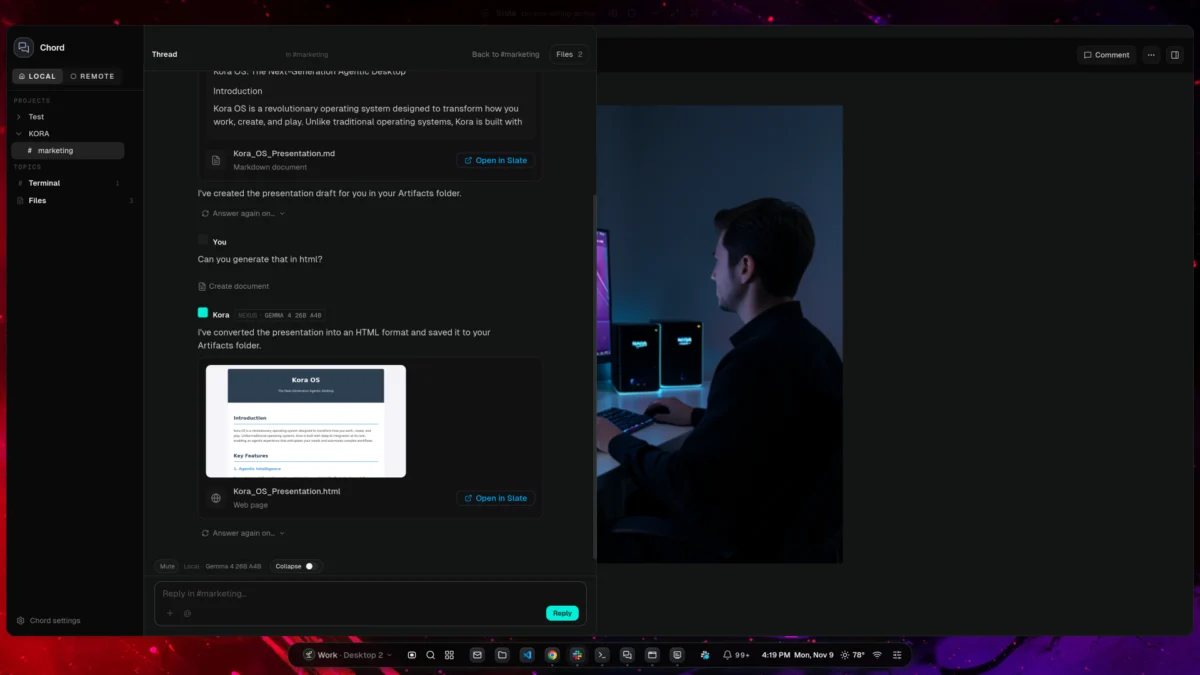
Almost a decade after Cyanogen officially shut down its ambitious Android operating system business following a bruising, years-long battle to challenge Google’s mobile dominance, company co-founder Kirt McMaster is returning to the operating system arena. This time, his sights are set squarely on Microsoft and the ubiquitous Windows ecosystem with an entirely new Linux-based operating system built from the ground up for professionals and power users who rely heavily on artificial intelligence in their daily workflows.
McMaster’s Palo Alto-based enterprise, Kora Systems—formerly known as the gaming operating system startup Playtron—unveiled the new desktop operating system on Tuesday. The software is designed to integrate advanced AI models and autonomous agents directly into the core computing experience. Rather than running as isolated applications or web-based browser extensions, these AI agents are built to operate fluidly across different applications, seamlessly access local files, and continuously retain context between disparate tasks.
According to the company, the software is slated for an official commercial launch in 2027 as a free-to-use desktop operating system. It will feature native support for existing Intel- and AMD-powered personal computers, as well as high-performance laptops and machines running Qualcomm’s advanced Snapdragon chips.
Developing a modern operating system is historically one of the most resource-intensive endeavors in the technology sector, but Kora is tackling the challenge with a remarkably lean team of roughly 50 engineers. To accelerate development, the company has leaned heavily on cutting-edge AI coding assistants, including OpenAI’s Codex and Anthropic’s Claude. McMaster noted that these tools have amplified the team’s productivity, speeding up development by at least fivefold, with the most dramatic efficiency gains materializing over the preceding six months.
Microsoft has maintained an iron grip on the personal computer operating system market for decades, creating a formidable barrier to entry for any competitor hoping to carve out a viable market share. According to recent web traffic data compiled by Statcounter for October, Windows commanded approximately 77% of the worldwide desktop operating system market, while Apple’s macOS trailed far behind at nearly 10%.
Despite these daunting statistics, McMaster maintains that Kora does not need to capture the entirety of the traditional Windows user base to achieve long-term viability and success. Instead, the company is deliberately focusing on a specific, highly active demographic: professionals, developers, and enthusiasts who use artificial intelligence extensively in their professional lives and are actively willing to pay for access to powerful, high-performance frontier models and specialized services.

“Microsoft can keep its billion users,” McMaster remarked, estimating that a concentrated group of roughly 45 million to 50 million people currently accounts for the vast majority of heavy AI usage and commercial revenue today. He projects that this specialized high-value market will expand dramatically, exceeding 200 million dedicated users by the year 2033.
For McMaster, this strategic positioning is deeply informed by the hard lessons learned during his tenure at Cyanogen, where he spent over five years attempting to build an alternative mobile ecosystem. Despite offering innovative features and customizations that reached far beyond Google’s stock version of Android, Cyanogen remained fundamentally dependent on Google Mobile Services. That structural reliance ultimately crippled the company’s independence and choked its ability to sustain a truly autonomous platform.
Reflecting on that past failure, McMaster articulated a clear philosophy for challenging tech monopolies: “If you are trying to compete with an incumbent but are still reliant on them, you have no chance.”
Kora directly incorporates concepts that McMaster began exploring toward the final chapters of his time at Cyanogen, where he first investigated methods to weave third-party services natively into the fabric of an operating system. With Kora, the objective is to liberate AI models and autonomous agents from the confines of individual software silos, allowing them to traverse system boundaries, manipulate documents, and execute complex multi-step tasks across the entire machine.
The company’s path to this AI-centric vision involved a significant pivot. Previously operating under the moniker Playtron, McMaster led a team focused primarily on building a Linux-based gaming operating system known as GameOS, tailored specifically for handheld gaming consoles and specialized hardware. However, as prominent industry players like Perplexity and OpenAI began pushing aggressively into AI-powered web browsers in mid-2025, McMaster and his leadership team recognized a critical limitation. They concluded that standard web browsers could never grant AI agents the deep, systemic access to a computer required to execute truly complex, automated workflows. Consequently, they determined that an operating system represented a vastly superior starting point.
This realization prompted a formal corporate rebrand to Kora Systems in July 2025. Crucially, the pivot did not require the company to discard its previous technical foundations; instead, it allowed Kora to build directly upon nearly three years of intensive research and development invested in Playtron’s Linux gaming infrastructure.
Kora’s software architecture is built upon a robust Linux foundation utilizing Nix for package management, successfully replacing the Fedora Silverblue framework that underpinned Playtron’s earlier GameOS iterations. While the underlying Linux and Nix components remain open-source, McMaster confirmed that Kora’s proprietary technology stack—including its core Cortex AI engine and custom desktop interface—will remain strictly proprietary. The company intends to support a diverse array of AI models and cloud services from various external providers, though it has not yet committed to open-sourcing its proprietary system software.

Even with its heavy emphasis on productivity and artificial intelligence, gaming remains an integral component of Kora’s long-term product roadmap. McMaster revealed that the company plans to introduce specialized AI-powered development tools designed to allow creators to build, publish, and play games natively within the operating system environment. Furthermore, the company has slated native support for Android applications for future release.
To ensure broad hardware compatibility, Kora’s engineering team has spent nearly a year collaborating closely with engineers at Qualcomm to optimize the operating system specifically for Snapdragon-powered personal computers. This deep technical partnership includes robust support for Qualcomm’s advanced Snapdragon X2 Elite processors.
Beyond consumer hardware, Kora is actively expanding its market reach through strategic enterprise partnerships. The company is currently collaborating with Humain, an artificial intelligence enterprise based in Saudi Arabia, to develop a specialized enterprise-grade iteration of the software tentatively called Humain OS. This enterprise version is projected to deploy on Snapdragon-powered laptops in 2027. Additionally, Kora plans to announce official hardware partnerships with major mainstream personal computer manufacturers at a later date, though McMaster withheld specific corporate identities and timelines.
To monetize the platform, Kora plans to implement a subscription model that seamlessly bundles access to a variety of cutting-edge AI models and specialized agentic services. Beneath the surface, the platform’s proprietary Cortex engine is engineered to intelligently route computing workloads, executing simpler AI tasks locally on the user’s hardware whenever possible while seamlessly routing more resource-intensive computations to powerful cloud-based models.
Kora’s financial backing reflects strong continuity from its days as Playtron. The enterprise is supported by an established roster of venture capital firms and strategic investors, including Samsung Next, Square Enix, Alumni Ventures, Polychain, VanEck, and Circle, all of which backed the startup during its gaming-focused era. McMaster noted that the company has successfully secured additional capital since executing its strategic pivot toward artificial intelligence, though he declined to publicly disclose the exact total amount raised or the company’s current private valuation. He emphasized, however, that Kora is currently well-capitalized with sufficient funding to sustain operations independently for several years.
| Source | : | Finance Poetry |
| Author | : | rifanmuazin |
| Editor | : | Finance Poetry Editorial Team |