
Figma Shares Tumble Despite Strong Third-Quarter Earnings and Raised Full-Year Guidance
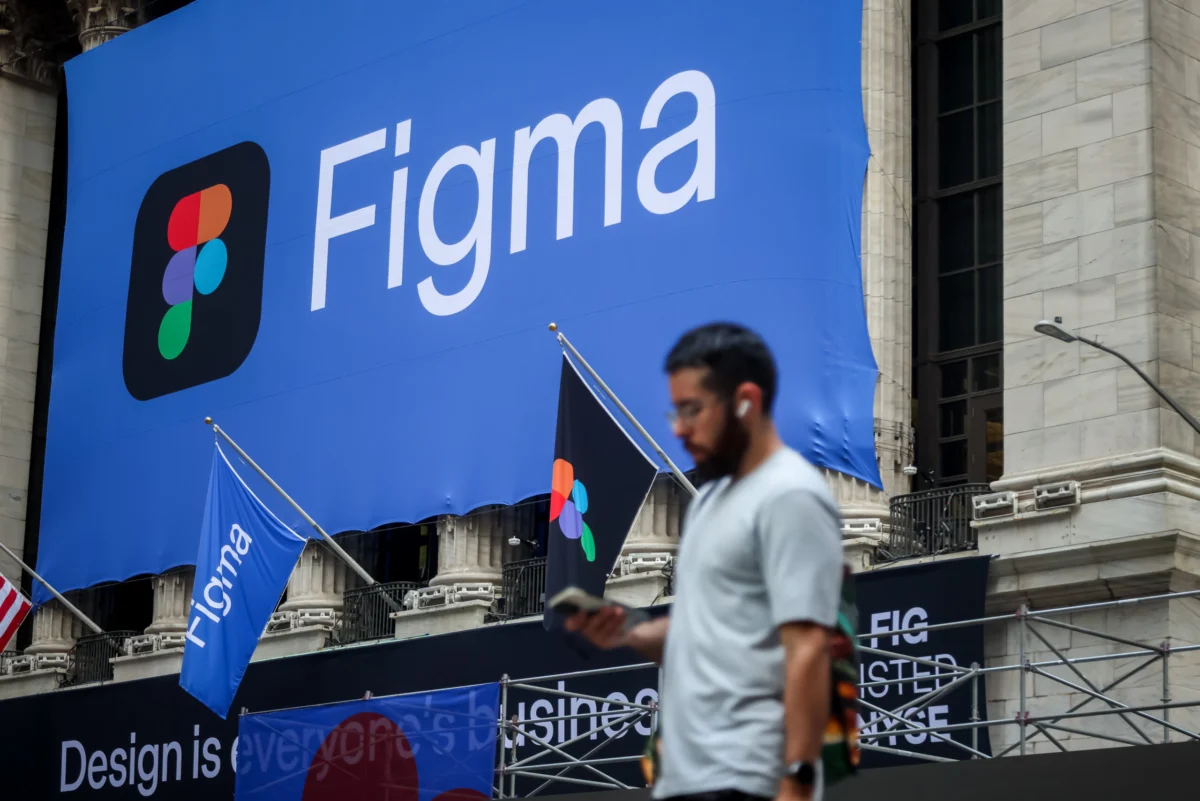
Figma signage is displayed prominently at the New York Stock Exchange in New York as the major design software company prepares for its shares to begin trading on July 31, 2025. The high-profile debut brought intense market scrutiny to the cloud-based design platform, setting the stage for its subsequent quarterly disclosures and financial performance metrics.
In its latest financial update, Figma shares tumbled 7% in extended trading after the company reported third-quarter results and forward-looking guidance that comfortably surpassed Wall Street’s consensus predictions. Despite the robust financial showing across multiple metrics, the immediate negative reaction in after-hours trading highlights the steep expectations already baked into the stock following its mid-2025 public market entry.
Figma’s revenue grew by approximately 43% year over year during the third quarter, according to a corporate statement released by the company. At the same time, its financial bottom line showed substantial improvement as the net loss narrowed significantly to $81.3 million, or 15 cents per share. This represents a stark contrast to the same period a year earlier, when the company posted a net loss of $1.10 billion, or $2.72 per share, underscoring a clear trajectory toward operational efficiency and financial maturity.
Profitability metrics also outperformed consensus estimates tracked across the financial sector. The company’s 12% adjusted operating margin meaningfully exceeded the 6.1% consensus prediction among analysts polled by StreetAccount, demonstrating that Figma is successfully scaling its core business operations while managing its underlying cost structure.
Encouraged by the strong third-quarter performance, company executives moved to lift their full-year financial forecast for the remainder of the fiscal cycle. Figma now anticipates achieving an 11% operating margin for the full year, representing an upward revision from its previous projection of 9% issued back in August. Furthermore, the company upgraded its full-year revenue expectations to a range of $1.497 billion to $1.499 billion, an increase from its earlier guidance of $1.463 billion to $1.467 billion. For comparison, independent analysts surveyed by LSEG had been looking for a full-year 2026 revenue figure of approximately $1.471 billion, placing the newly raised company guidance above the broader consensus expectations.
Looking ahead to the upcoming fiscal period, the company anticipates that fourth-quarter revenue growth will moderate to about 33%. While this marks a sequential slowdown from the blistering 43% pace observed in the third quarter, it still manages to outpace external forecasts. Prior to the earnings release, analysts polled by LSEG had predicted fourth-quarter revenue growth of roughly 28%.
Figma’s earnings announcement arrives against a backdrop of broader sector volatility and structural shifts within the design and collaborative software industry. Just a day prior to Figma’s financial disclosure, highly valued design software startup Canva made headlines across the technology sector by announcing that it would cut 22% of its total workforce, signaling ongoing cost discipline and shifting macroeconomic priorities across private and venture-backed enterprise software competitors.

For public investors, Figma’s stock has faced notable turbulence since its initial public offering. Shares have come down by about 41% so far in 2026, a sharp contrast to the broader market performance where the S&P 500 index has managed to gain 12% over the same timeframe. Earlier this year, market sentiment was weighed down by investor concerns that rapidly advancing artificial intelligence models could pose an existential competitive risk to Figma’s core collaborative design offerings.
However, across much of the broader software sector, this initial panic regarding artificial intelligence—often dubbed the "SaaS-pocalypse"—has largely subsided as established incumbent companies have continued to post persistent, durable revenue growth despite fears of disruption by automated tools.
Figma is actively positioning itself to benefit from the rising enterprise adoption of artificial intelligence to build websites and applications more efficiently. During the third quarter, the company initiated moves to provide more AI credits to its existing client base while keeping its core pricing structure stable.
"What that means is you’re potentially trading off near-term revenue, investing in your customers, and then allowing yourself to then grow durably over the long term," Figma’s finance chief, Praveer Melwani, told CNBC in an interview on Wednesday, explaining the strategic rationale behind the credit expansion.
The operational impact of this strategy is already beginning to materialize within user engagement metrics. The number of weekly active users working at organizations that spend over $10,000 annually on Figma who actively utilized AI credits increased by almost 50% during the quarter, according to data provided in the company’s earnings statement. Additionally, the share of total design and editing work performed by the company’s proprietary AI model doubled over the period, while the rate at which users found it necessary to manually undo AI-generated work has continued to decline.
"If there’s certain actions that we can power for our customers at lower latency, lower cost, or similar quality to third party, we’re open to that as well," Melwani added, highlighting the company’s flexible approach to integrating both proprietary and third-party artificial intelligence capabilities.
Beyond artificial intelligence adoption and product features, Figma is also placing an increased emphasis on corporate cybersecurity measures, according to comments made by Dylan Field, Figma’s co-founder and chief executive officer, during a conference call with financial analysts. In recent months, sophisticated AI agents and automated attack vectors have successfully infiltrated corporate systems at high-profile entities such as Hugging Face and other prominent technology companies, prompting heightened vigilance across the entire enterprise software landscape.
While enterprise clients are not currently demanding that Figma transform itself into a dedicated security vendor, Field emphasized that the company must rigorously scrutinize the operational security of all third-party vendors and external partners right now to protect its sprawling collaborative infrastructure and customer data assets.
| Source | : | Finance Poetry |
| Author | : | rifanmuazin |
| Editor | : | Finance Poetry Editorial Team |