
Stablecoin Giants Tether and Circle Showcase Real-Time Power by Thwarting Record Binance Hack
As North Korean cyberthieves were busy funneling billions of dollars out of Binance last month, the world’s largest cryptocurrency exchange urgently looked to two external industry heavyweights for help to stop the bleeding: Tether and Circle.
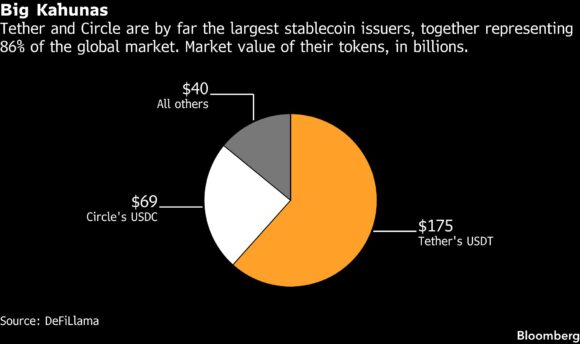
The duo, which together issue the dominant cryptocurrencies designed to mimic the US dollar, reacted with unusual and unprecedented speed to freeze the accounts that hackers were frantically using to move their massive haul across the blockchain. This rapid intervention served as a stark sign of the sheer seriousness of the cyberattack, the broader maturation of the digital asset industry, and the most public showcasing yet of the near-total control that Tether and Circle exert over the proprietary tokens they created. Combined, their two flagship stablecoins represent an overwhelming 86% of all stablecoins currently in circulation globally.
During the unfolding of the $6.3 billion Binance hack—an event that stands as the largest digital asset theft in history—Tether moved swiftly to freeze more than $1.5 billion of its USDT coin within a mere 30 minutes. Concurrently, Circle moved to freeze $1.1 billion of its USDC token. Their decisive and coordinated actions, prompted by urgent appeals from both Binance and the US government, acted as an immediate tourniquet for what otherwise would have been a catastrophic and vastly more expensive heist.
Until this high-stakes incident, Tether and Circle had maintained markedly different historical approaches toward freezing digital assets—a mechanism that essentially blocks the movement of funds to and from specific blockchain addresses. Tether had frequently faced sharp public criticism for operating without a consistent modus operandi. At times, the company allowed tokens to slide away unimpeded, while on other occasions it seized them indefinitely. According to customers who recounted their experiences to reporters, Tether would sometimes even charge a financial fee to eventually return recovered funds.
Meanwhile, Circle’s foundational philosophy until recently had been to act strictly only after receiving a formal court order. This method was traditionally so structured and time-consuming that a judge’s eventual decision could easily be rendered entirely irrelevant by the time it was officially issued.
However, during the historic Binance cybertheft, both companies discarded their typical operational lags and acted almost immediately. Circle referred to this nimble coordination as operating at “machine speed.” Fortunately for Binance, which actually holds a strategic financial stake in Circle, the company adopted a markedly different tack than it had in some prior hacking episodes. Back in May, Circle had quietly modified a policy statement on its corporate website, shifting its requirement from needing a formal court order to merely requiring a legal order from a recognized government authority. A company spokesperson subsequently stated that this specific language adjustment merely reflected "longstanding practice."
Amid the chaos, Binance also temporarily halted withdrawals and fully restored the stolen assets directly to customers’ accounts at its own corporate expense. This unusual move marked a relative success for everyday crypto investors who might otherwise have been left suffering permanent financial losses or lingering in administrative limbo. Yet, the breathtaking speed of Binance’s emergency response stands in sharp contrast to the frustrating experiences of victims from earlier hacks, some of whom have spent years fruitlessly trying to recover frozen funds.
Money on Ice
Consider the case of Bittok Technology Pte. Ltd., a small Singaporean crypto exchange that suffered a devastating $50 million loss to hackers back in June 2020. Tether initially decided to freeze a portion of the stolen assets. Yet, after more than five years of circuitous legal wrangling, not a single dollar of Bittok’s frozen USDT has ever been successfully returned.
Along the way, a lawyer representing Tether advised the entity that ultimately acquired Bittok about a steep 20% "reissuance fee" that would be levied on whatever funds were eventually returned, according to internal emails reviewed by journalists. Investigators noted this is not an isolated incident; in several separate instances, victims reported receiving their stolen USDT only in fragmented chunks over extended periods, accompanied by the exact same style of administrative fee, according to individuals involved who spoke on the condition of anonymity due to private negotiations.
Other individual victims have experienced an even less forgiving reality.
In Berlin, Valentyn Golyshenko spent months posting desperate pleas online for assistance from Tether, regulatory bodies, and politicians after he was caught in a painful $75,000 confidence scam. According to his social media posts, his repeated requests to have the specific fraudulent funds frozen were completely rejected. Ultimately, the personal wallet holding his pilfered cryptocurrency was completely drained down to zero. Tether Chief Executive Officer Paolo Ardoino reportedly blocked Golyshenko online, and the victim recently made his social media accounts private.
In Circle’s case, the company has historically faced the opposite criticism—namely, of being far too rigid and overly prescriptive in its governance model.
When hackers aggressively drained $285 million from a decentralized finance platform called Drift Protocol in April, a vast majority of the stolen funds were swiftly converted into USDC. Rather than freezing the tainted assets immediately, Circle opted to wait, with executives explicitly citing the company’s strict court-order policy. Industry researchers point to more than a dozen similar historical examples where Circle opted against executing freezes over the past few years.
Obtaining such judicial orders is exceptionally arduous, according to legal and investigative professionals. Ollie Smith, a former police officer who now works as a senior investigator at the crypto tracing firm zeroShadow, noted that obtaining these complex court orders is "very, very difficult and very, very complicated." He added bluntly, "They’re not going to get these court orders in 35 minutes."
Meeting Demands
Binance’s $6.3 billion hack was entirely unprecedented in its sheer scale, overall scope, and technical sophistication. It stands not only as the largest cybertheft in the history of the digital asset sector, but as the biggest digital heist in recorded history. Both the US government and independent industry analysts have directly blamed state-sponsored North Korean hacking groups for the breach. Binance has since publicly shared granular details outlining how the cybercriminals methodically infiltrated its internal systems over a period of several months, utilizing tactics that included sophisticated fake job interview offers.
Addressing these realities, Tether views its ongoing approach to managing such criminal schemes as a best-effort attempt to balance the heavy demands of international law enforcement with the protection of its own corporate liabilities, CEO Paolo Ardoino explained in a recent interview.
"When it comes to civil cases, we reissue in steps and we need to manage our own risk in a sense that there could be other claimants," Ardoino said. Highlighting the regulatory vacuum, he added, "The problem is there is no guidance, there is no law that guides this."
Tether is currently working alongside many of the cryptocurrency industry’s largest centralized exchanges to establish direct emergency communication lines specifically for major crisis situations akin to the Binance hack, according to a company spokesperson. To date, Tether has successfully reissued $1.2 billion in USDT to rightful claimants, with the controversial fees it charges helping to directly fund that complex administrative process alongside mounting legal defense costs.
The company has aggressively touted its broader efforts to halt illicit financial activity, particularly during the second administration of US President Donald Trump. In a press release celebrating its actions during the Binance hack, Tether boasted about having successfully frozen more than $7 billion in total illicit assets to date. Simultaneously, the US Department of Justice has publicly thanked Tether for its close coordination in national efforts to halt sophisticated money laundering schemes and cut off illicit payments destined for sanctioned nations, including Iran.
In total, Tether now actively interacts with 73 different countries and more than 170 governmental agencies on collaborative initiatives aimed at stopping the illegal misuse of stablecoins, the spokesperson noted. The firm has also funded specialized training programs designed to empower law enforcement agents to investigate complex crypto-related crimes across four separate continents.
At the same time, Tether has faced mounting cross-border legal difficulties as it aggressively pursues USDT freezing orders. Over just the past few months, the company has been formally sued by Thai businessmen and digital payments firm Conduit Technology Inc. over separate, contentious freezing incidents, while it also remains deeply embroiled in ongoing court proceedings concerning Iran-linked assets.
Just five years ago, Tether occupied a profoundly different position within the financial ecosystem. In 2021 alone, the company was slapped with roughly $60 million in fines by state and federal regulatory authorities for allegedly making misleading claims regarding the true composition of the reserves Tether utilizes to maintain its token’s stable peg to the US dollar. Tether settled those matters without formally admitting to any underlying wrongdoing.
During that era, Tether rarely blacklisted funds at scale, nor did it attempt to draw public attention to its rare freezing actions. However, under the current political landscape, the company has made a concerted, strategic effort to align itself much more closely with official US government policies. This alignment includes capitalizing on a 2025 stablecoin regulation that has significantly boosted Tether’s commercial standing, as well as echoing political rhetoric championing dollar-backed tokens as a vital tool for reinforcing the US greenback’s global currency supremacy.
The growing frequency of stablecoin freezing reflects a broader evolution in the market, as large-scale hacks and sophisticated illicit fund movements have become increasingly prevalent within this specific segment of the crypto economy, according to Ari Redbord, global head of policy at blockchain-security firm TRM Labs. In Redbord’s view, these security trends are bound to continue, but the central dilemma facing the industry is not whether entities like Tether and Circle possess the technical capability to freeze funds in real-time, but whether everyday customers will ever actually see their stolen funds reimbursed.
"The really important piece of the puzzle is the reissuing, because that’s how victims get their funds back," Redbord emphasized.
Rule-of-Law Operations
Whereas El Salvador-based Tether operates as a wildly profitable, privately held corporate rebel that invests aggressively across a diversified range of assets spanning physical gold to private securities, Circle is a publicly traded, New York-headquartered enterprise that was meticulously designed from its inception with regulatory compliance at its core. Its CEO, Jeremy Allaire, is widely known for strictly adhering to institutional norms to proactively avoid legal peril.
"We’re a rule-of-law company," Allaire stated in a recent interview, explaining how Circle’s corporate demeanor has steadily adapted in response to the rapidly accelerating sophistication of cyber hacks and the shifting demands of law enforcement agencies.
"The threat environment has been evolving very rapidly, even just over the past three months," Allaire noted. "Circle itself, the industry more broadly and law enforcement, all together, are operating on faster rhythms right now."
Yet for individual victims like Joshua McCollum, the lead plaintiff in a class-action lawsuit filed against Circle over its controversial handling of the Drift Protocol hack, such institutional evolution offers little comfort. McCollum lost approximately $23,500 during the April 1 exploit and is just one of more than 100 affected investors seeking formal financial restitution, according to court filings. The lawsuit details how prominent members of the digital asset community actively warned Circle on social media channels in real-time that a major exploitation was actively underway as funds continuously drained away. Afterward, Circle publicly cited its strict procedural policy regarding court orders, with Allaire defending the inaction at the time by calling it a difficult "moral quandary."
"Circle’s early intervention in last month’s Binance hack underscores that it has always had the power to respond quickly to avert massive losses by its users and investors," attorneys for McCollum from the law firm Gibbs Mura said in a written statement. "Unfortunately, for the victims of the Drift exploit, it is too little, too late."
Circle has formally requested that the presiding judge dismiss the class-action lawsuit entirely. In accordance with corporate policy, a company spokesperson declined to comment on pending litigation.
Same Headaches

While every individual recovery case possesses unique attributes, the overarching administrative headaches associated with retrieving frozen stablecoins from either Tether or Circle remain remarkably consistent for victims worldwide.
Tether typically complies with freezing orders "without thinking twice," according to Sathya Narayanan Subramanian, an India-based advocate at VSM Legal Associates who has actively represented USDT holders across Russia, Germany, and Spain. To date, none of his affected clients have successfully managed to have their frozen funds reissued.
Tether has "nothing to lose, to be very frank," Subramanian said, adding, "At the end of the day they have control of the assets."
Subramanian is far from alone, joining a chorus of legal representatives and victims who have voiced profound frustration regarding systemic hurdles in recovering frozen digital assets.
Meanwhile, shifting political winds in Washington could further complicate the future landscape for anyone still waiting for their stablecoin accounts to be unfrozen. Although Donald Trump remains in the White House, Democrats recently captured control of both houses of the US Congress—a legislative shift that policy experts view with caution regarding the broader trajectory of the cryptocurrency sector. What this dynamic ultimately means for everyday victims who had their digital savings stolen remains uncertain.
Policy analysts point specifically to a scathing September report published by the US Senate’s Permanent Subcommittee on Investigations, which directly blamed Tether for enabling Iran to allegedly utilize USDT to successfully evade international sanctions and finance regional militant proxies, including Hezbollah.
Tether is currently doing "nowhere near enough" to aggressively crack down on international criminals who systematically exploit its digital tokens, according to US Senator Richard Blumenthal, a Democrat representing Connecticut who authored the congressional report. Blumenthal has long stood out as one of the few prominent legislative voices persistently advocating for enhanced consumer protection measures within the decentralized finance space.
"Tether is one entity that deserves very serious and penetrating scrutiny and investigation," Blumenthal said in an interview.
While Ardoino dismissed Blumenthal’s scathing remarks as an unsubstantiated political attack, both he and Allaire appear to fully recognize that the monumental Binance hack served as a critical proving ground for their respective institutions to validate their utility to both retail customers and skeptical governments alike.
"Illicit actors will always try to find new ways and we are going always to find new ways to catch them," Tether CEO Ardoino asserted during his interview. "And it’s almost like suggesting that, ‘oh, there are robberies.’ Yes, there are robberies, but there will be always robberies and you always get better to find the thieves. And that is exactly what we’re doing."
| Source | : | Finance Poetry |
| Author | : | rifanmuazin |
| Editor | : | Finance Poetry Editorial Team |