
Thousands of Protesters Flood New Delhi Streets to Demand Election Chief’s Resignation Over Voter List Overhaul
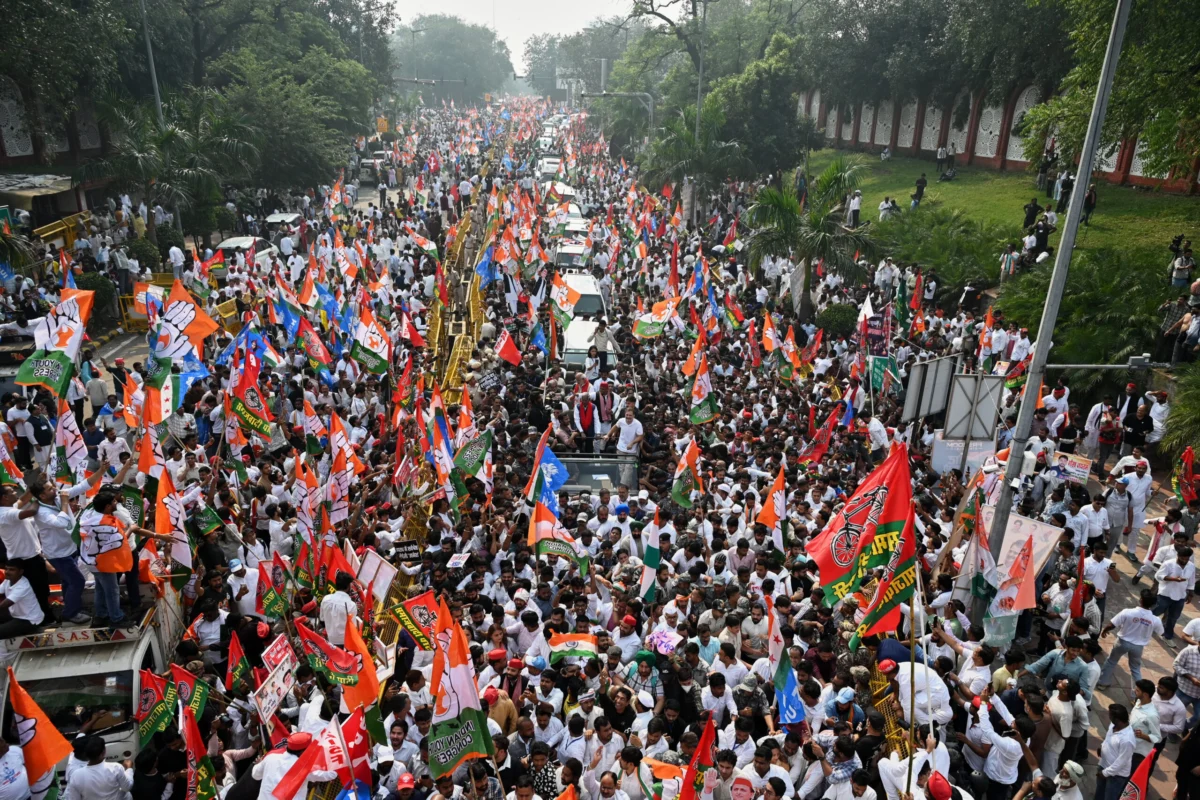
NEW DELHI — Thousands of protesters took to the streets in India’s capital on Sunday, demanding the resignation of the country’s chief election commissioner. The mass demonstration was triggered by sweeping changes to voter lists that opposition parties argue are deliberately structured to favor Prime Minister Narendra Modi’s ruling Bharatiya Janata Party (BJP).
The high-stakes rally in central New Delhi represents the latest escalation in more than a month of continuous demonstrations challenging the revision of electoral rolls and the conduct of Chief Election Commissioner Gyanesh Kumar. Indian National Congress party leader Rahul Gandhi led Sunday’s major demonstration, standing alongside other key opposition figures as they traveled in an open-top jeep while demonstrators waved Indian national flags and party banners.
The controversy centers on a massive voter list revision exercise that has removed more than 130 million names from electoral rolls nationwide. Opposition parties have fiercely alleged that the overhaul disproportionately targeted Muslims and other minority communities who are traditionally considered unlikely to support Prime Minister Modi’s Hindu nationalist agenda. Critics argue that stripping millions of marginalized voters from the registry threatens the fundamental integrity of India’s democratic system.
The protests have steadily gathered momentum since late September, galvanized initially when Chief Election Commissioner Kumar’s two deputies raised internal concerns regarding the management of the voter list revisions, registration procedures, and digital systems. These internal disputes quickly spilled into the public sphere, fueling broader public distrust and leading to near-daily demonstrations organized by a coalition of opposition parties, student organizations, and the youth-led Cockroach Janta Party.
Political analysts have described the unfolding demonstrations and the consolidation of opposition resistance as the most serious political crisis Prime Minister Modi has faced since he first assumed office in 2014.
Ahead of Sunday’s march, local authorities and security officials implemented heavy security measures and announced extensive traffic diversions. Demonstrators marched from central New Delhi toward the historic Ramlila Maidan ground, a traditional venue for major political protests and public gatherings in the capital. Hundreds of police officers, including units carrying batons and tactical shields, were deployed extensively around the rally site, supported by heavy riot-control vehicles to maintain public order.
Despite the scale of the public mobilization, the Election Commission has steadfastly denied favoring any political party. Election officials have maintained that the revision exercises are administrative necessities designed to clean up electoral rolls. Furthermore, the commission has stated that any eligible voters whose names were mistakenly or improperly removed from the registries are encouraged to complete the registration process again to restore their voting rights.
The ruling BJP has pushed back aggressively against the opposition’s narrative, accusing rival parties of actively undermining democratic institutions and delegitimizing standard electoral procedures for partisan gain. India’s general elections are constitutionally scheduled to take place in 2029, but the fierce battle over the voter registries has ignited political tensions years in advance.
Senior government officials did not hold back in their criticism of Sunday’s massive rally at Ramlila Maidan. Health Minister Jagat Prakash Nadda dismissed the entire demonstration as a "carefully orchestrated drama" designed to create political instability rather than address genuine policy grievances.
"What is unfolding today at Ramlila Maidan is not an act of respect for democracy," Nadda told the ANI news agency during a media briefing. "It is a calculated conspiracy to plunge the nation into anarchy, all in the name of democracy."
As the political showdown between the ruling administration and a resurgent opposition continues to play out on the streets of New Delhi, the dispute over the integrity of India’s electoral rolls shows no signs of abating. With months of protests already behind them and the next general election looming on the horizon, both sides remain deeply entrenched in a battle over the future of the world’s largest democracy.
| Source | : | Finance Poetry |
| Author | : | rifanmuazin |
| Editor | : | Finance Poetry Editorial Team |