
US, Russia and China Hold Historic Trilateral Meeting in Shenzhen as Beijing Shapes Global Diplomacy
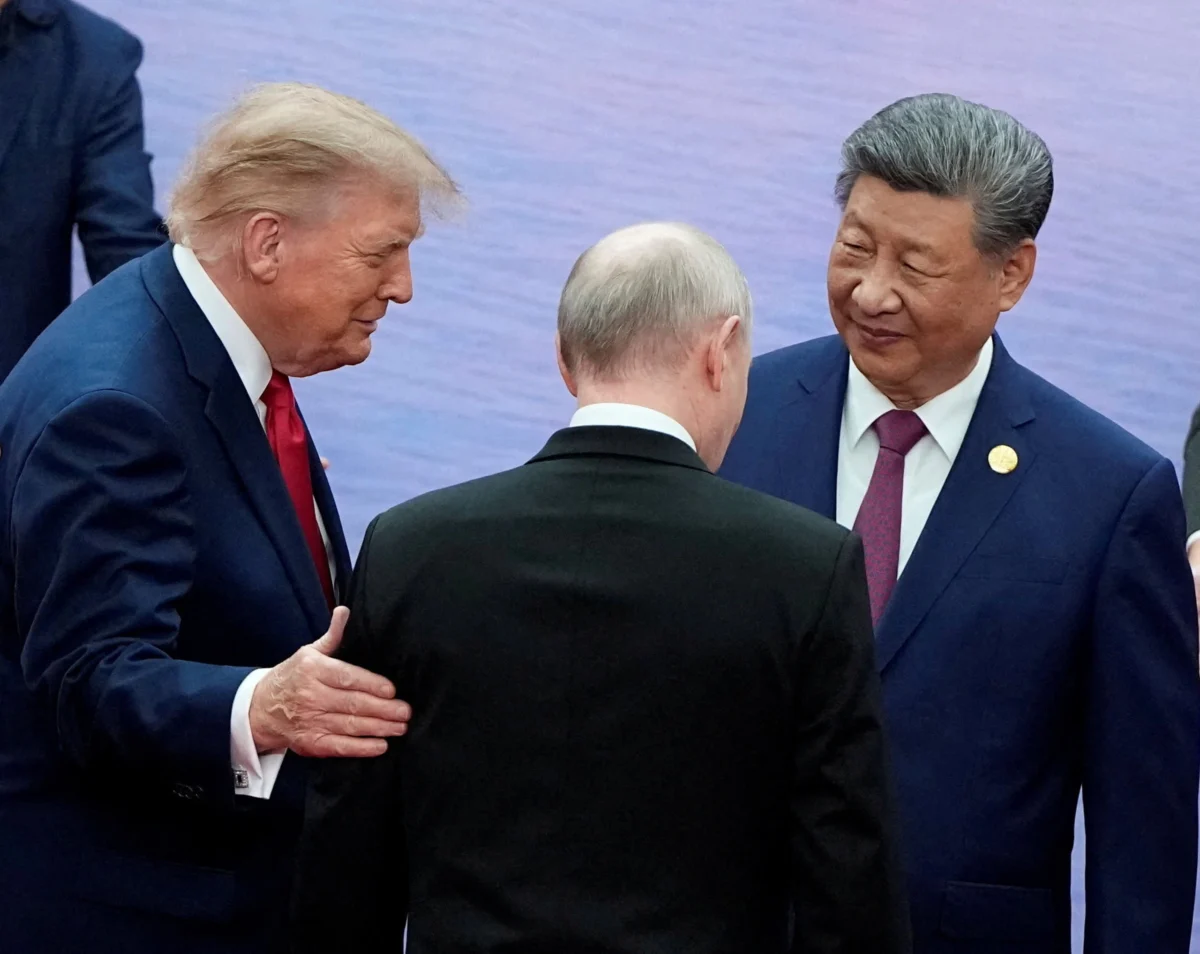
SHENZHEN, China — For the second consecutive year, Chinese President Xi Jinping has successfully brought together some of the world’s most formidable and strategically consequential leaders on mainland Chinese shores, cementing Beijing’s growing stature as a central hub for high-stakes international diplomacy.
U.S. President Donald Trump participated in a high-profile trilateral meeting with Chinese President Xi Jinping and Russian President Vladimir Putin on Thursday, following an initial gathering the previous evening during a grand welcome banquet for the Asia-Pacific Economic Leaders’ Meeting in Shenzhen, Guangdong province. The landmark gathering marked the very first time the three leaders have ever met together in person in a trilateral format, creating an unprecedented diplomatic tableau on the global stage.
The momentous event in southern China immediately drew comparisons to a similar diplomatic photo opportunity that occurred in September 2025. At that time, Xi, Putin, and Indian Prime Minister Narendra Modi briefly laughed together for a friendly photo-op on the sidelines of an annual meeting of the Shanghai Cooperation Organization in Tianjin, China—a gathering that closely followed a period of easing geopolitical tensions between Beijing and New Delhi.
The progression from regional multilateral optics to a direct, three-way engagement involving the United States, China, and Russia highlights an evolving diplomatic landscape. Analysts note that China’s ongoing efforts to host and facilitate these pivotal interactions underscore its expanding diplomatic footprint and influence across the Global South and the vast expanse of Eurasia.
Summit Diplomacy
China’s demonstrated ability to engage directly and consistently with the world’s major powers reflects a calculated strategy to anchor its influence in an increasingly fragmented international order, according to foreign policy experts.
"China hopes to play a more constructive role in this conflict-ridden, unstable world," said Jodie Wen, a postdoctoral fellow at the Center for International Security and Strategy at Tsinghua University. Looking ahead, she suggested that "China will hope to provide more platforms" within its own sovereign borders for the international community to deliberate, negotiate, and address pressing global friction points.
Beijing has increasingly leaned into the role of diplomatic broker on the world stage. Most notably, China provided the crucial neutral forum that successfully brokered the restoration of diplomatic ties between regional adversaries Saudi Arabia and Iran in 2023, signaling its readiness to mediate complex geopolitical disputes outside of traditional Western-led diplomatic frameworks.
By actively participating in and hosting a diverse array of multilateral organizations, Beijing has successfully maintained its footing within the broader Western-dominated global economic orbit while simultaneously cultivating deep, strategic relationships with non-Western nations. The high-profile photo-ops captured in Tianjin last year and now in Shenzhen represent only a small fraction of the staggering diplomatic calendar managed by Xi and his foreign ministry.
Official Chinese readouts and subsequent analyses indicate that Xi has hosted well over 40 heads of state so far this year alone. This heavy diplomatic workload included hosting at least eight visiting leaders concurrently around the high-stakes Asia-Pacific Economic Cooperation (APEC) meetings in Shenzhen this week. This intense schedule follows a massive diplomatic push in 2025 that saw the Chinese leader receive more than 60 state visits.
Domestic Chinese media have extensively covered these high-level engagements, consistently highlighting how Xi has utilized events hosted on Chinese soil to meet with a wide spectrum of foreign counterparts, reinforcing the narrative of a confident, globally connected superpower.
Yue Su, principal economist for China at the Economist Intelligence Unit (EIU), noted that Beijing views these sprawling multilateral platforms through a dual lens. "Beijing sees these multilateral platforms as opportunities to expand its international influence and demonstrate its commitment to multilateralism, while bilateral diplomacy remains equally important," Su explained.
At the same time, Su cautioned that the realities of modern geopolitics present substantial hurdles to achieving substantive consensus. As different nations increasingly pursue divergent geopolitical objectives and economic priorities, securing unified agreements through traditional multilateral organizations becomes exceptionally difficult.
"Against this backdrop, China’s diplomatic priorities are increasingly focused on delivering tangible economic benefits through trade, investment, financial connectivity and technology cooperation," Su added, emphasizing that Beijing is eager to anchor its political influence in practical, economic partnerships.
APEC Outcomes
Beyond the captivating optics of the trilateral summit, the broader APEC Economic Leaders’ Meeting produced concrete initiatives and sweeping policy declarations from Beijing.
On Thursday, during his address to regional leaders, President Xi announced that China would commit $20 million in targeted financial and developmental support for the wider Asia-Pacific region. Building on this financial pledge, Xi passionately advocated for the development and institutionalization of what he termed an "Asia-Pacific community with a shared future." The phrase serves as a specific regional iteration of his commonly used, broader philosophical slogan regarding a "shared future" for all of humanity—a concept Beijing frequently deploys to contrast its multilateral vision with protectionist or isolationist tendencies elsewhere in the world.
Tsinghua University’s Wen emphasized that summits of this magnitude, particularly those held in Shenzhen, carry immense practical value because they create meaningful institutional outcomes for international crisis management. Furthermore, they provide essential diplomatic breathing room and physical space for future behind-the-scenes negotiations. In an era marked by deep geopolitical distrust, Wen argued that it remains critically important for top leaders to come together in person, a dynamic that helps mitigate dangerous misunderstandings and prevent the further escalation of global tensions.
The utility of such face-to-face diplomacy was immediately evident during the unprecedented trilateral session. President Trump remarked during the meeting that the United States, China, and Russia find themselves "uniquely positioned" to engage in serious discussions regarding the reduction of global nuclear arsenals, labeling the gathering a historic milestone for great power communication.
Following the conclusion of the closed-door talks, a comprehensive Chinese official readout revealed that the three world leaders used the historic forum to exchange views on some of the most intractable geopolitical flashpoints of the era, including the ongoing conflict in Ukraine, the volatile security situation in the Middle East, and the enduring challenges on the Korean Peninsula.
| Source | : | Finance Poetry |
| Author | : | rifanmuazin |
| Editor | : | Finance Poetry Editorial Team |