
Zest Brings Its AI Restaurant Concierge Directly to Text Messages
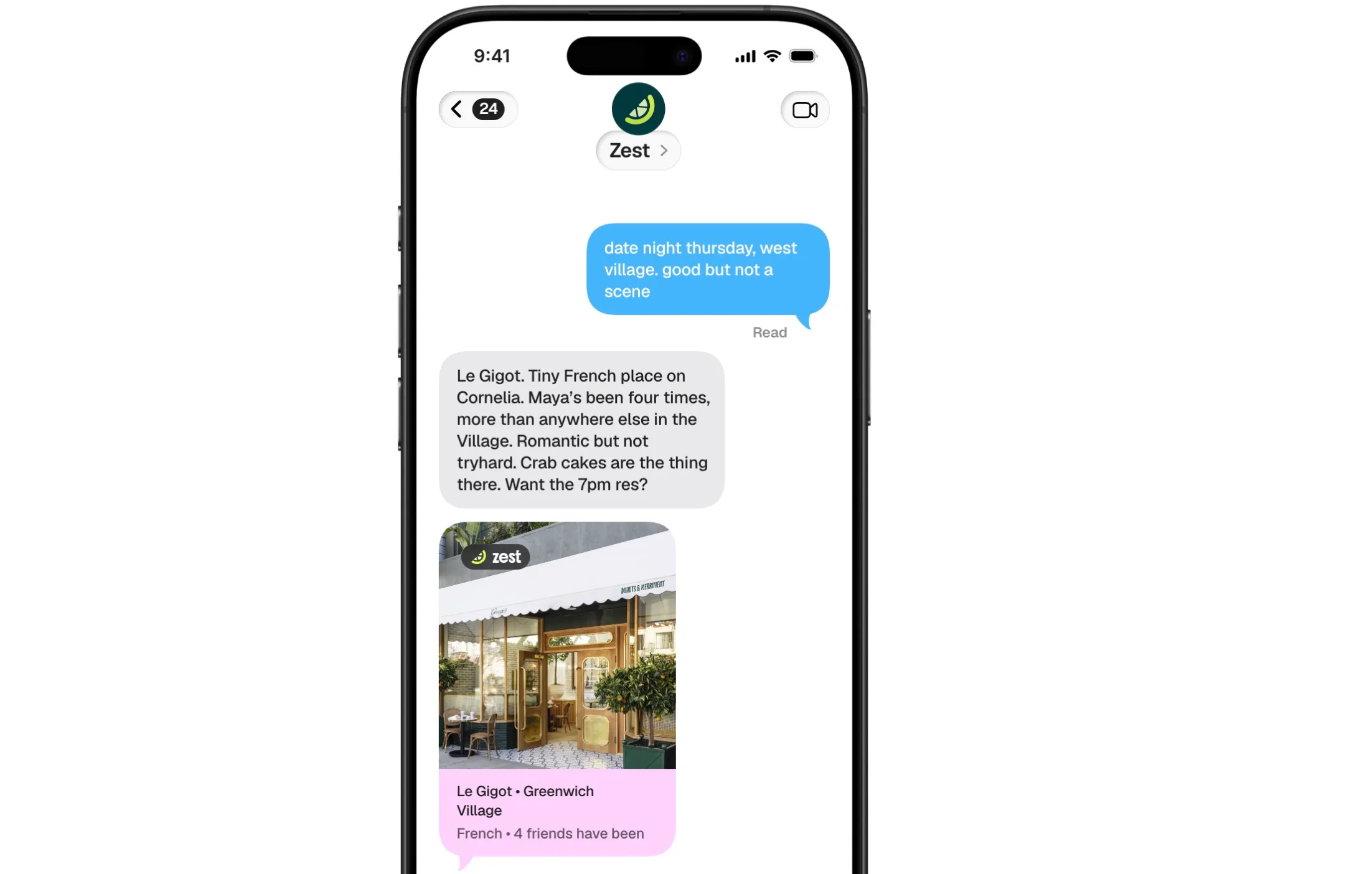
Zest, the innovative restaurant discovery application that initially launched earlier this year to help diners find places based on where people actually eat, is already looking ahead to a future where traditional standalone mobile apps may no longer serve as the primary digital interface for consumers. Accelerating this vision, the startup introduced a major new feature on Thursday: a personal, artificial intelligence-powered restaurant concierge that operates natively within text messages, joining a growing wave of conversational AI agents designed to meet users inside their existing communication channels.
The launch of the text-based concierge reflects a much broader structural shift across the technology startup ecosystem. Increasingly, companies are exploring how conversational AI agents can autonomously execute multi-step tasks that previously forced users to download, open, and navigate standalone mobile applications. For Zest, this evolution means translating its signature localized restaurant recommendations directly into standard text message threads, and then empowering users to seamlessly transition from discovering a venue to locking in a reservation without ever leaving the conversation.
According to Zest founder and CEO Mario Gomez-Hall, the core philosophy guiding this latest release centers on shifting the focal point of digital interaction from a static piece of software to a dynamic conversational assistant. He explained that the agent effectively becomes the core product, noting that users simply text the service and receive immediate answers tailored to their unique history and the shared dining preferences of their friends. Gomez-Hall emphasized that the system does not require weeks of drawn-out conversational onboarding to understand an individual’s tastes because it immediately starts from a foundation of where the user has actually dined in the real world.
Founded initially in November 2024 with $1.8 million in pre-seed financial backing led by prominent investors Alexis Ohanian at 776 and Steve Jang at Kindred Ventures, Zest built its core value proposition around a distinctive data integration mechanism. The app links directly with users’ credit cards to securely track where they actually spend money on dining out, establishing a precise and authentic profile of their culinary tastes, interests, and spending habits. Armed with this verifiable financial data, Zest can generate highly tailored, hyper-personalized suggestions regarding what dining establishments a user might want to try next, whether they are looking for a new spot in their hometown or seeking out reliable culinary recommendations while traveling in unfamiliar cities.

The underlying transaction data utilized by Zest is seamlessly imported via Plaid, the widely trusted financial services technology platform relied upon by major traditional banks, modern fintech applications, and popular personal budgeting tools. To protect user privacy and maintain relevance, Zest has consistently noted that its algorithmic mapping and recommendation engines focus strictly on transactions categorized specifically within the food and drink sectors when curating personalized maps and restaurant lists.
With its latest feature rollout, the startup is tackling the eternal dilemma of where to eat from an entirely fresh angle, shifting the interaction model away from app grids and map interfaces. The new text-based concierge can leverage advanced artificial intelligence to handle complex logistical chores, such as checking real-time table availability and executing reservations on behalf of the user through deeply integrated partner reservation networks like OpenTable, Resy, and SevenRooms.
To utilize the service, users can directly text the Zest concierge at its designated phone number. One of the most compelling aspects of the system is its capability to be integrated directly into collaborative group chats with friends, family, or colleagues. In a group setting, the AI can intelligently blend the diverse culinary tastes and dietary preferences of all participants to surface dining options that the entire group will genuinely enjoy. Furthermore, the concierge can help resolve common group indecision through an integrated in-thread voting feature, subsequently booking a table for the entire party directly inside the messaging interface.
Users can query the Zest concierge for recommendations using a wide array of criteria, including specific cuisines, active cravings, social occasions, dietary restrictions, or neighborhood preferences. The system is also equipped to answer detailed questions about specific dining establishments, such as assessing how busy a venue is likely to be at a given hour, checking whether it provides reliable guest Wi-Fi, or retrieving full menus to help diners finalize their choices before committing to a reservation.

Early evaluations of the AI assistant demonstrated that the technology functions reliably, delivering tailored lists of newly discovered dining spots that precisely match individual preferences while respecting situational constraints such as specific times of day, party sizes, and geographical locations. While the fundamental capability of finding open restaurant tables online is a service that various digital platforms have offered for years, the primary advantage introduced by Zest lies in the sheer convenience of conversational friction-reduction. Users can converse back and forth naturally about various options and instantly receive accurate, up-to-the-minute booking availability without toggling between multiple apps or browser tabs.
The company initially began quietly testing the text concierge concept with a limited audience last month, but deliberately chose to hold off on a public launch until it could successfully integrate robust table-booking capabilities into the messaging workflow. Looking ahead down its long-term product roadmap, the startup is actively considering expanding Zest’s capabilities far beyond restaurants, potentially introducing smart recommendations for general local businesses, retail shopping, and other consumer experiences.
By pivoting heavily toward text messaging as a primary distribution channel, Zest leadership hopes the company can rapidly scale its user base well beyond its initial thousands of early adopters while simultaneously establishing a viable, recurring revenue model.
Gomez-Hall noted that booking and food ordering operations represent the company’s primary initial revenue streams. He pointed out that Zest currently facilitates table bookings through major platforms like OpenTable and Resy, with direct food ordering functionalities slated to follow, creating transactional touchpoints for the business. He added that the underlying strength of the model is that Zest learns individual user tastes significantly faster than a general-purpose digital assistant because it grounds its insights in actual historical behavior rather than administering lengthy onboarding questionnaires, an asset he believes carries profound value well beyond the dinner table.
| Source | : | Finance Poetry |
| Author | : | rifanmuazin |
| Editor | : | Finance Poetry Editorial Team |