
Gaza Cinema Academy Launches Second Annual Women’s Film Festival Amid Ruins of al-Bureij
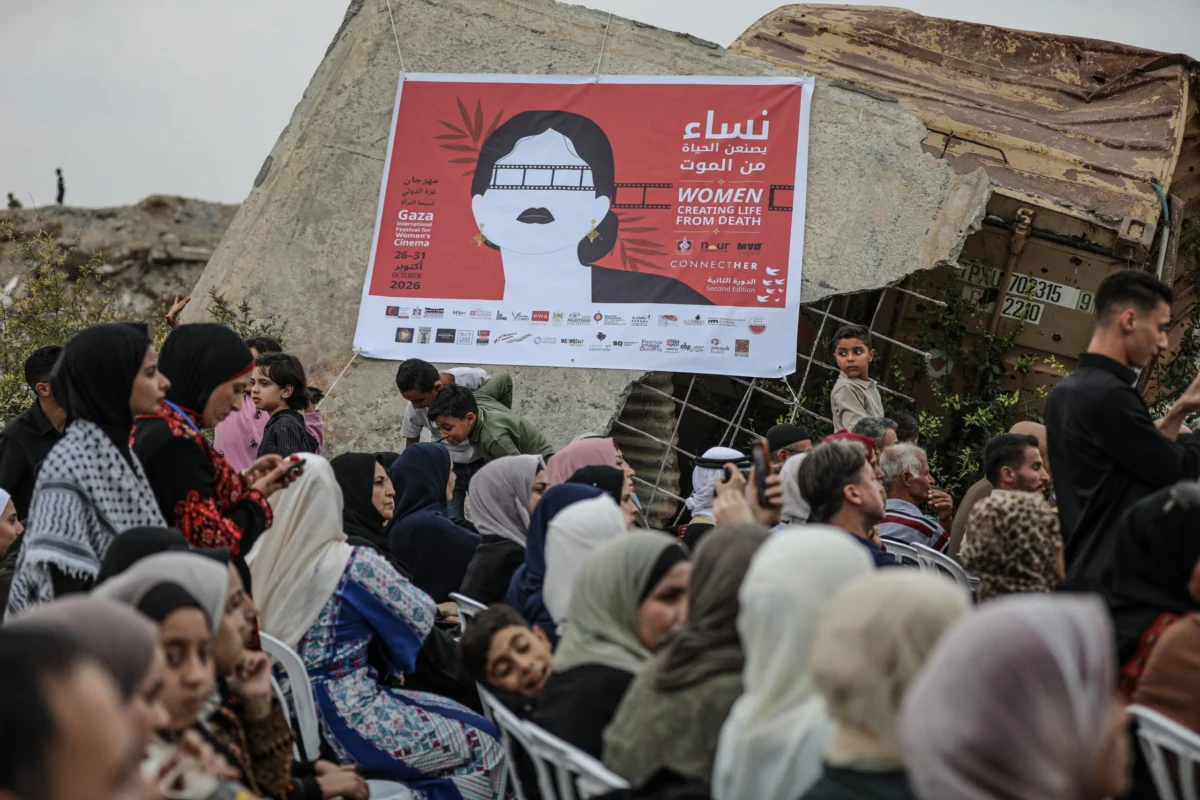
AL-BUREIJ, Gaza Strip — Against a backdrop of profound devastation, the second Gaza International Women’s Film Festival opened on Monday, serving as both a celebration of resilience and the official launch of the Gaza Cinema Academy. The event’s opening ceremony took place amid the skeletal remains of the al-Nakheel Hall in al-Bureij, located in the central Gaza Strip. The venue, like the overwhelming majority of architectural structures across the enclave, stands heavily damaged and scarred following three years of relentless bombardment during Israel’s war, which has claimed the lives of more than 74,000 Palestinians.
Gathered under the powerful and defiant slogan “Women Creating Life from Death,” attendees witnessed the screening of five poignant short documentaries directed by emerging Palestinian women. These films formed the core of the opening day, offering raw, unfiltered visual testimony to the realities of daily life, loss, and survival under siege. The showcase provided a platform for voices that have been systematically marginalized by years of blockade, military assault, and the destruction of cultural infrastructure.
Among the standout features of the opening night was A Sack of Flour, an 11-minute documentary directed by emerging filmmaker Mona Abu Qass. Drawing directly from her own personal experiences, Abu Qass examines the calculated use of starvation as a weapon against Palestinians in Gaza. The film captures the agonizing, everyday struggle to secure basic sustenance, the extreme perils associated with navigating chaotic aid distribution points, and the tragic loss of lives simply incurred in the pursuit of a single bag of flour.
Furthermore, Abu Qass explores the enduring psychological aftermath of hunger, demonstrating how the trauma persists within families even after food supplies intermittently become available again. These themes have assumed an agonizingly renewed relevance amid ongoing Israeli restrictions on the entry of vital goods and sudden cuts to international food assistance, which have triggered severe shortages and reignited widespread fears of an impending return to famine.
“The idea for the film stems from a personal experience and a true story,” Abu Qass told Al Jazeera, reflecting on the arduous production process. “It documents daily life in Gaza, weighed down by bombardment, destruction, siege, hunger, and loss.”

She added that her primary objective as a filmmaker is to record the granular details that reveal both profound suffering and an unyielding human determination to cling to existence. “I want to capture details that reveal suffering and people’s determination to hold on to their life,” Abu Qass said. “I seek to show reality as people experience it and help viewers understand what the war has done to their relationships, dreams, and hopes.”
Highlighting Struggles of the Disabled
The festival’s opening slate also featured Beyond Silence, a deeply moving documentary that marks the directorial debut of emerging filmmaker and journalist Raghda al-Buhaisi. The film turns its lens toward the often-overlooked wartime struggles endured by people with disabilities in Gaza, framing the narrative through the life of a deaf artist who never learned to read, write, or communicate through traditional sign language.
The artist’s life was upended when his studio in Rafah, southern Gaza, was completely destroyed by Israeli bombardment, a catastrophe compounded by the tragic loss of his parents and several other close family members. Following his displacement to Deir el-Balah in central Gaza, another local family took him in and assisted him in establishing a modest workspace by the roadside. Today, his paintings serve as a visual language of grief, reflecting the depths of his personal loss and displacement, and expressing through color and line what spoken words cannot.
“I want to highlight the additional challenges people with disabilities face during war, including displacement, family loss, and the destruction of livelihoods,” al-Buhaisi told Al Jazeera. “Art can cross barriers of language and silence, turning an individual experience of pain into a visual message that conveys Gaza’s suffering to the world.”
Complementing these two works were three additional short documentaries created by emerging Palestinian women filmmakers: Soso: The Lifeline, Remnants of Light, and Dandana. Each film captures a distinct facet of the human condition under siege. Soso: The Lifeline follows an orphaned child and his loyal donkey as they navigate the ruins to help community members survive. Remnants of Light chronicles a filmmaker’s internal struggle to process the catastrophic loss of her family and home. Meanwhile, Dandana tells the heartbreaking story of a mother who lost all eight of her children, and who ultimately turns to traditional Palestinian songs alongside her surviving family members as a mechanism to cope with overwhelming grief.
These five short documentaries were brought to fruition through an intensive filmmaking diploma program that commenced in March, successfully uniting 25 young Palestinian women under a shared artistic vision.

Preserving Gaza’s Stories
Festival director Ezzedine Shallah emphasized that the curated films draw directly from the lived realities of women and girls throughout the war, functioning as vital visual testimonies while granting women the autonomy to narrate their own stories in their authentic voices.
“Though their subjects differ, the films turn individual pain into broader human stories, revealing war’s psychological and social scars,” Shallah told Al Jazeera. “They preserve stories that might otherwise never reach the screen, transforming suffering into cinematic testimony and bringing Gaza’s stories to audiences beyond its borders.”
The festival, scheduled to run through October 31, features an expansive lineup of 73 films originating from 24 countries, thereby establishing a broader international platform for local filmmakers from Gaza and their global counterparts.
Despite the profound cultural significance of such initiatives, filmmaking within the Gaza Strip remains fraught with formidable obstacles. The systemic destruction of cultural institutions, severe scarcity of proper equipment, limited financial backing, chronic power and internet outages, and the relentless pressure of ongoing war and displacement have heavily restricted opportunities for sustainable film production. Female filmmakers face even steeper barriers in accessing specialized training, production resources, and pathways to international festivals.
Filmmaker Rima Mahmoud, a co-founder of the festival, noted that the protracted military siege on Gaza—which existed long before the escalation in 2023—has consistently hindered the ambitions of young women directors. These structural limitations have forced many creators to rely on rudimentary methods and self-funding to document their reality against all odds.
“Despite limited resources, these films deserve international exposure,” Mahmoud said. “Their makers need technical and financial support, translation, and partnerships with festivals and platforms.”

Resisting Attempts at Erasure
Prominent Palestinian filmmaker Mai Masri, based in Lebanon and a fellow co-founder of the festival, stressed that these cinematic endeavors empower young women to reclaim their narratives, resist ongoing attempts at erasure, and actively preserve collective memory. At the same time, the initiative equips participants with marketable skills and opens professional pathways within Gaza and across digital platforms.
To formalize and expand these efforts, the newly launched Gaza Cinema Academy has established a specialized filmmaking diploma program in cooperation with al-Quds Open University, which has been fully accredited by the Palestinian Ministry of Education. Masri noted that the academy is actively forging pathways to connect local directors with international screening circuits.
“We are seeking agreements with distributors to screen these films in educational and cultural institutions outside Palestine, and through international platforms and festivals focused on women’s and human rights,” Masri said.
“This would bring the voices of Palestinian women to a global audience, shed light on their human experiences and artistic creativity, strengthen the presence of Palestinian cinema internationally, and open new horizons for young female directors to reach global screening platforms and film festivals,” she added.
| Source | : | Finance Poetry |
| Author | : | rifanmuazin |
| Editor | : | Finance Poetry Editorial Team |