
Historic Mississippi Senate Race Ushers in Democrat Scott Colom and Breaks 150-Year Barrier
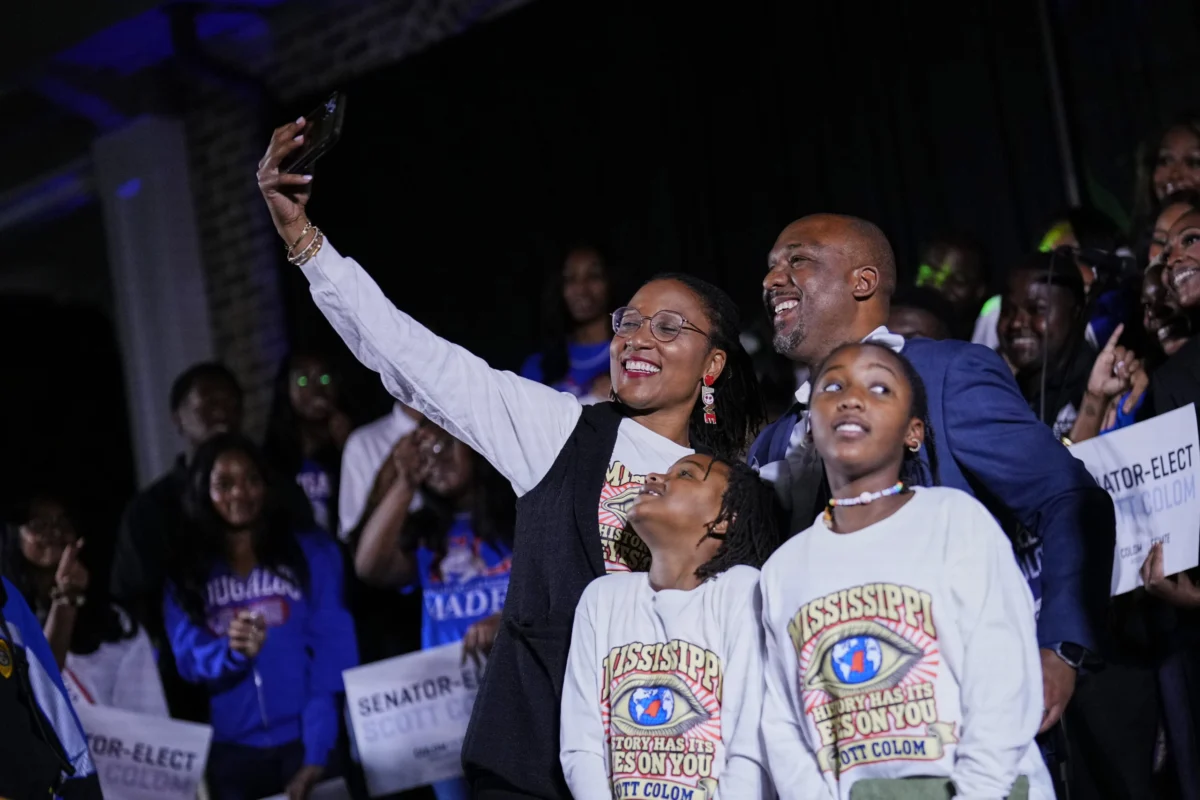
JACKSON, Mississippi — In what political analysts are already calling one of the most stunning upsets in modern American political history, Democrat Scott Colom has secured a historic victory in Mississippi, defeating Republican incumbent Cindy Hyde-Smith. The narrow win not only solidifies a broader national "blue tsunami" that has firmly handed Democrats control of both the United States Senate and the House of Representatives, but it also marks a profound turning point for the Deep South state.
Colom, a seasoned prosecutor and lawyer, has made history by becoming Mississippi’s first Black senator in more than 150 years, as well as delivering the state’s first Democratic Senate victory in over four decades. The last time a Democrat captured a Senate seat in Mississippi was in 1982. Furthermore, Colom’s triumph carries immense weight for the state’s African American community, making him the first Black senator to represent Mississippi since 1874.
The race was fiercely contested and went down to the wire. Colom’s narrow victory over Hyde-Smith—a staunch ally of President Donald Trump—was officially declared late on Wednesday, more than a week after the high-stakes US midterms. With 99 percent of the ballots counted, Colom edged ahead of the incumbent by fewer than 5,000 votes.
The outcome defied pre-election polling in Mississippi, a deeply conservative stronghold where Trump had previously won by 23 points in the 2024 presidential election. Colom’s victory expands the Democratic majority in the Senate to 55-44, with another exceptionally tight race in Alaska still undergoing tabulation, where Democrat Mary Peltola was also leading by a slim margin.
With Colom’s election, the national landscape of representation is also shifting. Only 14 Black senators have ever been elected or appointed in the history of the United States. Colom will now take his place as one of seven new Black senators entering the chamber, significantly increasing the historic presence of African Americans in the legislative body.
Reflecting on his grueling campaign during a celebratory gathering on Wednesday night, Colom addressed supporters at the historically Black Tougaloo College in Jackson. Visibly moved, he admitted that there were moments during the race when the immense pressure nearly caused him to give up.
"There were times when I was tired, and I felt like I couldn’t keep going, but I kept the faith," Colom told the cheering crowd. "I had the courage to believe in Mississippi. I had the courage to understand that we can show the country that Mississippi matters."
By Thursday, the senator-elect continued expressing his gratitude through a series of public messages shared on social media platform X. "This victory belongs to all of us, and I am honored to be your new senator-elect," he posted, signaling the dawn of a new political era for his constituents.
What was the Mississippi Senate result?
The path to Colom’s historic victory was fraught with skepticism from political pundits who viewed the seat as safely locked within the Republican column. Hyde-Smith, who had cultivated a strong base as a cattle rancher and a reliable conservative vote closely aligned with Donald Trump, was widely expected to retain the office.
However, a combination of grassroots mobilization, strategic campaigning, and a series of missteps by the incumbent created an opening for Colom. When the final tallies solidified his lead by a razor-thin margin of under 5,000 votes, it confirmed a seismic shift in a state long defined by predictable partisan alignments.
The timing of the result coincided with a wave of Democratic momentum nationwide. As control of Congress decisively shifted to the Democrats, Colom’s win added a historic exclamation point to an already transformative election cycle. For many residents in Mississippi, the outcome proved that traditional political boundaries could be redrawn through coalition-building and direct engagement on everyday economic concerns.
Who is Scott Colom?
At 43 years old, Scott Colom brings a deep background in the legal profession to Washington. Born in Columbus, Mississippi, into a prominent family of lawyers, Colom spent the years leading up to his Senate run serving as a district prosecutor beginning in 2016. He shares his life with his wife, Nadia Colom, and their two children, while his identical twin brother, Andrew, played an instrumental role in managing his campaign operations.

Despite boasting one of the highest percentages of Black residents of any state in the US, Mississippi had not elected a Black official to statewide office in more than 140 years prior to Colom’s breakthrough. Throughout the campaign, Colom emphasized that his primary motivation for running was to "look out for the people," placing a heavy emphasis on economic affordability. He routinely criticized Hyde-Smith for allegedly neglecting the day-to-day needs of everyday Mississippians and losing touch with the working class.
Colom’s reputation as a reformer was forged during his tenure as a prosecutor. In 2015, he made history by becoming the first Black American elected as district attorney for the 16th Judicial District, which covers the predominantly white counties of Clay, Lowndes, Noxubee, and Oktibbeha. Among the most notable moments of his legal career was his handling of the case of Eddie Lee Howard, a Black man who had spent 26 years on death row for a murder conviction before being exonerated and released in 2021 due to a severe lack of physical evidence. Once a judge dismissed the underlying charges, Colom formally confirmed that his office was dropping the prosecution entirely.
His judicial trajectory nearly took a different path in 2022, when then-President Joe Biden nominated Colom to serve as a US district judge. However, that nomination was successfully blocked in the Senate by his future political rival, Cindy Hyde-Smith, who publicly opposed the appointment by alleging that Colom supported transgender athletes and pointing to campaign contributions he had received from liberal financier George Soros. Rather than stalling his career, the blockade galvanized his supporters and ultimately set the stage for his statewide political ascent.
How did Colom win over Republican voters?
Colom’s historic victory was not achieved solely by consolidating the Democratic base; it required chipping away at the conservative white majority in a heavily Republican state. Political observers have widely credited his success to his approachable personality, polite and measured rhetoric, and a series of clever, highly effective campaign advertisements that resonated across demographic lines.
One of the most defining moments of the campaign materialized from an unforced error by his opponent. Earlier in the year, during an interview addressing the economic fallout of rising beef prices amid geopolitical conflicts, a television reporter asked Hyde-Smith how ordinary citizens were expected to cope. The incumbent senator suggested that consumers simply look for alternative foods, noting that shoppers had "so many proteins to choose from."
The remark sparked immediate public backlash and accusations of out-of-touch elitism. Seizing the moment, Colom launched a biting yet humorous television advertisement that urged voters not to pick another protein, but rather to "pick another senator instead."
The campaign also leaned heavily into Colom’s personal life, frequently featuring his wife, Nadia. In one memorable spot, as Colom informed an interviewer that he did not have a nickname, Nadia unexpectedly appeared on camera to dub him "Sweet Thang," humanizing the candidate and endearing him to voters who appreciated his lighthearted demeanor.
However, the campaign’s closing message pivoted to a much more solemn and reflective tone. Colom’s final major campaign video invoked the legacy of Medgar Evers, the legendary civil rights activist and World War II veteran who fought for the United States in Normandy only to return home to Mississippi to battle systemic racism and disenfranchisement. Evers was assassinated outside his home in Jackson in 1963 by a member of the Ku Klux Klan. By connecting his contemporary multi-racial coalition to the long struggle for voting rights and equality, Colom framed his candidacy as the continuation of a historic march forward.
The strategy worked. Across social media platforms and community gatherings, numerous voters who identified as lifelong Republicans or members of conservative families came forward to announce that they had crossed party lines to cast their ballots for Colom.
Are there whispers of a Colom presidency?
Following his landmark victory, political circles have already begun speculating about Colom’s long-term political trajectory. As the Democratic Party searches for fresh leadership and viable national figures ahead of the 2028 presidential election, some enthusiastic supporters have quietly begun wondering if Colom could eventually emerge as a contender for the White House.
Conservative critics have taken notice of his rapid rise, with some figures warning that Colom represents a formidable political force on the national stage, comparing his potential influence to that of high-profile progressives like Representative Alexandria Ocasio-Cortez, who is also frequently mentioned in early 2028 conversations.
When pressed by journalists about future national ambitions, Colom has firmly brushed off the speculation, insisting that his sole concentration remains rooted firmly in his home state.
"I am not trying to be a threat to anybody," Colom told CNN. "I’m trying to focus on delivering for Mississippi… We’ve got to get back to leadership that’s rooted in serving people, listening to them, learning their concerns, and delivering for them."
| Source | : | Finance Poetry |
| Author | : | rifanmuazin |
| Editor | : | Finance Poetry Editorial Team |