
US Natural Gas Exports to Mexico Rebound Above 7 Bcf/d Amid Looming Seasonal Demand Shifts
US natural gas exports to Mexico surged back above the critical threshold of 7 billion cubic feet per day (Bcf/d) to close out the week, staging a notable recovery from recent lows. This rebound highlights the continued strength of cross-border energy trade and pipeline utilization, even as changing seasonal demand patterns loom over the horizon, threatening to limit these robust flows in the weeks ahead.
The recent upward trajectory in pipeline deliveries reflects shifting market dynamics across North America, where producers and distributors are continuously adapting to regional supply fluctuations, storage levels, and power generation requirements. For months, the interplay between US supply hubs—particularly in Texas—and Mexican industrial and power generation demand has dictated pricing and volumetric flows across the border.
The recovery above the 7 Bcf/d mark provides a welcome sign of stability for market participants following a period of softness. Exports had dipped amid localized pipeline maintenance, fluctuating domestic power generation demand within Mexico, and broader price volatility at key supply points. However, strong end-of-week nominations demonstrated that foundational demand for US natural gas south of the border remains robust, driven heavily by the ongoing expansion of Mexico’s combined-cycle gas turbine power plants and industrial sectors that rely on reliable, cleaner-burning hydrocarbons.
At a Glance
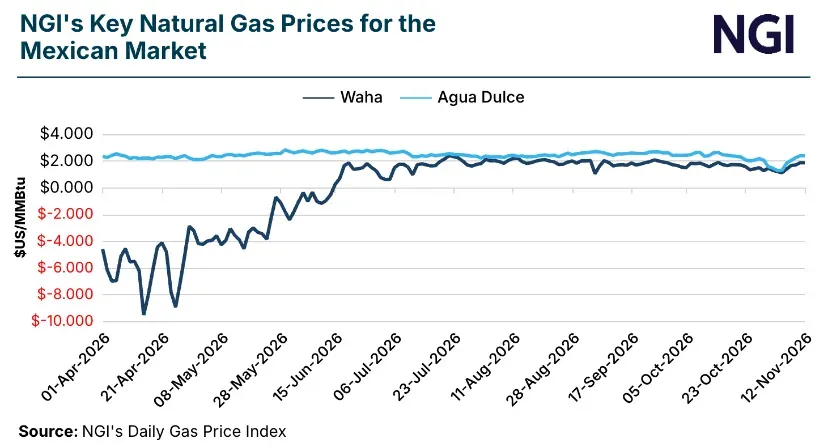
The broader North American gas market continues to navigate complex regional dynamics, where domestic production in the United States feeds directly into Mexico’s expanding energy infrastructure. Key pricing hubs such as Waha in West Texas and Agua Dulce in South Texas play a pivotal role in shaping the economics of these cross-border shipments. In recent months, West Texas markets like Waha experienced extreme downward pressure, occasionally plunging into deeply negative pricing territory due to pipeline constraints, robust associated gas production from the Permian Basin, and limited egress options.
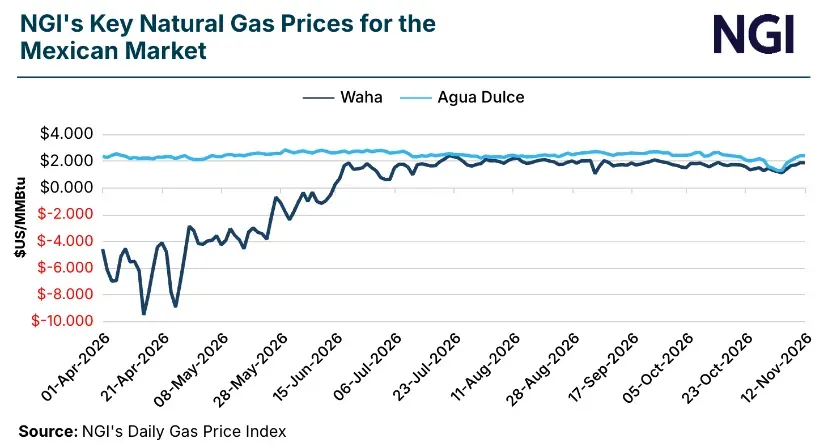
However, spot prices have shown signs of recovery from those historical troughs, mirroring the broader stabilization seen in cross-border export volumes. As pipeline networks adjust to seasonal shifts, the ability of producers to move excess gas southward has acted as a vital pressure valve for oversupplied US basins.
Looking ahead, market observers note that seasonal demand patterns could soon exert downward pressure on export volumes. As winter approaches, weather-driven heating demand in the United States typically alters regional supply balances, while milder transitional weather in parts of Mexico can temporarily dampen domestic power generation requirements. These competing regional factors often introduce volatility into daily pipeline nominations, making the recent push back above 7 Bcf/d an important baseline for market health as the industry transitions into a new demand cycle.
The intricate web of pipelines connecting the United States and Mexico remains a cornerstone of regional energy security. Major border-crossing infrastructure projects completed over the last decade have deeply integrated the two nations’ power and industrial grids, ensuring that fluctuations in daily export volumes carry significant weight for stakeholders across the entire energy value chain.
As the market digests the latest trade data, industry analysts will be closely monitoring whether exports can sustain levels above 7 Bcf/d or if impending seasonal demand shifts will prompt a moderation in cross-border flows as the year draws to a close.
| Source | : | Finance Poetry |
| Author | : | rifanmuazin |
| Editor | : | Finance Poetry Editorial Team |