
‘They smile but do nothing’: Students on meeting Macron and other leaders
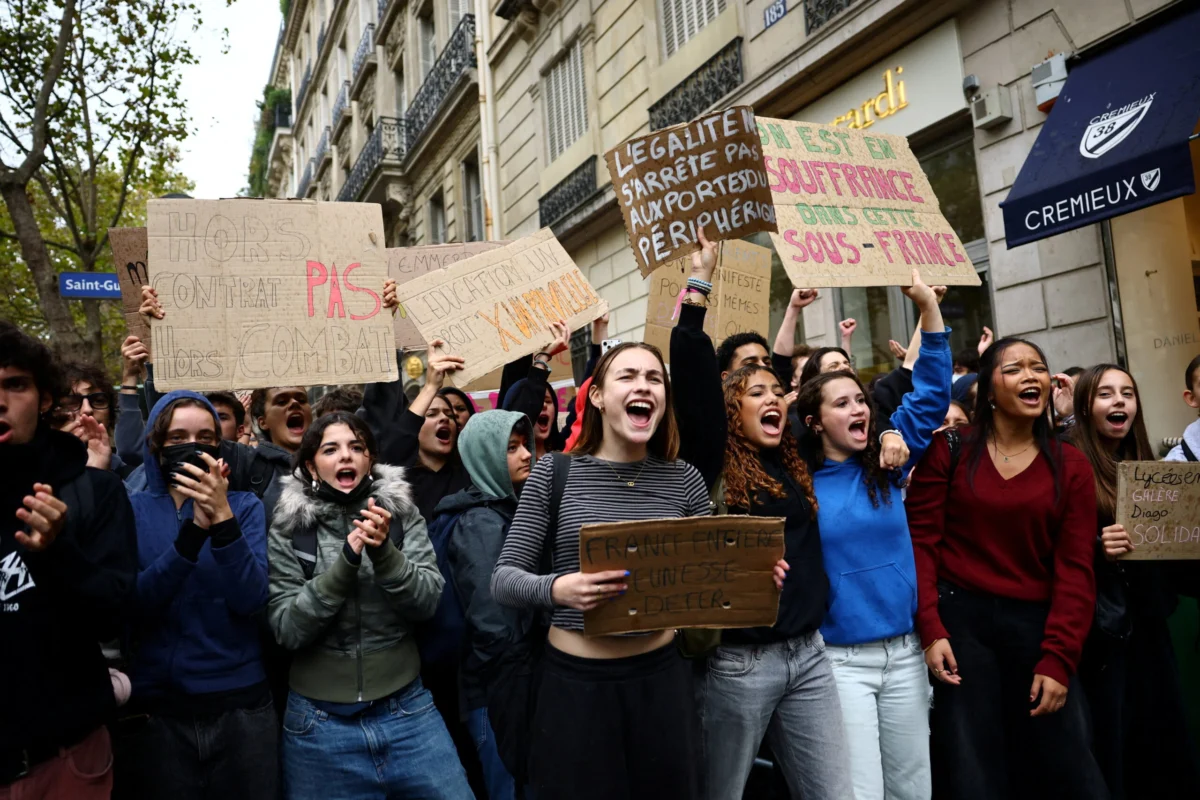
The movement, which erupted across mainland France following initial demonstrations in the overseas territory of Mayotte, has transformed into a nationwide mobilization. Students are demanding sweeping reforms to address decaying infrastructure, chronic teacher shortages, grueling daily schedules, and a controversial university admissions process.
Marius Mensil, a 17-year-old co-leader of the French high-school students’ union, Union Syndicale Lyceenne (USL), has participated in several government meetings in Paris that have occasionally lasted up to two hours. While he acknowledges that officials have been accommodating in appearance, he remains deeply skeptical of their ultimate intentions.
“They’re very good at listening to us. They welcome us, smile at us, tell us, ‘Yes, you’re right, your demands are legitimate’, and in the end, they do nothing,” Mensil told Al Jazeera.
Describing the dynamic inside the government offices, Mensil pointed to a stark contrast in styles among top leaders. With Education Minister Edouard Geffray, the encounters were characterized by a rigorous exchange of arguments where officials attempted to downplay the feasibility of student demands.
“With Geffray, it was mainly an exchange of arguments. We’d present our demands to him, and then he’d try to explain why they weren’t feasible,” said Mensil. “He used very technical language to try to confuse us. Macron and Lecornu were much more attentive. They took notes, smiled and gave us winks — in short, they did everything they could to show us that our demands were being heard. All of this, of course, was just a way to avoid making any concrete commitments.”
A Nationwide Wave of Discontent
The wave of protests began picking up momentum in mainland France on September 17, starting at a high school in Creteil, a suburb southeast of Paris in the Val-de-Marne region. The demonstrations quickly spread to neighboring Saint-Denis and across the country, attracting various groups with broader socioeconomic grievances.
For weeks, students have organized blockades and rallies to protest what they describe as a systemic decline in educational quality. According to student representatives, the deterioration has been compounding year after year through successive budget cuts affecting both instructional staff and local government-managed facilities.
“It’s been clear ever since Macron took office — and even before — that conditions have deteriorated year after year. With every budget, there are fewer teachers. There are cuts to local governments, who manage school facilities,” Mesnil said. “We’re not asking for five-star restaurants, MacBooks, or castles… We’re asking for enough teachers, buildings where the ceilings aren’t falling on our heads and class schedules adapted to our biological rhythms. We’re asking that, once we’ve earned our high school diploma, we can study at university.”
In response to the mounting pressure, officials initiated outreach efforts in late October, inviting student representatives to dialogue. However, despite subsequent policy adjustments, student unions maintain that their core grievances are still being ignored.
At the heart of the student platform is a demand to completely overhaul Parcoursup, the centralized university admissions program. Critics argue that the system is opaque and discriminatory, leaving rejected applicants without clear explanations for their rejections. Furthermore, because the platform and certain degree programs factor in the academic ranking of an applicant’s high school, top-performing students in economically disadvantaged areas frequently find themselves overlooked.
Beyond university admissions, protesters are pressing for an emergency infrastructure plan to repair failing school buildings, an expansion of permanent contracts for teaching staff, and a dedicated 10-billion-euro ($11bn) financial injection into the public education system.
Government Concessions and Pledges
The administration has responded to the crisis with a series of targeted measures. In early October, the government recruited 920 substitute teachers and outlined plans to hire an additional 3,000. Upcoming budget proposals also feature increased funding to guarantee more substitution hours across high schools nationwide.
Additionally, the government has committed to spending 1 billion euros ($1.1bn) annually through 2030 on building renovations, alongside establishing broader frameworks for high school representatives to engage in national education discussions.
When contacted by Al Jazeera, the Ministry of Education pointed to a joint statement issued on October 26 by Education Minister Edouard Geffray and the Minister of Higher Education, Research and Space, Philippe Baptiste. In the statement, the government promised to cap class sizes at 28 students by the start of the 2027 academic year in “the most disadvantaged schools,” while also reducing class sizes for specialized courses.

While some radical factions continue to demand the complete abolition of Parcoursup, the government has pledged to update the platform to assist students in navigating their academic futures more transparently.
“Some measures will be implemented very quickly, while others will be included in the 2027 budget bill, which will be introduced in the coming weeks,” Geffray stated.
Although Mesnil dismissed these government offerings as “a few crumbs,” he acknowledged that the concessions demonstrate the tangible impact of the student movement.
“The government is starting to give in,” he said. “Gen Z, together with the workers, have forced Macron to back down on some initial points, and we’re very happy about that.”
Suburb Realities and Structural Pressures
To gauge the depth of student dissatisfaction, the government launched an online consultation platform titled “High school students, the floor is yours” on October 6. Over an 18-day period, the platform garnered more than 100,000 submissions. Approximately 70 percent of respondents characterized the current educational framework as ill-suited to their needs, citing grueling daily schedules, insufficient breaks, and excessive academic pressure.
Many French high school students face long days running from 8 a.m. to 6 p.m., burdened by minimal downtime during the day and heavy homework loads at night. Moreover, 56.3 percent of participating students reported that their school buildings were dilapidated, poorly insulated, and inadequately equipped. These issues are reportedly magnified in underprivileged suburban and rural districts.
Bilal Narjissi, a 17-year-old student at the Paul-Eluard school in Saint-Denis and a member of the Renouveau Lyceen student union, argued that government outreach efforts frequently overlook the dire realities faced by students in peripheral communities.
“In schools in the suburbs and in rural areas, roofs have collapsed, there are water leaks, rats, and classes with 30 students,” Narjissi said. “Young people today are pushed to pursue higher education, but they aren’t given the means to succeed.”
To draw direct attention to these conditions, Narjissi has extended an invitation to a special adviser to the prime minister to visit Paul-Eluard. “It would be truly symbolic if he were to come by and we could take him on a tour of the high school, show him the conditions there, and talk to him,” he noted.
Reflecting on his own experiences in government meetings, Narjissi described the initial atmosphere as relaxed and open to dialogue. However, he noted that representatives from the economy, education, and labor ministries remained uncompromising on key structural policies, particularly concerning reforms to the baccalaureate, the national high school exit exam.
The current structure of the baccalaureate is rooted in 2018 reforms introduced by former Education Minister Jean-Michel Blanquer. According to Rafaela Uzan, a research associate for European studies at the Council on Foreign Relations, those reforms introduced more subject concentrations, shortened the final exam, and placed a heavier emphasis on ongoing grades. However, critics argue that the abundance of concentration options has exacerbated social stratification while lengthening the school day.
Despite the hurdles, Narjissi views the ongoing dialogue as moderately constructive, though he remains unconvinced that meaningful policy shifts will follow without continued pressure.
“We’ve managed to establish a balance of power through our mobilisation,” he said.
With further negotiations scheduled between student representatives and the prime minister, student leaders maintain that their protests will persist until real structural change is delivered.
“We hope there will be announcements that live up to our expectations,” Mesnil said. “We’re happy to attend these meetings, but if it’s just to talk and, ultimately, there are no concrete political results, then there’s no point.”
| Source | : | Finance Poetry |
| Author | : | rifanmuazin |
| Editor | : | Finance Poetry Editorial Team |