
Infrastructure Pressures and Regional Basis Dynamics: Analyzing Gulf South Pipeline’s Hall Summit Constraints and Market Impacts
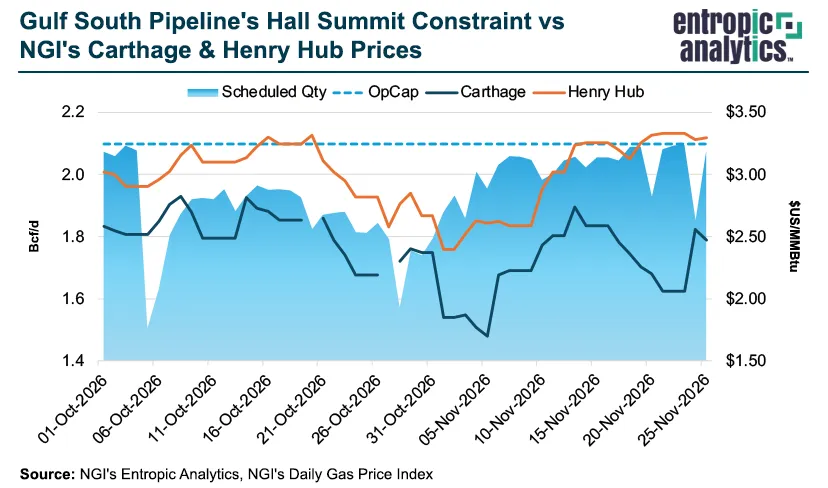
As North America’s energy infrastructure continues to navigate evolving supply-demand fundamentals, localized bottlenecks frequently emerge as critical drivers of regional basis differentials. A prime example of this market dynamic involves the operational constraints observed on the Gulf South Pipeline system, specifically around the Hall Summit compressor station. Market analysts monitoring the Daily Gas Price Index have increasingly turned their attention to how midstream infrastructure restrictions ripple across pricing hubs, influencing regional trading strategies and highlighting the complex interplay between local pipeline capacity and broader benchmark prices like Carthage and Henry Hub.
Market intelligence provided by NGI’s price and data analysts sheds light on these structural developments, offering deep-dive perspectives into the underlying fundamentals shaping natural gas economics. Through comprehensive examination of pipeline flow data, storage inventories, and regional production trends, experts are able to map out how physical constraints translate directly into financial value shifts for market participants. The interplay between the Hall Summit capacity constraint and its comparative pricing relationship with Carthage and Henry Hub during the fall months—specifically October and November—underscores the sensitivity of the grid to localized disruptions.
Understanding the Role of Gulf South Pipeline and Hall Summit
The Gulf South Pipeline system serves as a vital artery within the intricate network moving natural gas out of prolific producing regions, connecting rich supply basins with key demand centers and downstream interconnects along the Gulf Coast and beyond. Within this vast transit network, compressor stations and localized segments act as critical pressure regulators and volume handlers. The Hall Summit facility, located strategically within this footprint, plays a pivotal role in maintaining adequate line pressure and ensuring that steady volumes can clear regional constraints to reach destination markets.
When maintenance events, mechanical issues, or regulatory reductions limit the operational capacity at vital nodes like Hall Summit, the immediate physical impact is a restriction on the volume of natural gas that can flow past the bottleneck. This localized constriction can quickly create upstream supply backing up into the basin or downstream tightness depending on the direction of the flow and the prevailing market balance. For producers, marketers, and utilities relying on firm or interruptible transportation paths along the corridor, such constraints introduce immediate operational challenges and basis risk.
Comparative Price Movements: Hall Summit, Carthage, and Henry Hub
The economic manifestation of pipeline constraints is most clearly observed through basis differentials and regional spot price behavior. During the months of October and November, market analysts tracking the Gulf South corridor noted distinct divergence and convergence patterns when comparing the pricing behavior associated with the Hall Summit constraint against benchmark pricing points such as Carthage and the national benchmark at Henry Hub.
Carthage, acting as a prominent trading hub in East Texas and a major pricing marker for regional production, often bears the brunt of localized takeaway limitations. When gas is trapped or restricted from moving freely along designated paths due to upstream pipeline limitations, local supply can temporarily outstrip immediate takeaway capacity. This oversupply dynamic frequently depresses spot prices at nearby receipt points relative to downstream benchmarks. Conversely, destination markets or interconnected hubs downstream of the constraint may experience tighter conditions, pulling pricing dynamics in the opposite direction.
Henry Hub, situated in Louisiana, serves as the ultimate pricing anchor for the domestic natural gas market, reflecting the broader supply and demand balance of the continental grid, weather-driven consumption patterns, and liquefied natural gas (LNG) export demand. While Henry Hub captures macro-level market sentiment, regional points impacted by midstream bottlenecks often decouple from the national benchmark, creating localized basis blowouts or compressions that trading desks must navigate with precision.
Analytical Insights from NGI’s Market Observers
Navigating these complex market dynamics requires rigorous data collection and expert interpretation. Analysts at NGI, including commodity specialists specializing in pipeline infrastructure and price formation, continuously monitor flow nominations, capacity notices, and historical basis trends to provide actionable intelligence to the energy sector. By breaking down the specific impacts of events like the Gulf South Pipeline Hall Summit constraint, market participants gain a clearer understanding of how physical pipeline operations translate into financial outcomes.
The insights generated by NGI’s analytical team emphasize that infrastructure is just as important to price formation as seasonal weather forecasts or storage inventory reports. As production profiles shift and the U.S. natural gas grid adapts to growing export capabilities and shifting power generation demand, the resilience and capacity of midstream networks remain under constant scrutiny. Events at compressor stations or pipeline segments that might appear minor in a national context can have outsized local economic consequences, altering the profitability of regional drilling activity and dictating the cost of supply for industrial and utility end-users.
Broader Implications for Infrastructure and Regional Pricing
The ongoing monitoring of corridors like the Gulf South Pipeline highlights a broader narrative within the North American energy landscape. The delicate balance between pipeline maintenance, regulatory compliance, and capacity optimization requires constant vigilance from midstream operators and market participants alike. As seasonal demand transitions—such as the shoulder months of autumn moving into the peak heating demands of winter—the sensitivity of regional pricing to operational constraints is heightened.
For traders, risk managers, and analysts, the lessons drawn from October and November pricing behaviors around Hall Summit reinforce the necessity of integrating granular infrastructure data into their daily forecasting and hedging strategies. Understanding the precise timing, magnitude, and market reach of pipeline limitations allows stakeholders to anticipate basis volatility and position themselves effectively in an increasingly dynamic commodity market. Through ongoing coverage and data-driven analysis provided by experts like Josten Mavez, the industry remains equipped to interpret these critical infrastructural signals and their subsequent economic impacts.
| Source | : | Finance Poetry |
| Author | : | rifanmuazin |
| Editor | : | Finance Poetry Editorial Team |