
Natural Gas Forward Curves Sag as Weak Winter Demand and Rising Production Weigh on Markets
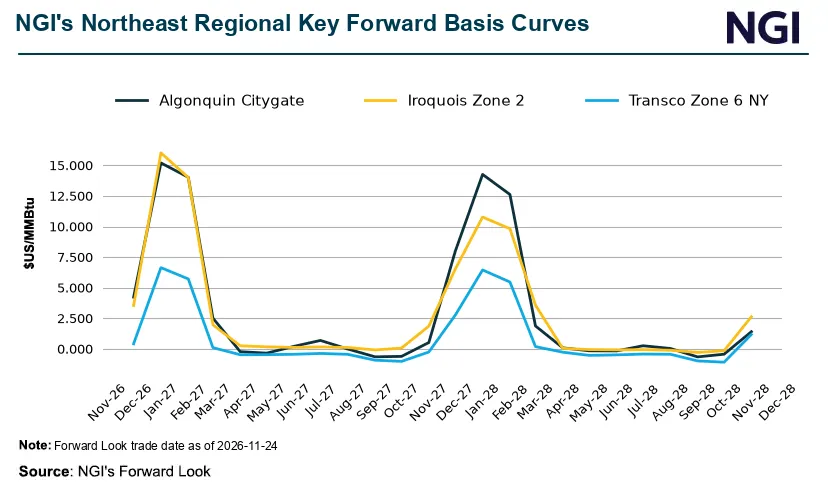
The natural gas forward curve continues to experience downward pressure across major trading hubs as steady market signals indicate that heating season demand is likely to remain weak throughout the Lower 48 states. At the same time, domestic natural gas production is poised to surge higher as the winter months approach, creating an increasingly oversupplied market outlook for the near term.
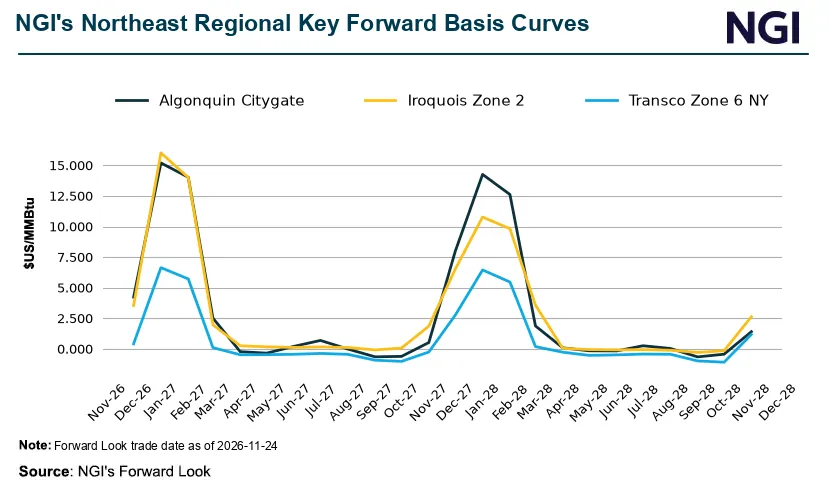
Market participants analyzing regional forward basis curves—including key pricing points such as Algonquin Citygate, Iroquois Zone 2, and Transco Zone 6 NY through December 2028—are observing persistent weakness that reflects broader macroeconomic and fundamental trends across North American energy sectors. This ongoing downward trend highlights the challenges facing commodity holders and producers alike as they navigate shifting seasonal consumption patterns and robust supply metrics.
At a Glance
The primary driver behind the sagging forward curve is a combination of persistent weather forecasts pointing to a milder-than-average heating season and expectations of accelerated production growth. Energy analysts tracking supply and demand balances across the Lower 48 note that winter heating demand forms the backbone of seasonal price support. When weather models consistently trend toward warmer temperatures or fail to indicate sustained, deep-freeze events, the perceived necessity for high storage withdrawals diminishes rapidly. Consequently, buyers and utilities show less urgency in locking in higher winter prices, causing forward values to drift downward.
Compounding the demand-side softness is the anticipation of climbing production volumes. As upstream operators optimize efficiencies, bring back previously curtailed volumes, and press forward with development in key shale plays, output is projected to ramp up heading into the winter season. This anticipated influx of natural gas threatens to outpace consumption capabilities, leading to more comfortable storage inventories and dampening the bullish spikes that typically characterize peak heating months.
The intersection of subdued demand forecasts and robust output potential has created a cautious sentiment among market participants. Regional basis differentials, particularly in the supply-constrained yet volatile Northeast markets, continue to price in these bearish fundamentals. Infrastructure constraints and pipeline dynamics often dictate regional price behavior, but the broader macroeconomic trajectory reflected in the forward curve points toward a well-supplied market capable of absorbing standard winter weather fluctuations without triggering severe price volatility.

As trading desks and industry stakeholders assess the evolving landscape, the focus remains firmly on updated weather outlooks, storage report trajectories, and daily production estimates. With the forward curve reflecting these prevailing headwinds, market participants are adjusting their risk management strategies to account for an environment where seasonal premiums are increasingly difficult to sustain.
| Source | : | Finance Poetry |
| Author | : | rifanmuazin |
| Editor | : | Finance Poetry Editorial Team |