
Baghdad and Erbil Lock Horns in Sharpest Power Struggle in Years Over Oil and Border Control
Iraq’s federal government and the semi-autonomous Kurdistan Regional Government (KRG) are locked in their sharpest confrontation in years, engaging in a high-stakes power struggle over control of the nation’s lucrative oilfields, crucial border crossings, and the substantial revenues that flow through them.
The escalating crisis reached a boiling point when Prime Minister Ali al-Zaidi issued sweeping executive orders directing federal authorities to take absolute control of all border crossings located within the northern Kurdish region. His directives also mandated the immediate closure of all unofficial border crossings allegedly utilized for illicit smuggling operations, alongside orders for federal security forces to seize control of vital oilfields situated in disputed provinces currently held by Kurdish security forces. Within twenty-four hours of these executive actions, Iraq’s Federal Supreme Court stepped in, issuing a decisive ruling that firmly backed Baghdad’s constitutional powers and validated the federal government’s operational reach.
The Kurdistan Regional Government swiftly denounced the measures, characterizing them as a flagrant violation of the Iraqi constitution and an aggressive attempt by Baghdad to steer the country back toward a centralized system of governance. As unconfirmed reports circulated mid-week suggesting that federal army units were mobilizing and heading north toward the region, government officials in Baghdad firmly insisted that there were no active plans to deploy troops into the Kurdish territory.
What Are the Tensions About?
On the surface, the core of the dispute appears centered on suppressing widespread oil smuggling and restoring fiscal order. Early in the week, Prime Minister al-Zaidi directed the Border Ports Authority to assume full administrative control over all crossings into the Kurdish region while simultaneously ordering the energy police to secure critical oil installations. Furthermore, the federal Oil Ministry was instructed to take over the direct management of hydrocarbon fields located in the provinces of Kirkuk, Nineveh, Salahuddin, and Diyala.
These specific provinces occupy a contested geographical belt that is claimed by both Baghdad and Erbil. Under Article 140 of the 2005 Iraqi constitution, a structured process was originally established to resolve the disputed status of these territories, but that process was never fully implemented. Kirkuk, which boasts some of the most productive and extensive oilfields in Iraq, has historically been the most bitterly contested flashpoint. Kurdish forces assumed control of the city in 2014 after the Iraqi military withdrew during the chaotic onset of the conflict with ISIL (ISIS). However, federal forces successfully retook the city in October 2017 in the wake of an independence referendum organized by the Kurdish region—a vote that Iraq’s Federal Supreme Court subsequently declared unconstitutional and entirely void.
Al Jazeera correspondent Suhaib al-Asa reported that the specific oil installations targeted in the latest federal directives sit geographically outside the officially recognized borders of the semi-autonomous Kurdish region, yet they have remained under the de facto control of Kurdish security forces.
The subsequent ruling by the Federal Supreme Court elevated the stakes significantly. In an interpretive decision, the court affirmed the federal government’s overarching constitutional authority to secure Iraq’s international borders and deploy armed forces across every inch of Iraqi territory. The court ruled that federal authorities retain the legal right to supervise all border crossings, including those operating within the Kurdish region. Additionally, the decision confirmed Baghdad’s exclusive power to oversee the production and export of oil and gas, as well as the collection of both oil and non-oil revenues.
According to Tallha Abdulrazaq, an independent international security and defense consultant based in the United Kingdom, both political entities have framed the escalating dispute as a fundamental constitutional battle. Baghdad points to federal authority over national wealth and borders under Articles 110 and 112 of the constitution, whereas Erbil invokes provisions concerning shared customs administration and regional autonomy under Article 114.
"Paradoxically, both sides are right," Abdulrazaq noted. "Since its adoption in 2005, Iraq’s constitution has contained contradictory and ambiguous provisions on oil and border management, making it a recurring recipe for political chaos."
What Has the Iraqi Government Said?
Baghdad has consistently presented its assertive measures as an essential campaign directed strictly against corruption and illicit smuggling, rejecting characterizations that it is mounting an offensive against the Kurdish population.
"National sovereignty is indivisible," stated Prime Minister al-Zaidi, who serves as the commander-in-chief of the armed forces. He described the ongoing effort to protect Iraq’s national wealth as "a battle for existence" aimed at eradicating all forms of illegal trafficking.
These sweeping orders follow a detailed internal investigation into rampant smuggling operations uncovered at the state-run North Oil Company. In response to the findings, al-Zaidi dismissed eight senior security and administrative officials, including the head of the Border Ports Authority, the operations commander for Kirkuk, and the province’s chief of police.
During a broadcast on state television via Al-Iraqiya, government spokesperson Haidar al-Aboudi stated that there was "no truth" to circulating reports that military troops were advancing toward the region. He emphasized that al-Zaidi remains fully committed to "protecting the people of the region, not threatening them," adding that the salaries of public employees in the Kurdish region would be safely secured within the upcoming 2027 national budget.
Baghdad’s actions are unfolding within a broader domestic security drive. Earlier in the month, Iraqi security forces entered Jurf al-Sakhar, a town south of Baghdad that has long served as a stronghold for the Iran-aligned armed group Kataib Hezbollah. According to Reuters, the armed faction permitted federal forces to enter following a delicate settlement brokered by political intermediaries.
Abdulrazaq suggested that al-Zaidi’s maneuvers are justified "on the narrow facts." He noted that oil smuggling across unofficial border crossings is a well-documented and genuine phenomenon, though he observed that the crackdown on smuggling frequently serves as a political pretext.
The security analyst described the current escalation as "largely a calculated domestic manoeuvre." In confronting the sensitive situation in Jurf al-Sakhar, al-Zaidi faces formidable political hurdles. Rebuilding the town, facilitating the return of displaced Sunni Arab residents who have been locked out for twelve years, and fully expelling Kataib Hezbollah all carry the severe risk of triggering an intra-Shia armed confrontation.
"A controlled dispute with the Kurdistan Regional Government carries far lower political costs for Baghdad than an armed confrontation among Shia factions," Abdulrazaq explained. Furthermore, al-Zaidi must demonstrate to his Shia coalition partners and powerful allied armed factions that he is decisive across the board, rather than selectively targeting specific groups. Abdulrazaq added that adopting a hard line toward Erbil may even have been an explicit demand made by these factions during the height of the standoff in Jurf al-Sakhar.
Why Are Oil Revenues So Important?
Oil remains the undisputed backbone of the Iraqi economy, generating the vast majority of state revenue and funding the salaries of millions of public sector employees, including those working within the semi-autonomous Kurdish region.
Baghdad contends that widespread smuggling is draining this vital national wealth on an industrial scale. Spokesperson al-Aboudi stated that tens of billions of dollars have vanished into private pockets without ever benefiting ordinary residents of the region. According to reporting from Al Jazeera’s al-Asa, federal government estimates suggest that between 200,000 and 230,000 barrels of oil per day (bpd) are being smuggled out of the country, generating an estimated $200 million per month in illicit profits.
Al-Asa reported that this oil is frequently transported from the disputed provinces into other parts of Iraq and subsequently moved abroad, or shipped directly from the cities of Sulaimaniyah, Kirkuk, and Erbil toward neighboring Iran. Most of the region’s unofficial border crossings are concentrated along the Iranian frontier.
The Iraqi News Agency recently published excerpts from a government intelligence dossier tracing specific smuggling routes that lead from Kirkuk and Sulaimaniyah into Iran and onward to Afghanistan. The report also details sophisticated operations designed to disguise Iranian oil products so they can be deceptively passed off as domestic Iraqi crude.
For Erbil, unfettered control over oil production and export has long been foundational to maintaining its autonomous status. In February 2022, the Federal Supreme Court ruled the Kurdish region’s independent oil and gas law to be unconstitutional. The Kurdish region, which has enjoyed extensive autonomy from Baghdad since the 1990s, has historically ignored federal court rulings, and it chose to disregard that verdict as well.
Independent energy exports from the region suffered a severe setback in March 2023 when the operation of the Kirkuk-Ceyhan pipeline was abruptly halted. The shutdown followed a ruling by the International Chamber of Commerce in Paris ordering Turkiye to pay Iraq $1.5 billion in damages for unauthorized crude oil exports transported from Iraq’s Kurdish region without Baghdad’s explicit approval. Exports finally resumed in September 2025 following an interim arrangement negotiated between the Iraqi federal government, the KRG, and international oil producers.
Revenues collected at international border crossings are similarly crucial. Salim Zakhour, a Qatar-based researcher specializing in constitutional law and political systems, told Al Jazeera that a pivotal debate centers on the court’s decision to grant federal authorities direct oversight of revenues collected from non-oil fees and taxes, noting that this particular issue is likely to remain heavily contested in ongoing legal battles.
What Has the Kurdistan Regional Government Said?
The KRG has firmly rejected Baghdad’s aggressive measures, denouncing them as "a violation of the constitution and an infringement on the region’s rights," while making it clear that Erbil rejects "the language of threats" and any military approach to resolving the impasse.
Following an emergency meeting chaired by Prime Minister Masrour Barzani, the KRG Council of Ministers declared that it would oppose "any attempt to return Iraq to a centralised system." Similarly, Kurdistan Region President Nechirvan Barzani emphasized that addressing the region using "military language" would ultimately "solve any problem."
Erbil has maintained that it supports genuine efforts to combat corruption and illicit smuggling, consistently advocating for the dispute to be resolved through constructive dialogue and the strict implementation of constitutional principles.
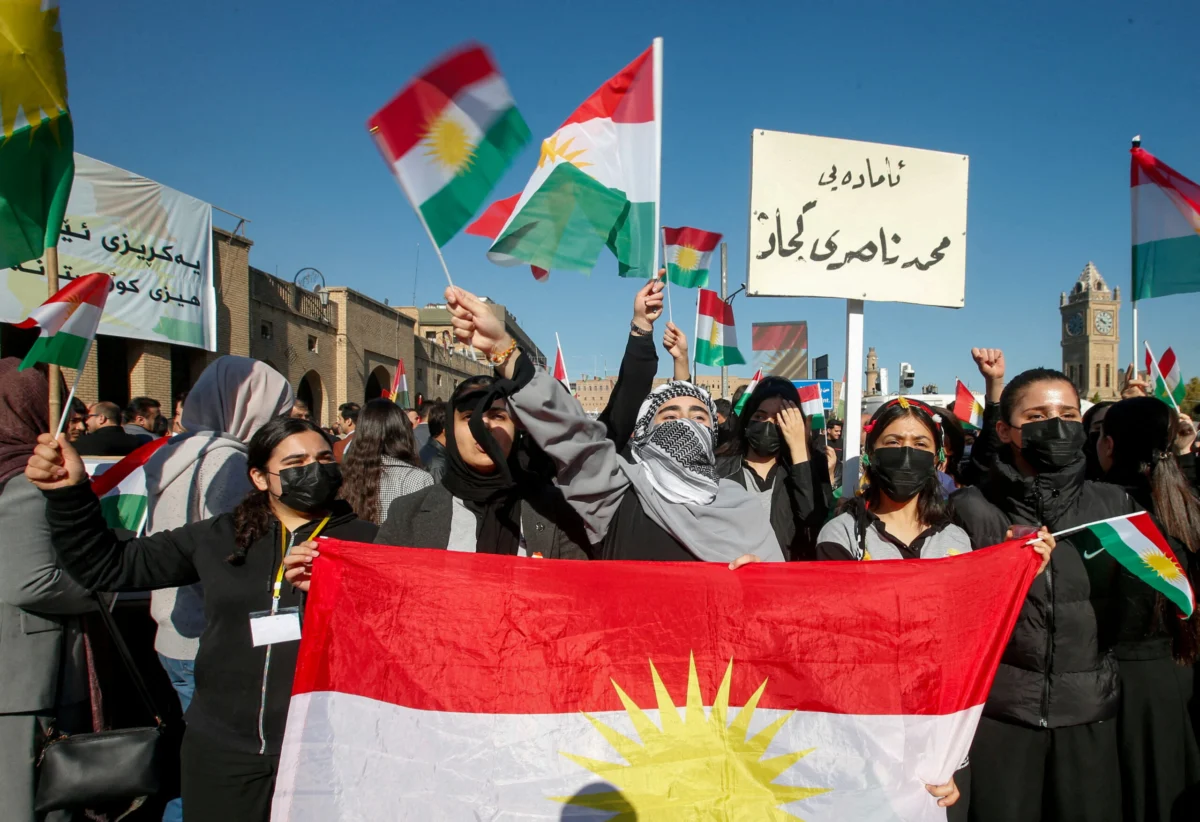
Opposition to the federal measures quickly spilled out onto the streets. Thousands of demonstrators gathered in Erbil, the capital of the semi-autonomous region, to protest Baghdad’s moves to seize control of oil operations and border checkpoints previously administered by local authorities. According to the Erbil-based broadcaster Kurdistan24, tens of thousands of citizens participated in the rallies, calling for greater Kurdish political unity in the face of external pressure.
The Kurdish news agency Rudaw reported that the region’s two dominant political factions, the Kurdistan Democratic Party (KDP) and the Patriotic Union of Kurdistan (PUK), issued a rare joint statement describing Baghdad’s decisions as "unexpected and deeply surprising." They warned that any attempt to undermine the institutional power of the Kurdish political entity constituted crossing a definitive "red line."
However, security analyst Abdulrazaq characterized this sudden display of political solidarity as a "defensive reflex" motivated primarily by the self-preservation of each party’s individual interests. A direct threat from Baghdad to one party is viewed as an existential threat to both, as both factions risk losing the lucrative political positions and budgetary allocations they have accumulated since the 2003 US-led invasion.
"It is therefore a pragmatic unity that will rapidly dissolve once the immediate threat recedes," he observed.
Where Is This Dispute Headed?
For the moment, Baghdad appears keen to avoid a destructive military confrontation. Abdulrazaq pointed out that the federal government has formally denied deploying combat troops to the region and has dispatched Popular Mobilization Forces chief Faleh al-Fayyad to Erbil to press Kurdish authorities for administrative cooperation.
Nevertheless, the legal landscape has shifted markedly in Baghdad’s favor. "The court’s decision is final and decisive," researcher Zakhour noted. "But the issue is not only constitutional and legal. There is a political problem." He observed that while Erbil had initially planned to challenge the federal measures through the judicial system, Prime Minister al-Zaidi effectively "pre-empted this step."
External backing for Erbil also appears notably limited. Abdulrazaq explained that Washington remains "heavily focused on supporting Zaidi," particularly regarding his broader political agenda to consolidate state authority and rein in powerful Iran-backed Shia armed groups.
"The Kurds should not expect American backing in this dispute; if anything, Erbil is more likely to face quiet US pressure to accommodate Baghdad’s demands," he said.
Tehran, meanwhile, is reportedly satisfied with the mounting pressure applied to Erbil. Iran has long expressed frustration over the presence of Iranian Kurdish opposition groups operating inside the region, which has previously prompted Iranian drone strikes on local camps. However, Abdulrazaq stressed that there is "no hard evidence" indicating that the timing of Baghdad’s crackdown is part of a direct quid pro quo with Iran stemming from the Jurf al-Sakhar agreement.
Ankara’s calculations remain strictly pragmatic, anchored primarily in cross-border trade, energy security, and regional stability. Turkiye has little strategic interest in fostering an armed crisis on its southern border that could trigger another wave of refugees, and it is expected to avoid overt military intervention. Instead, Ankara is likely to quietly favor a political arrangement that maintains stable commercial ties while curbing illegal smuggling.
What Happens Next?
In a concerted effort to defuse the escalating crisis, Iraq’s four highest presidencies—representing the republic, the government, parliament, and the judiciary—have agreed to a formal proposal put forward by Supreme Judicial Council head Faiq Zaidan to convene a national dialogue on December 1.
Abdulrazaq noted that the upcoming dialogue offers "a face-saving opportunity rather than a permanent fix." He suggested that the talks could potentially yield a temporary compromise, such as establishing a joint administrative oversight mechanism that polices official border crossings while shutting down illicit smuggling routes.
"Long-term, however, the underlying tensions will remain in play," he concluded. "The constitution is contradictory and Iraq doesn’t have a federal law that clearly delineates who is responsible for what in the oil and gas sector. These issues will simply resurface at a later date, even if both parties want to kick the can down the road."
| Source | : | Finance Poetry |
| Author | : | rifanmuazin |
| Editor | : | Finance Poetry Editorial Team |