
Thousands Protest in San Juan Over Surging Cost of Living and Deteriorating Public Services
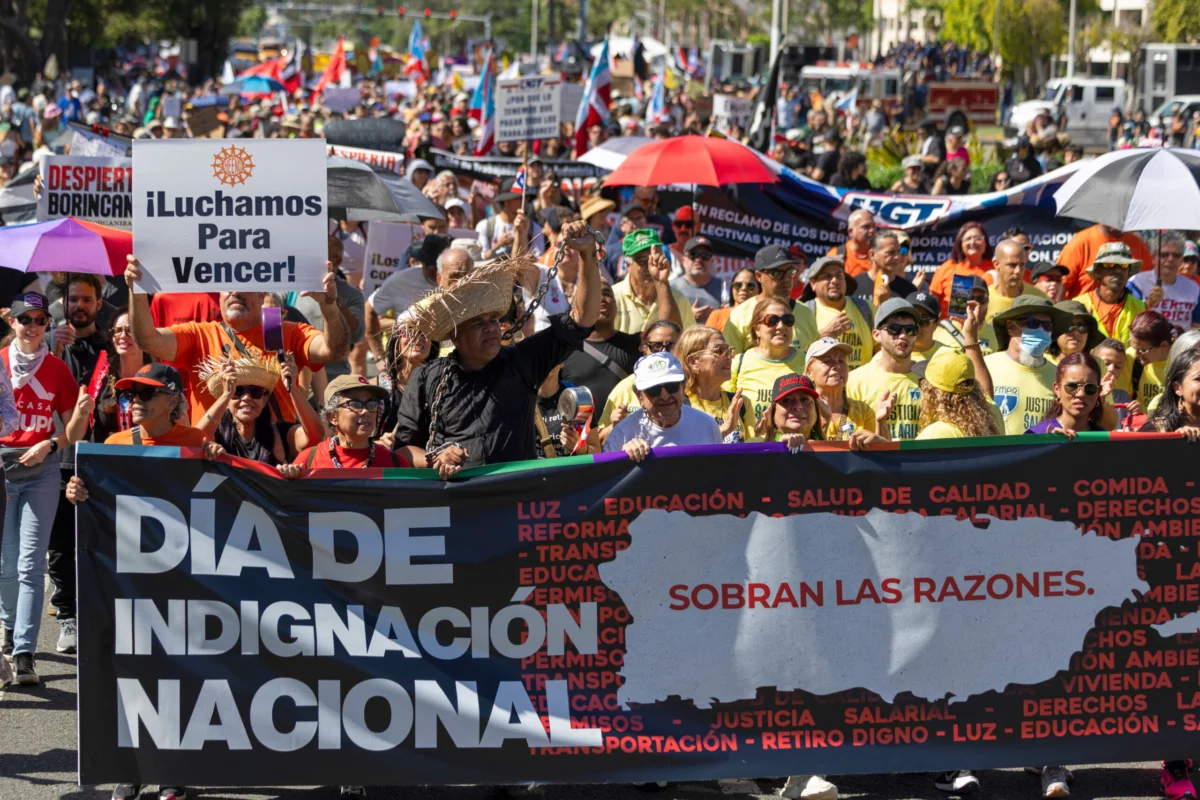
SAN JUAN, Puerto Rico — Thousands of demonstrators converged on the Puerto Rican capital on Friday, fueling a massive wave of public anger and frustration over record-high electricity rates, a surging cost of living, and the continuous deterioration of basic public services across the US territory.
Retirees, university students, bus drivers, and citizens from all walks of life joined the large-scale demonstration, which was organized by a coalition of approximately 30 diverse groups ranging from labor unions to religious organizations. The surging crowds gathered in front of a major commercial shopping center in San Juan for what event organizers dubbed the "Day of National Outrage," transforming a commercial hub into the focal point of civic discontent.
Hundreds of demonstrators arrived in the capital aboard chartered buses traveling from dozens of cities and towns scattered across the entire island, underscoring the widespread geographical reach of the discontent. The turnout marked one of the largest mass mobilizations witnessed in the US territory since Governor Jenniffer González assumed office in January 2025. As the day progressed, the demonstration grew steadily in both size and intensity, eventually spilling over and taking control of one of the island’s primary highways, forcing authorities to shut down the major thoroughfare entirely.
Organizers estimated that roughly 8,000 people took part in the coordinated mobilization, according to local media reports. Many participants waved or wore the Puerto Rican flag, while others deliberately chose to display the historic flag variant utilized before the island officially became a United States commonwealth in 1952. For many residents, the historic flag serves as a powerful symbol of deep cultural pride and, increasingly, as an emblem of political and economic resistance against prevailing conditions.
When asked about the myriad problems currently plaguing Puerto Rico, 74-year-old demonstrator Radames García Badillo encapsulated the mood of the gathered multitude. "Where to start? The outrage is absolute," he said.
García Badillo pointed out that essential public utilities, such as electricity and water services, have become entirely unreliable, noting that his neighborhood routinely goes dark at least once a week for several hours at a time. He also decried the sharp and continuous increase in the cost of basic consumer goods.
"We’re buying less because things are extremely expensive," he explained, noting the severe financial strain placed on fixed-income households. "For us retirees, it is essential to make every dollar stretch."
Soaring Electricity Bills and Utility Crises
The grievances animating Friday’s protests are deeply rooted in the daily struggles of ordinary Puerto Ricans facing compounding economic hardships.
"Things have never been good in Puerto Rico, but they keep getting worse," said Verónica Ishtar, a visual arts student who joined the demonstrations to voice her generation’s economic anxieties. Highlighting the frequency of infrastructure failures, Ishtar noted that during the single week leading up to the protest, the electricity in her neighborhood failed 12 distinct times.
The frustration over power reliability is compounded by severe financial burdens. Monthly residential electricity bills for some local customers recently spiked by approximately 18 percent. Compounding the pain, the new rate charged per kilowatt-hour far surpasses the national average for residential utility customers on the United States mainland, according to data compiled by the US Energy Information Administration.
A significant share of the public ire is directed squarely at Luma Energy, the private company that oversees the transmission and distribution of electricity across the island. The privatization of the power grid has long been a lightning rod for public criticism, marked by persistent blackouts, billing disputes, and slow recovery efforts following natural disasters.
The political and legal landscape surrounding the island’s energy infrastructure shifted dramatically just days before the protests. Puerto Rico’s Supreme Court approved a significant legal move to cancel the government’s controversial power contract with Luma Energy on Wednesday. While the cancellation of the contract was welcomed by many weary consumers who viewed the private operator as a failure, it has also sparked widespread anxiety and uncertainty regarding what comes next for the fragile electrical grid.
The decision has drawn warnings from key economic sectors. Puerto Rico’s Association of Industries publicly cautioned that the sudden cancellation of the major contract could actively discourage private investment and seriously jeopardize ongoing infrastructure projects. These repairs and upgrades are still urgently needed as utility crews continue the protracted task of rebuilding a power grid that was utterly razed by Hurricane Maria when it struck the island in 2017.
Organizing the Outrage
Despite the complex economic and political hurdles facing the territory, leaders of the various community, environmental, and labor groups that organized Friday’s historic protest pledged that the momentum will not dissipate. They emphasized that channeling public anger into sustained, organized civic action is the only viable path forward to secure meaningful structural reforms from the government.
"We must begin to channel the rage," said Hernaliz Vázquez, the executive director of Sierra Club Puerto Rico, addressing the massive crowd of demonstrators in San Juan. "We must begin to organise the indignation felt by people who do not know what to do."
As the demonstrations concluded and participants prepared to return to their respective towns and municipalities across the island, the message left behind in the capital was clear. The convergence of soaring utility rates, a debilitating cost of living, and crumbling infrastructure has forged a broad-based solidarity among Puerto Ricans determined to demand accountability and tangible improvements to their daily lives.
| Source | : | Finance Poetry |
| Author | : | rifanmuazin |
| Editor | : | Finance Poetry Editorial Team |