
Private Capital Giants Eye Europe’s €10 Trillion Insurance Asset Pile Amid Sweeping Regulatory Overhaul

The world’s biggest private capital firms are stepping up their hunt for a larger chunk of the European Union’s €10 trillion ($11 trillion) insurance asset pile, settling in for what promises to be a long and strategic pursuit. As major alternative asset managers position themselves to capture pools of newly unfettered capital, the landscape of European finance stands at a crucial crossroads.
A sweeping regulatory revamp is set to take effect on January 30, introducing lower capital charges on complex securitized assets. This legislative shift stands to unlock billions of euros in extra funding for critical European Union priorities, including digital sovereignty, defense capabilities, and decarbonization initiatives. These incoming changes give major alternative investment managers such as Blackstone Inc., Apollo Global Management Inc., and Pimco a tangible target of as much as €80 billion beginning next year. These firms are moving quickly to offer European insurers new, diversified avenues to deploy capital that was previously locked behind restrictive regulatory barriers.
Policymakers—including former European Central Bank President Mario Draghi—have long urged the European Union to loosen its regulations in this area to bring them closer to Wall Street standards. However, the memory of the role that opaque mortgage securities played in the devastating 2008 financial crisis has made regional regulators highly cautious. That conservative approach has naturally bedded in with institutional investors across the continent as well.
Even as the broader European economy risks falling further behind economic powerhouses like China and the United States, investment firms are warning of a built-in conservatism among many domestic insurers. Entrenched bureaucracy, lingering regulatory skepticism, and fierce competition for cash from the credit-hungry US economy all threaten to slow down Europe’s long-anticipated shift into alternative asset classes.
"Insurance companies, institutional investors, they are no speed boats," said Fabian Gerlich, head of insurance and public pensions coverage for Germany at Deutsche Asset Management in Frankfurt. "Requirements for investor due diligence, transparency, and data collection as well as documentation are vast and can prove a hurdle to onboard securitization as a new asset class."
Insurance Rules and Structural Shifts
Changes to insurance rules known as Solvency II could immediately free up the €80 billion of regulatory capital based on insurers’ existing holdings, according to assessments by S&P Global Ratings.
While some of the rule changes will not directly affect Europe’s largest insurers—such as Allianz SE, AXA SA, and Generali, which are authorized to use internal models to calculate their capital charges—the vast majority of European insurance companies stand to benefit significantly from the adjustments.
A parallel legislative package will overhaul the rules surrounding securitization, which involves the creation of tradeable assets out of credit and the ownership of company stakes. Among these modifications, traditional banks will face lower capital requirements on their exposures to securitizations.

These reforms form part of a long-running effort stretching back to Europe’s debt crisis in the 2010s to revive the domestic market. Policymakers realized that the region had scant capacity to leverage credit and funnel funds directly to the broader economy outside of a heavily constrained banking system.
Until now, proponents argue, regional savings have been excessively tied up in an outdated system of risk management that causes asset owners to shun higher-yielding private and alternative investments.
Figures like Oliver Wyman’s former vice chair—and current Apollo partner—Huv van Steenis have argued that Solvency II previously made long-term infrastructure projects and packages of small-business loans economically unattractive for insurers. Meanwhile, former Bank of France governor Christian Noyer noted in a 2024 report that Europe had retained excessive prudential penalties calibrated to past practices that were no longer relevant to modern financial markets.
"Insurers want to invest more in Europe’s needs," said Diego De Giorgi, who became Apollo’s head of Europe earlier this year.
Speaking at Bloomberg’s Global Credit Forum in London, De Giorgi emphasized the firm’s positioning. "We are there as a provider of long-term capital, but also as a provider of solutions and a potentially great partner to all these financial institutions," he said.
Dan Leiter, who oversees Blackstone’s credit and insurance business outside the United States, echoed similar sentiments regarding market appetite. "We’re seeing growing interest in securitized assets as insurers assess the opportunities created by Solvency II reform, with collateralized loan obligations and private investment-grade credit among the clearest beneficiaries," Leiter said. "Some insurers will move more quickly than others, and a slower adoption can be healthy for market dynamics."
No market participant expects insurers to rotate even a small slice of their vast portfolios overnight. Institutional investors will still need to formally approve new mandates, build internal expertise, and ensure that less-liquid investments carefully match the cash flows of their long-term liabilities.
Lower Charges for Alternative Assets
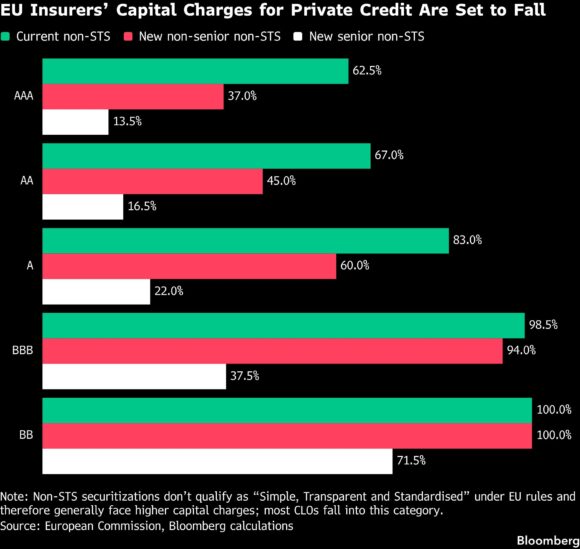
Starting next year, capital requirements for select investments in private equity and senior structured credit are set to fall sharply, in certain cases dropping by more than half.
Easier regulatory rules for long-term equity investments will allow more holdings to qualify for a more favorable 22% capital charge. This compares favorably against the 39% charge required for ordinary listed shares and the 49% charge mandated for most private equity and other unlisted investments. In theory, this adjustment steers more insurer capital toward domestic operating companies, private equity and venture capital funds, infrastructure assets, and energy-transition projects.

"The Solvency II amendments are definitely a big shift, as European insurers haven’t been able to invest as much in long-dated equities and investment-grade structured credit in the past as they would have liked to," said Ed Collinge, head of insurance solutions at CVC Capital Partners Plc.
According to Collinge, these changes are already a regular feature of CVC’s ongoing discussions with insurers across Europe. "They’re now working out whether it’s something they want, and the answer is generally yes."
Lower charges on high-quality securitizations could ultimately transform insurers into much larger buyers of packaged mortgages, consumer credit, and corporate loans. Participating banks could then transfer portions of that risk, free up valuable space on their balance sheets, and extend greater amounts of credit to households and businesses alike. Insurers, in turn, would gain access to a much broader, diversified pool of income-producing investments.
The Cost of Capital and Market Realities
Policymakers have reached a preliminary agreement to cut risk-weighted floors—an indicator of the capital that banks need to set aside to cover unexpected losses—on the senior portions of certain securitizations down to 5% from 10%, Bloomberg News reported.
Europe recorded almost €1.3 trillion of securitizations outstanding, including collateralized loan obligations, at the end of June, according to data from the Association for Financial Markets in Europe. While that figure represented growth of 2.7% over the preceding year, the regional market remains a mere fraction of its US counterpart.
At the same time, doubts regarding valuations in private credit and buyout firms remain elevated, raising concerns about the potential for broader financial turbulence ahead. Conservative parts of Europe’s regulatory machinery are warning that the reforms could leave the financial system lacking sufficient capital when the next major crisis hits.
The European Insurance and Occupational Pensions Authority has cautioned that the Solvency II capital relief risks eroding the system’s protective buffers. Petra Hielkema, chair of the organization, stated that the insurance watchdog will closely monitor how firms utilize these benefits and whether their deployment aligns with broad strategic economic goals. The European Central Bank has voiced similar apprehension.
"The reality is that once these changes take effect, the impact on solvency ratios may appear small, but there will be less actual capital in the system backing that number up in today’s environment of interconnected risks and high uncertainties," Hielkema said in response to inquiries. "The capital relief is not intended to simply fund payouts for shareholders and managers."
The US Diversion and Future Outlook
A central irony of Europe’s concerted efforts to boost securitization is that the most immediate beneficiaries might not be located on the continent at all. Booming US debt markets, driven largely by the immense capital requirements of the artificial intelligence infrastructure build-out, are churning out opportunities for higher-yield investment at a much faster rate than any equivalent European market.
Major US players such as Nuveen, one of the world’s largest asset managers with $2.6 trillion under management, are actively pointing European insurers further west.
"The US provides scale where allocations can happen in the near term as the European market looks to recover lost ground," Nuveen noted in marketing materials published this year.
The presence of a giant foreign market competing fiercely for capital may focus European minds as the regulatory changes bed in. The differences between the ways European insurance firms invest compared to their US peers remain stark, according to Laila Kollmorgen, global head of CLO tranche investments at MetLife Investment Management.
Kollmorgen noted that collateralized loan obligations make up 15% of US life insurance companies’ investment portfolios, whereas securitizations of all types account for less than 1% of EU insurers’ investment books.
That massive discrepancy implies that while European firms remain traditionally conservative, the potential for growth from such a remarkably low base is significant.
"The solvency regime really was the only regime in the world that did not include securitizations and very specifically CLOs," Kollmorgen said in an interview. "Solvency II for European CLOs is going to have a huge, huge impact."
| Source | : | Finance Poetry |
| Author | : | rifanmuazin |
| Editor | : | Finance Poetry Editorial Team |